Dawn Edmiston
More than ever before, AI is creating an environment where there's so much noise and distractions. If you are not explicitly taking control of your personal brand, it will be implicitly developed for you.
Female Voice
From William & Mary in Williamsburg, Virginia. This is Leadership & Business, produced by the William & Mary School of Business and its MBA program. Offered in four formats: the full-time, the part-time, the online, and executive MBA. For more information, visit wm.edu.
Ken White
Welcome to Leadership & Business, the podcast that brings you the latest and best thinking from today's business leaders from across the world. Sharing strategies, information, and insight that help you become a more effective leader, communicator, and professional. I'm your host, Ken White. Thanks for listening. Whether you're happily employed, between jobs, or employed and looking for your next role, it can easy to forget about your personal brand. Building and promoting your personal brand is important in today's competitive and crowded world, and it requires time, thought, and effort. On the positive side, more tools than ever are available today to help you communicate those qualities that make you special. Dawn Edmiston is a professor of marketing at the William & Mary School of Business. Among other things, she teaches personal branding. She's also a leader in the teaching of artificial intelligence. She joins us on the podcast today to define personal branding and to share some insights on how you can improve your brand so you stand out from the rest of the pack. Here's our conversation with Professor Dawn Edmiston.
Ken White
Well, Dawn, it's great to see you. It's been a little while, and we always talk when you're on the podcast, you're the person we've had on the most over the now 11 years of the podcast. So welcome back.
Dawn Edmiston
Amazing. Thank you. And congratulations on over a decade of a really insightful Leadership & Business podcast.
Ken White
Well, thank you. Yeah. And we always have you back because obviously things change in the market, things change in business. And we like to talk to you about personal branding. I think we have a couple of different groups of people today. Companies are downsizing, people are losing their jobs. We've got that group. But why don't we start with the people who are employed, they like where they are, they think they'll be there for a while. What should they be doing in terms of building their personal brand?
Dawn Edmiston
In the simplest terms, when we think of a personal brand, it is the value that you contribute to others. When we consider personal branding, it's how you communicate that value to others. That's really important if you are in the current workforce because it's potentially never been as dynamic and as complex. If you are happy where you are, you do not want to take that for granted. You want to continue to build your value, and you want to continue to communicate that value to others. This concept of personal branding is a very effective method of doing that.
Ken White
So know the value you contribute to others, and communicating it is the key piece. What's the best way?
Dawn Edmiston
Well, this is not a self-promotion exercise. I think it's very important that you center your value in other perspectives, not your own perspectives. You know what you do well, but it does not necessarily matter what you do well if others do not believe that it contributes value to the organization. It's very important to have an understanding of where the organization is headed, what the organization needs, and how you can take it to the next level. I know you, and I have had conversations about the power of AI and how we potentially can use AI to help us take our skills to the next level and help us understand the language of business so that when we're communicating our value, we can take that to the next level as well.
Ken White
Well, now that you brought up AI, it's interesting. So many people I'm talking to that are on LinkedIn, which is pretty much everybody. Using AI. What are your thoughts on that?
Dawn Edmiston
LinkedIn continues to be a very powerful platform. In the US, still one of the top five social media platforms. We do not always think about it as that dominant of a communication channel. I want to emphasize how important it is to continue to build your LinkedIn profile, even if you are in an organization where you are happy, because you want to be open to opportunities. In this current market environment, I've been working with so many individuals from the early '20s to the late '60s that did not see these jobs shifts coming. One day they're at work, and the next day they're not. That is not the time that you want to focus on building your LinkedIn network. You want to ensure that you have that LinkedIn network so that you can depend upon it in good times and bad times. With regards to using AI for LinkedIn, AI can help you understand the language of employers. Take a look at the position description of a dream job and appreciate what language these employers are using to describe that job. Interestingly, and again, I've been doing many LinkedIn reviews recently, AI for as dominant as it is in the current workforce environment, very few, if any, individuals are actually listing AI and their AI skills on their LinkedIn profile, which I would not have expected, especially with the individuals with whom I'm working, the students at William & Mary, because we are so integrated with AI and what we do, as well as mid to senior level executives who are leveraging AI. But it just does not appear on their LinkedIn profile, and it's potentially one of the most important skills. It's not enough to just simply state that you have used AI or Gen AI tools. State the specific tools and share how you've actually used those tools to drive value for your organization.
Ken White
That's amazing. I mean, every job, it seems like you need to know AI.
Dawn Edmiston
Yes. I promise you that there are individuals listening at this very moment that realized, Oh, my goodness, I have not included AI on my resume or my LinkedIn profile or in my conversations when I have information or initial interviews for opportunities.
Ken White
It's not on my profile. As you're talking, I'm thinking we are doing such amazing things with AI, and you're a part of it, and we've been doing it from the get-go. When I talk to peers at other schools, we are ahead in this arena. Why am I not going to one of the workshops and just posting something on LinkedIn and saying this is what we're doing? At least do that.
Dawn Edmiston
Yes. I will admit my bias. You know that my undergraduate degree is from Rensselaer Polytechnic Institute, where we are so technology-oriented that our mascot is literally an engineer. I've always had that bias towards technology. But I do want to emphasize, and I'm leading the AI efforts in the School of Business, but it's so important that we look at AI as a complement to, not a substitute for, education.
Ken White
Oh, absolutely.
Dawn Edmiston
For critical thinking skills and creative thinking skills. It is a partner, but it should only be a supplement to the greatness that individuals and humans have to share with others.
Ken White
That's such a great point. I was just talking to a colleague across campus yesterday. He was concerned across the country how people are doing just that, going right to AI, whether it's ChatGPT, Copilot, whatever, and having that do the work and moving on and not thinking. Are people doing that in terms of their profiles?
Dawn Edmiston
Yes. Also, it's important when you're working on, quote, your profile that you ask others, your peers, other professionals with whom you work, to also look at your profile, because it's a really hard thing to do. I mean, this is what I teach, but it is one of my least favorite things to do is to update my own profile and to understand the value that I actually do share with others, because how I'm perceived can be different from how I've positioned myself. That's a disconnect that we really have to intentionally focus upon to ensure that we're very clear about what we can deliver and how we can deliver that value.
Ken White
In terms of using AI to boost the profile or to help find a job, I've talked to several a job seekers who said, Well, yeah, I looked at the job description. I know they have applicant tracking systems, and I want to make sure I use the right words. So I ran it through AI to make sure my resume reflects that. Do you recommend doing that?
Dawn Edmiston
Yes. When we think about AI and we think about search engine optimization in the past have been very important. So Google, of course, is known as the leading search engine, which is probably not a surprise that they also now have one of the leading AI tools with regards to Gemini. Keywords are, of course, still important, but the context. Now with AI, we're moving into generative engine optimization and AEO and answer engine optimization. How do we provide context around what we've done? I actually think a change that LinkedIn had made a few years ago with regards to allowing you to simply check a box for keywords was a very poor decision. You have a keyword skill. It's a keyword for skills, but you have no context as to how you've demonstrated value with those skills. Now, to AI's credit, they're forcing you to have context around what you do. There are certain language that you could use to ensure that you're optimized for AI tools, such as in summary or using examples. Those are important considerations because it's not as simple as, again, I think LinkedIn did us a disservice by just checking a box and stating, I have these skills, without truly demonstrating and explaining how you've built value for organizations with those skills.
Ken White
Which is exactly what the organization is looking for, right?
Dawn Edmiston
Yes.
Ken White
We'll continue our discussion with Dawn Edmiston in just a minute. Our podcast is brought to you by the William & Mary School of Business. When it comes to choosing an MBA program, there's much to consider: the curriculum, fit, cost, quality, the time it takes to earn your MBA. One major component is the learning environment, and for that, the William & Mary MBA program cannot be beat. For the fourth year in a row, Bloomberg Business Week has ranked the William & Mary MBA program number one in America for learning. The faculty are simply outstanding, and the students support one another inside and outside the classroom. If you're thinking about pursuing an MBA, choose a program in which you'll learn, one that transforms you and takes you to the next level and beyond. Check out the MBA program at William & Mary at wm.edu. Now, back to our conversation with Professor Dawn Edmiston.
Ken White
We're talking about AI, we're talking about LinkedIn, and personal branding. How important still is it to meet people, talk to people, and build that piece of your-
Dawn Edmiston
So important. Just because we have these AI tools, we have to be very intentional about how we use these tools. Research has shown again and again and again recently that what is going to allow us to succeed in an AI environment is that human approach, that human touch. That is where true value proposition will lie moving forward. How can we demonstrate? There are certain tasks that we as humans are fine doing with AI. Certain routine tasks. Tell us the operating hours of your organization, or your email address, or contact information, very simple tasks. But when you want to actually communicate with a human to drive value about the experience of your products or services, that's when you need to know, how do we ensure that we are seen as an organization that cares about individuals as humans and not just simply as consumers? That's very true on LinkedIn as well. There are a few things that I think you can do on LinkedIn that will be very helpful. For one, I've seen this trend towards using AI to generate AI profile photos, and I am not a fan. I do not want you to look like a caricature of yourself. I want you to look like an authentic version of yourself. Now, having said that, I will admit in my own profile, I have updated my background image using AI. I had previously served as a Fulbright scholar in Estonia, so I was very proud of this photo that I had taken of Estonia and had used it as my background image. I asked, Gen AI, can you please create a watercolor image of the Tallinn, Estonia, skyline? Ken, in 10 seconds, it had this beautiful image that just elevated my profile, and I felt made it far more engaging and creative and compelling. I said, Thank you, AI. That was definitely a good use of it. The second thing I want to caution individuals about is just because AI is so good at articulating, very often in a verbose manner, your experiences, recruiters are still giving about 6 seconds to reviewing your resume, to reviewing your LinkedIn profile. You also need to use AI to allow you to be more concise in how you're articulating the value of those experiences. Just because AI now allows you to be more flourishing in the words that you use does not necessarily mean that that is a good thing to do. You want to be clear, direct, concise. You want your value proposition to be very quickly understood.
Ken White
I've talked to several people searching for work, either coming out of school or graduate school, or people who were downsized, and they'll say, Oh, yeah, I'm applying to five or six, or I'm applying to 20 jobs a day. My immediate response is, but who are you speaking with? What part of connecting with human beings and talking to them, whether you know them or not, what role does that play in your personal brand.
Dawn Edmiston
Another great insight and networking and who you surround yourself. I mean, I'm often sharing with my students that, please, surround yourself with good people. It's just an important part of the college education, but it's also an important part of your decision to move from one job to another. That cultural aspect is still critical. Then, when you've created those relationships, work to maintain those relationships through platforms like LinkedIn. Take it a step further. Just because you're connected on LinkedIn does not necessarily that you're nurturing relationships. That's an important thing to do. You and I had mentioned just before this podcast began that there are times when we're on, as you said, in an AI exercise or in a workshop or having conversations, post about that on LinkedIn, tag people on LinkedIn, express your appreciation for individuals on LinkedIn. I want you to look at it not as a chore, but as a joy, as an opportunity to build relationships with others, and 10 minutes a week. Honestly, it does not have to be a significant time commitment, but if you're consistent about it and you're intentional about it, you will definitely have positive effects as a result of your networking efforts and the community that you've developed on LinkedIn.
Ken White
You may have just answered it, but for a final question, one piece of advice for people that aren't paying a whole lot of attention to their personal brand. I mean, they have a profile on LinkedIn, but what do you recommend?
Dawn Edmiston
More than ever before, AI is creating an environment where there's so much noise and distractions. If you are not explicitly taking control of your personal brand, it will be implicitly developed for you. You owe it to yourself to give yourself that time and attention and to ensure that you have articulated the personal brand, the value proposition that you want to to others, and then to use personal branding tactics to ensure that you are effectively communicating that value to others.
Ken White
That's our conversation with Dawn Edmiston, and that's it for this episode of Leadership & Business. Our podcast is brought to you by the William & Mary School of Business, home of the MBA program offered in four formats: the full-time, the part-time, the online, and the executive MBA. Check out the William & Mary MBA program at wm.edu. Thanks to our guest, Dawn Edmiston, and thanks to you for joining us. I'm Ken White, wishing you a safe, happy, and productive week ahead.
Female Voice
We'd like to hear from you regarding the podcast. We invite you to share your ideas, questions, and thoughts with us by emailing us at podcast@wm.edu. Thanks for listening to Leadership & Business.



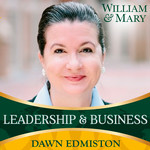 Whether you're happily employed, between jobs, or employed and looking for your next role, it can be easy to forget about your personal brand. Building and promoting your personal brand is important in today's competitive and crowded world, and it requires time, thought and effort. On the positive side, more tools than ever are available today to help you communicate those qualities that make you special. Dawn Edmiston is a professor of Marketing at the William & Mary School of Business. Among other things, she teaches personal branding. She's also a leader in the teaching of artificial intelligence. She joins us today to define personal branding and to share some insights on how you can improve your brand so you stand out from the rest of the pack.