Ken White
From William & Mary in Williamsburg, Virginia, this is Leadership & Business, the podcast that brings you the latest and best thinking from today's business leaders from across the world. We share the strategies, tactics, and information that help make you a more effective leader, communicator, and professional. I'm your host, Ken White. Thanks for listening. There are few things in life more stressful than being out of work. Mid to late-career professionals face an especially difficult challenge. The unemployment rate for older professionals is more than three times the national average. And as this group exits the workforce due to downsizing, COVID-19 or termination, it takes them twice as long as others to get hired and often for less money than they had been making. The picture for unemployed workers over 50 is not pretty. But rather than blame the market or age discrimination. Our guest today says, look in the mirror. Fawn Germer is the best-selling author of nine books, including her latest Coming Back How to Win the Job You Want When You've Lost the Job You Need. She says many experienced professionals have not kept up with technology. The skills needed today, social media, and the overall pace of change. She says older workers want to come back, but they don't always know-how. She shares her advice with us today. Here's our conversation with Fawn Germer, author of Coming Back How to Win the Job You Want When You Lost the Job You Need.
Ken White
Well, Fawn, thanks very much for being with us. We appreciate your time and sharing your expertise with us. It's nice to see you.
Fawn Germer
It's great to be with you.
Ken White
For the mid-career professional or someone even later than mid-career who just lost their job for whatever reason. That's a boy that's a life event that can really shake you with your experience and expertise. How would you advise somebody? What's the first thing maybe they should do when that happens?
Fawn Germer
Well, I think I'm supposed to say buy my book, but it's make up your mind. That you're going to get in the game, that the people who will win and believe me, if you make up your mind, you will win. But the people who win are the ones who say; I'm not gone. That you don't buy into this idea that it's going to be so hard and you're never going to breakthrough. You're going to breakthrough. It's going to be a challenge. It's going to be a test to see how tough you are. But if you make up your mind, you will get where you need to go. And then I'm going to give you one more thing. The next thing you do is you make a list. You make a list of every single thing you need to do so that when you start to lose momentum or when it gets discouraging, you always have one more thing to do because, you know, you work out, you know this when your feet are hurting, and you feel like you can't go any further if you just take the next step and the next step, you get where you need to go. So if you have a list, you just do the next thing on the list and the next thing on the list and with the certainty that you are going to do it.
Ken White
Excellent. I think most people if they were to lose their job late in their careers, might think I better look in the field where I've spent the most time. Do you recommend they stay in the same profession or look elsewhere?
Fawn Germer
Well, that's hard to say because it depends on what the field is. You're looking at a former newspaper person, and if somebody lost their job in newspapers, I'd be like, you got to go look for another gig because that dance has about run its course.
Ken White
Right.
Fawn Germer
But what I would do is do some research on your industry, see if it's still viable. And then the first thing you ask yourself is, do I still like this? And if you still like it, can you get hired? And really, you want to eliminate the negative out of your mindset, saying I'll never get a job because that's going to make it hard for you to make a good decision. You have to be able to be realistic about it. Is that do you have opportunities that you can get? And if you still love it? Stay in it, but don't try to force the world to accept skills that are no longer being utilized. The world has changed. If it's still a viable profession and you love it, stay. If not, go.
Ken White
How about fit? How much does the job have to fit? And do I have to like it 100 percent, 80 percent, 50 percent at this stage in life?
Fawn Germer
Well, and sometimes it depends on how long you've been unemployed because sometimes you need to have a job in order to get a job. So you may take something that's not a good fit just to show that you're employable, but you want the right fit because you are entitled to have work that is meaningful, that makes you happy. Sometimes you have to, on a short term basis, take something that doesn't feel quite right. And you do it because you've got to take the next step to get where you need to go.
Ken White
Which might mean lower pay, for example.
Fawn Germer
Sometimes that is common. I really tell people that from the beginning, keep your mindset that you're going to be able to get pay. That is going to take care of you. You have to be able to eat. But there are times when you will take something for less. And largely that's something I write a lot about, is that the world changed. So if you're the person in the office who has the highest paycheck, that automatically makes you more vulnerable because technologically younger people are coming out of school who will work for a third the cost and who likely can do more than you can. So they're going to take the cheaper work. So in those kinds of situations, if you can't justify the higher paycheck, you will be taking a pay cut. But you want to upskill and learn everything you possibly can. So you're not just seen as somebody with experience, but as somebody who can lead your company and your organization into the future so that you're not the best person for the job today. But in five years.
Ken White
Upscaling is a great point. I'm not so sure some people even know where to begin. Is it determining maybe what you want to do and then getting the skills? How do you approach that?
Fawn Germer
Well, I say it's pretty easy if you regularly read The Wall Street Journal, Ink, Fast Company, and you don't have to read every article, scan the tables of contents, see what's going on, and then Google your industry. If my industry if I were in the news industry, I would Google trends in newspapers, and I would see what's going on with that if I'm in the insurance business trends in the insurance business and see what's coming. And everybody really needs to look at artificial intelligence, robotics, blockchain, big data, and machine learning and see how those things are going to impact their specific skill set. And then you just one by one take something, so you're at least familiar with those things. And that's the easiest thing in the world. There is so much learning out there that is free with these online courses. And you can say I've studied artificial intelligence from Harvard professors for free. You don't have to get an A in the class. You need the information. So always add something into your repertoire. And sometimes it's confusing. Blockchain that that's something I couldn't understand it. It took me forever. I did so many YouTube videos. I still didn't get it. And then I found a video on how to teach a, I think, six-year-old about watching. And then I watched that ten-minute video, and I understood blockchains like even if you take it to its easiest level and then start from there, you get the training you need. And let's admit it, we thought we were technologically up to date. We're not, and companies don't care about experience as much as they care about relevance. So if you've got time and you're not working, make yourself relevant. It's not hard, and the payoff is huge.
Ken White
We'll continue our discussion with Fawn Germer, author of Coming Back How to Win the Job You Want When You've Lost the Job You Need in just a minute. Our podcast is brought to you by the William & Mary School of Business. The post COVID world will require new skills and new approaches. And those skills and approaches are taught in the William & Mary MBA program. We offer four different formats, including the full-time, the evening, the online, and the executive, all taught by our top-ranked MBA faculty. The William & Mary MBA will prepare you to succeed in our new world. Check out the MBA programs at William & Mary today. Now back to our conversation with Fawn Germer.
Ken White
What about networking? That's uncomfortable for a lot of people, but when you're out of work, that's a that's an important thing to do. What advice do you have for people in terms of networking?
Fawn Germer
Well, I am an introvert. If I go to a party, it's kind of, you know, unless I'm there as the speaker, I'm very engaged because people come up to me. But if I have to go up to them, it's hard. So you do want to get in the room, and it's very easy to network during COVID because you people are available, so you can do informational Zoom calls all the time and ask people who are your mentors to hook you up with their mentors and just do these little informal meetings, and you build this network, and it's useless if you don't ask your network for help. And I don't mean saying, hey, do you mind sending my resume out? I mean, you say, can you send my resume to Jim Davis tomorrow? It's about this job. And I would like to make an appointment to see him next week, blow some of your clout because it's no good to have clout if you don't use it. And so it's you got to go guerilla. Your network will help you again and again, but you have to specifically show it what you want.
Ken White
And then in terms of personal branding, social media, you say that's a place that people have to have to look at. They've got to embrace it. How do you what do you do what you say when you talk about social media to folks later on in their career? So we're looking for new work?
Fawn Germer
Right. LinkedIn, LinkedIn, LinkedIn, LinkedIn. And I'm somebody who is not that crazy about all of those social media. I do like Facebook so I can post my kayaking pictures, but we have to do this, and it shows that you are a player. And if you have ten companies that you're targeting, start adding contacts in those companies because recruiters see that you have people in their company already. So that gives you points. And then if you start commenting on those people and what they post, that gives you more of a connection to be able to say, hey, I'm really interested in your company, what would you suggest I do? So social media automatically builds your network, and your ability to use it makes you a viable player in that network. It's just the way we do business now.
Ken White
Do you recommend people write and publish on LinkedIn?
Fawn Germer
Yeah, LinkedIn is the place. That is the place. And so you do that, you write your articles if you want, but be in the right groups, and people love it when others comment and say they did a good job with their posts. So just schmooze the right people, and they'll start noticing your name.
Ken White
You and I are talking on Zoom. I can't think of too many companies that do not use video interview, even pre-COVID. Is video and communicating on video something that this generation is adapting to, or they having struggles adapting to that.
Fawn Germer
Well, I think people like it. The older people are certainly figuring out how to use it so they can stay in touch with their children and grandchildren. So they just have to realize that this is the way that business is done then.
Ken White
Yeah.
Fawn Germer
And it's frustrating to me because I can't sneak off and look at Amazon while I'm having a business meeting. I have to pay attention fully. But it is the way business is being done. It is the way people are being interviewed constantly. And then, you know, companies don't think a thing of it. So when you're on that, you've got to really be sure that you've got good lighting, that you've got good sound, test out your camera and your sound before you do it. So you reboot your computer, and when you start, you say, hey, let me get a callback number in case something goes wrong here. Stick your dog in the other room, all of these things, because you want to create an impression that you've got it going on. And the other thing is get the garbage out of the back of your room. You want people to see that you have a professional set up, and sometimes it's you can make it interesting with whatever books you have or whatever things are out there. But what you don't want to do is look like you're a mess and that this was just some afterthought. And particularly for older people, your appearance is so important that you don't look like you're some frumpy old person. And believe me, I'm in the age group that I could qualify for that. But get your hair done. Get the right outfit, dress for your top and your bottom, because you may have to stand up, but you don't have to wear shoes, okay, and just make a good presentation. And you know, the other thing being that that connect, look into the camera, look at that person and validate them by just showing that you're seeing them, you're looking at them, you're taking them seriously.
Ken White
What do you say if someone says there's no way I'm going to get hired? There's just so much age discrimination out there.
Fawn Germer
Then you're not going to get hired. I mean, come on. I learned that lesson when I was young, and I went to River Country. Disney used to have the first water park, and there was this T bar. And if I kept watching people and they would get on the T bar, and it would go down this line, and then they reached the end and then jump in the water. And I kept saying to myself; I'm never going to be able to do that. I'm never going to be able to do that. And then the minute I got on that thing and left the platform, I lost it, let go, fell in the water. But of course, I fell in the water because I thought I couldn't do it. The next time I said I can do this, they all did it. And then I went easily. So if you think that's the case, it's the case. Yes, there are definite age discrimination issues. We can't pretend that they're not. But usually, those issues are magnified because there is an assumption that we are not relevant. So if you can say what you are learning today, that you're taking a class on innovation at MIT, which incidentally, I did, and it was free and it was wonderful. Right. If you're, you can say what you're learning constantly. That's what they want. They want somebody who's an insatiable learner. And if a younger person is interviewing you, don't say, oh, I have a kid your age, or back when I was your age, I was doing whatever. We don't care about your experience anymore. I'm sorry. It's just the way it is. We want to know what you're going to be able to do in the future. And if you try to make it look like you know so much more than the person interviewing you, you're automatically setting yourself up as a threat. So that is how you make age an issue for yourself.
Ken White
So, yeah, great. So so be proactive about it. I do hear sometimes I'll hear someone older say things, wear things, and it screams I am older
Fawn Germer
Right.
Ken White
and out of touch and just wow. Get it together, you know, get it together. And it's not the company's fault. It might be your fault, actually.
Fawn Germer
Well, you know, when and when I start writing that chapter, you know how to de-frump. I looked in the mirror, and I went, well, you're not looking so hot yourself. So we really have to give ourselves a good look in the mirror, not just physically, but that's important, but also in how we are presenting ourselves as professionals because we don't automatically get points for having been there and done that anymore. That can work against us. I think the most important quote in the book came from a millennial who said, if you have thirty years of irrelevant experience and a millennial has three years of relevant experience, the millennial is the expert. And that is the truth.
Ken White
That's our conversation with Fawn Germer, and that's it for this episode of Leadership & Business. Our podcast is brought to you by the William & Mary School of Business. Businesses and organizations are seeking professionals to lead in our post COVID world. Professionals who think strategically, communicate effectively, and manage ambiguity. You'll learn those skills and more in the William & Mary MBA program. Offered in four formats the full-time, the evening, the online, and the executive MBA. Check us out online to learn more. Finally, we'd like to hear from you regarding the podcast. We invite you to share your ideas, questions, and thoughts with us by emailing us at podcast@wm.edu. Thanks to our guest, Fawn Germer. Thanks to you for joining us. I'm Ken White. Wishing you a safe, happy, and productive week ahead.



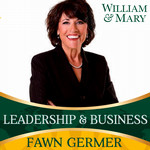 There are few things in life more stressful than being out of work. Mid- to late-career professionals face an especially difficult challenge. The unemployment rate for older professionals is more than three times the national average. And as this group exits the workforce due to downsizing, COVID-19, or termination, it takes them twice as long as others to get hired, and often for less money than they had been making. The picture for unemployed workers over 50 is not pretty. But rather than blame the market or age discrimination, our guest today says "look in the mirror." Fawn Germer is the best-selling author of nine books, including her latest, "Coming Back: How to win the job you want when you've lost the job you need." She says many experienced professionals have not kept up with technology, the skills needed today, social media, and the overall pace of change. She says older workers want to come back, but they don't always know how. She shares her advice with us today.