Ken White
From the College of William & Mary in Williamsburg, Virginia. This is Leadership & Business. The weekly podcast that brings you the latest and best thinking from today's business leaders from all across the world. We share the strategies, tactics, and information that can make you a more effective leader, communicator, and professional. I'm your host, Ken White. Thanks for listening. The number of American households worth $25 million or more is growing. According to MSNBC, there are 142,000 households in the US that meet or exceed that $25 million mark. That's a significant jump from just two years ago. In addition, more people are becoming wealthy in America. Well, that's good news for wealth management professionals like John Hyman, CEO of Algonquin Advisors in Greenwich, Connecticut. Hyman and his colleagues at Algonquin professionally manage portfolios of high-net-worth individuals, helping them achieve their wealth objectives. We spoke with Hyman in New York City recently about the wealth management field, what's expected of investment advisors at that level, and the role ethics and regulation play. Here's our conversation with John Hyman, CEO of Algonquin Advisors.
Ken White
John, thank you very much for doing this. We know you're busy. It's great to meet you in Manhattan. Thanks for your time.
John Hyman
Great. Thank you, Ken.
Ken White
Wealth management is a little bit different. You're an investment advisor but in the area of wealth management, what does that mean?
John Hyman
So, wealth management is really a process where we work with investors, institutional or individual investors, but principally in our case, individual investors, and help them identify their investment objectives, help them allocate their assets appropriately, given those investment objectives, and help them identify the appropriate way to fulfill that is, how should they invest? Should they be using mutual funds, separately managed accounts, hedge funds, private equity funds, ETFs to really provide a full suite of really the investment internal CFO role, if you will? Really for most of our clients they work with us, they pay us a fee. So they're expecting to get something in return for that fee. And that would presumably be either better returns, lower volatility in their experience. But for most of our clients, because our clients tend to be very high, net worth individuals tends to be peace of mind that someone is watching after their investments and watching it in a professional fashion with an objective, systematic approach as opposed to being somewhat emotional and dealing with the sharp market moves and reacting perhaps in a way that shouldn't be reacting.
Ken White
How often do you communicate with clients?
John Hyman
So our client base is somewhat small. We're dealing with clients today. The firm that I'm associated with, Algonquin Advisors, we today manage approximately half a billion dollars. We have about 25 clients. So you do the math, the average account size is quite large, and it's a high-touch business. We, at a minimum, are talking to our clients and reviewing their performance at least quarterly. But to be fair, we're probably talking to our clients much more frequently. What we don't end up having conversations about would be the sharp market moves and, gee, should I be moving out, should I moving in? Our clients really, they've been with us for quite a long time. They have, I think, a high degree of confidence and trust in what we're doing and they appreciate the disciplined approach to their investments. So regular conversations with the regular conversations tend to be more about lifestyle issues, tend to be about personal investment issues that they may be having. And then quarterly, it's really revisiting the investment plan and making sure that we're on track and reviewing the performance, frankly, to make sure we're delivering the results that they're looking for.
Ken White
So what's your typical day like? What do you tend to spend most time with?
John Hyman
So my day is varied, and we have a reasonably small staff, and having worked in large investment banks, it can be very different from working in a smaller investment advisory firm. But my day is varied. So as the CEO of the firm, my responsibilities tend to be managing the day-to-day business side of the firm. So that would be dealing with everything from technology to legal and compliance to infrastructure to client reporting to any new initiatives that we're thinking about, taking on, building new products, and the like. I also spend a lot of my time with our analyst team doing research on the investments that we are likely to place our clients with, either those that we have existing client money with or those that we are prospectively looking at to place client monies with. So I do spend a lot of my time, and that's the part of the job I like the best, and frankly, it's part of the job my partners like the least. So it's a good fit.
Ken White
You beat me to it. I was going to ask what do you like best. There's got to be the two or three things that really get you fired up.
John Hyman
I mean, for me, doing the research on the investment opportunities is really that's the most fun for me. We get to sit down and talk to some of the best investment minds in the business, hear what they're thinking, hear what they're doing in their portfolios, and making a decision as to who we want to work with and how we'd like to deploy that in our client portfolios. And we're working across the spectrum from the most benign investments to some of the most exotic investments that are out there. So you really do get a broad swath, and it's intellectually incredibly stimulating. I also like working with the younger people on our team. So at the firm I'm with, Algonquin, we have a small analyst team. At other firms that I've been associated with, we've had large analytical teams. But that's the other part of the job that's very rewarding is working with folks who have come right out of school or reasonably close to graduation and then working with them and getting them moving in their career as they kind of move up the corporate ladder. So those are probably the two things that are most fun for me.
Ken White
And you've been in this a long time. You've seen the investment world go through changes, highs and lows, and difficulties. Where are we now? What's your feeling overall about opportunities for your clients?
John Hyman
So I'm going to be able to take it two different paths. So there's opportunities for people coming into the business and opportunities for clients. I'm an optimist by nature, so I always like what's going on, and there's always someplace to be investing. There's obviously periods of time where that has not been the case, but there's always something to be looking at, and there's always either new opportunities or opportunities to be revisiting. But in general, we are optimistic on the current investment landscape. If that's the question. For folks coming into the business, it is a little bit different than when I entered the business 30 years ago. It is very, very competitive to come to work in Wall Street. And despite some of the reputational changes that have taken place subject to the 2008 market correction and some of the activities took place there, it's a different environment today than it was. I would say people coming to The Street look at it as potentially the opportunity to get rich quick. And if that is your only motivation, probably not the right reason to come to The Street because you'll work hard. If you don't really love what you're doing, it's going to show up, and you're probably not going to be as successful as you might have hoped you would have been. So people who really enjoy the business, who like the aspect that they're getting into, tend to thrive, and it will show people you're working for, they'll know it, they'll be able to figure out who the real people who really love what they're doing.
Ken White
When a young person comes to you and says, I think this is what I want to do, what kind of characteristics are you looking for? What are you looking for from them?
John Hyman
So I think the first thing is if you're a young person coming to The Street, understand the people that you're talking to. So I work in the wealth management business, so when people come to me and say, I really want to work in investment banking, they may not understand the nuances, but if you're going to be that specific, be careful. And so just how you position yourself and what you're looking for. What I've looked for, and I think in as much as business schools would tell you, that boy, having a great undergraduate business degree, which I had, and a graduate business degree which I had, would be helpful, I don't really care. We're looking for people who are multidisciplinary. So if you're very smart, if you are a good analytical thinker and can communicate. I mean, those are critical skills. You can learn the finance, the technical aspects of finance. So in my current environment, I have a history major, an economics major, and a philosophy major working for me as analysts. One has a CFA, one's finishing off her CFA. I've hired people who were Kinesiology majors who are now comedians. It's looking for the right personality, strong ethical background, people who can communicate, and people who I think are good analytical thinkers. Having good team chemistry is really important. So in as much as we're looking at the hiring side for people who will fit well, people who are looking for positions should be looking for places where they feel they're going to fit well. And hopefully, I can identify someone who might fulfill a mentor role or mentoring role for them down the road where there's some personal chemistry, as aside from just someone who if you suck up, they're going to help you get ahead with your career.
Ken White
How do you help determine your client's objectives?
John Hyman
So it is really an iterative process where if it's someone who we've never met before or have been referred to us by an existing client, which is how we typically win new business, we'll sit down with them, and it'll typically be there's three partners at the firm. The gentleman who founded the firm and my other partner, who is based in Cleveland, really have the client-facing relationships, and they spend the most time with the clients. And the rest of us try to keep the pipes and plumbing running so they're able to do their jobs effectively. But I think really the critical path issues will be sit down and have a frank discussion with the individuals. What is it that they are looking to do with their money? Most of the people that we're dealing with are what you would consider to be high-net-worth or ultra-high-net-worth investors. So surviving their capital typically is not an issue.
Ken White
Sure.
John Hyman
What are their goals? They have lifestyle goals, they have legacy goals, they have heirs, or they have plans for leaving money to places where there might be some charitable opportunities. And so there's different goals that you look at. The time horizon will be important as to what they're looking for and if they have any biases. And as well, if they have any issues that they prefer not to invest in, maybe a senior executive at company, and they don't want to invest in anybody else in that industry or their own company because they're already fully exposed.
Ken White
Sure.
John Hyman
So you start to walk through and help identify an appropriate allocation of assets, stocks, bonds, cash, and the like. And then, from there, it becomes very much an iterative process. And you really want the prospective or the existing client to be engaged in that process so they understand how their money is operating. And a lot of that's an education on our part working with them or family members.
Ken White
Does every client know what they want or is that part of your role to help them?
John Hyman
Yeah, most clients, I think, have an idea what they want, but the idea of what they want, they may be sophisticated, and they may know because they have friends, family, or may have actually may actually be in the business. But many folks, frankly, don't know what they want and they're looking for that guidance. And I think that is one of the reasons that firms like ours exist because people are looking for professionals to help guide them through the investment process. And they're coming to us typically because someone has said, these folks have done a good job for me in the past, and you should sit down and talk to them.
Ken White
Being a smaller firm in a bit of a niche market, you're not going to be on billboards and on the radio. So how is the word spread, and how do you other than referrals?
John Hyman
Yeah, it's not a business where you can advertise and Algonquin Advisors is not a firm that most people have heard of. It's not one of the bulge, bracket Wall Street shops that are advertising at golf tournaments and tennis tournaments and the like. For us, it is largely word-of-mouth and referral based. So we have clients to the extent that they like what we do, and we've been fortunate they've referred us to other folks. And a lot of it's just a networking. It's networking opportunities where there's people that we know either in the business or outside of the business. They could be third parties, accountants, attorneys, sports or Hollywood entertainment managers who have been pleased with the work that we've done for their clients and then they may refer us to other clients. So that's really the way we do it. We are hardly a marketing dynamo in terms of we don't advertise. You're right. And I think for our clients, they really don't want to see us advertising. They like the fact that it is kind of a small, very cloistered sort of opportunity.
Ken White
Regulation. Things have changed. How has that affected you, and what has taken place?
John Hyman
Well, it's interesting, depending on where you sit in the financial services business, if you sit in a big bank, you've faced a lot of regulation. If you sit in a brokerage firm, you're probably a bank today, and so you're facing a lot of regulation. But even for smaller firms like ours, where we don't have a legal staff, where we don't have a full-time compliance staff, you're subject to the changing regulations. So things as arcane as cybersecurity is a big flashpoint for the SEC and for, FINRA and other regulators in our space today. It's not something that most of our clients would even think that we would have to deal with. We're not a bank. We don't have ATM cards, we don't have credit cards, we have a website with a password-protected login, but there's not a whole lot of clients. So we don't view us as necessarily a prime target, but we have obligations that we have to fill no differently than any other large mutual fund company or bank or brokerage firm. There's been regulations around custody of assets post Madoff, where nothing that specifically impacted a firm like mine. But if I were a hedge fund, they would want to know that the assets are where the assets are supposed to be, that there is audit, and third parties looking at it and verifying it. So parts of the business that are not even investment specific, but they're more operational, the nuts and bolts of the business have become very time-consuming for firms, and it's caused a lot of firms to consolidate because they'd like to really roll up that coverage if you will. It's also something that has hit the bigger firms in a very meaningful way, where they're spending tens if not hundreds of millions of dollars on compliance, on risk management, and the like because the regulators are requiring them to do that as a result of what happened in 2008 or 2001 or 1987. Pick your crisis that might have caused an issue. And so it's created tremendous job opportunities for people in those fields. If you're a compliance person or professional, if you're a risk professional, it's a great opportunity for you. And for smaller firms, a lot of folks have outsourced, so we have an outsourced. We have two law firms that we deal with. We have a compliance firm that we deal with. We have outsourced technology. And so that's how we deal with some of the regulations.
Ken White
How have people in your field approached ethics over the years? Things have changed because of events.
John Hyman
Right.
Ken White
Discussion on that, I mean, do people talk about it? How do you approach it now versus maybe ten years ago?
John Hyman
It's a very interesting topic, and a lot of designation-granting entities like the CFA, for instance, they have an ethics component, IMCO, which is another group, and the CFP, they all have ethics components that are ongoing education. But it really is either it's a tone at the top, either from the firm or the individuals of the firm, as to how ethics are communicated and dealt with. Our philosophy really is, look, the client comes first. If our clients are not happy, then they're not going to be with us, and we're not going to have a business. And so if we don't put the client first and operate in that fashion where we have fair fees and fair service, and we treat our clients equitably because, one, we're obligated to, and two, because it's the right thing to do, we're going to have a tough time maintaining our business. Your employees have to come second. And if you don't treat your employees well and don't ground them in firm ethical business practices, they could damage the business, or they could also, frankly, damage their careers. So it's really making sure that that's an important aspect. So at our firm, I am the chief compliance officer. I'm not a lawyer. I'm not a compliance professional, but I've been around the business long enough to know what most people think are probably sound business practices and keeping on top of what is appropriate regulation. We have a compliance meeting at least once a year where we walk through the legal obligations, and then we take it a step further. Here's our code of ethics. Here's what it means. Don't screw around with it, because if you do, you may not be working here. And so it's really putting teeth behind ethics and understanding that it is the critical component. Our business is a trust business. You work your whole career to build a great reputation and have the trust of your clients. You can undo that with one bad act. And so it's so important in a service-related business that it almost goes without speaking. You have to operate that way. Unfortunately, in the financial services business, that's not always the case. And you have to be careful who you hire or picking who you work for to make sure that you don't find yourself in one of those tough situations.
Ken White
Yeah, wonderful. Very interesting. Thanks so much for your time and for meeting us here in the city. It's great to talk with you. Really appreciate your insight and advice. Thanks so much.
John Hyman
Great. Thanks, Ken. I appreciate it.
Ken White
That's our conversation with John Hyman, CEO of Algonquin Advisors in Greenwich, Connecticut, and that's our podcast for this week. Leadership & Business is brought to you by the Center for Corporate Education at the College of William & Mary's Raymond A. Mason School of Business. The Center for Corporate Education can help you and your organization by designing and delivering a customized leadership development program that specifically fits your needs. If you're interested in learning more about the opportunities at the Center for Corporate Education, check out our website at wmleadership.com. That's wmleadership.com. Thanks to our guest this week, John Hyman, and thanks to you for joining us. I'm Ken White. Until next time, have a safe and productive weekend.



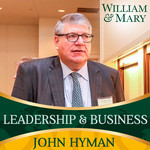 John Hyman is CEO of Algonquin Advisors. The company manages the financial portfolios of high net-worth individuals. Listen in to learn more about the wealth management field and the role that investment advisors play.