Ken White
From the College of William & Mary in Williamsburg, Virginia. This is Leadership & Business. The weekly podcast that brings you the latest and best thinking from today's business leaders from across the world. We share the strategies, tactics, and information that can make you a more effective leader, communicator, and professional. I'm your host Ken White. Thanks for listening. Well, we've never witnessed the United States presidential race quite like the one taking place now. Bernie and Hillary, Cruz, Kasich, and Trump. The races seemed to have just about everyone talking, but when the dust finally settles and the parties select their nominees, today's guest will step in. Frank Fahrenkopf is co-chairman of the Commission on Presidential Debates. The organization conducts the general election presidential and vice presidential debates in presidential election years. Fahrenkopf is the former longtime Republican National Committee chairman. He and former Democratic National Committee Chairman Paul Kirk co-founded the Commission on Presidential Debates in 1986. Fahrenkopf and his colleagues on the committee have four debates scheduled for the fall. In addition to the dates, the committee determines the location, format, rules, moderators, and all other details. Fahrenkopf visited the Mason School of Business recently as a part of the Tokar Chair of Business and Investment Analysis speaker series. After Fahrenkopf spoke with MBA students, he sat down with us. Here's our conversation with Frank Fahrenkopf.
Ken White
Frank, thank you for being here. You literally just came out of the classroom with the students had a great talk with them. How did that go? What's your reaction in the classroom?
Frank Fahrenkopf
It was great. You know I speak at universities quite a bit. In fact, four years ago, I spoke to university students in Beijing and Shanghai, and I thought they would ask good questions. They spoke great English and asked, but this group really had some very insightful questions, and I was just really, really excited about it. I really enjoyed it.
Ken White
You know, it's interesting an MBA student they are so enveloped by their studies. It's a time you actually lose sight of what's going on in the world, but with this election being so interesting in these campaigns, I think students today are making sure they are involved. You don't organize or lead the debates we've seen so far, but you've certainly been observing them. You've had a lot of years of experience in that realm. What do you think? What do you see?
Frank Fahrenkopf
I've really been upset by what's happened. The parties have lost control. It's the networks who are driving it. They're making a fortune. They're making it into the old racehorse thing the way they advertise it. Tomorrow night we'll have the showdown. And then they get on there, and they ask questions, the moderators ask question trying to get the candidates to fight. I mean, the classic one, particularly if Trump's involves, says well, Mr. Jones, last week Donald Trump said this about you. What do you got to say? I mean, they want to start fights rather than asking substance, getting into the issues that are disturbing the American people and ought to be discussed. I'm very unhappy with the manner in which the networks have conducted these primary debates, and ours are much different. We don't have any sponsorships. Well, we have a single moderator. There's the audience. No audience participation. If they clap or yell or boo, they're thrown out, and we go for 45 minutes and, excuse me, 90 minutes and hope that we get some depth on the issues.
Ken White
And you've been doing the presidential vice presidential debates for how long now?
Frank Fahrenkopf
The commission started the debates with the 1988 cycle. And so, up to this point in time, we've produced 19 presidential debates and seven vice presidential debates. So we'll break 20 in this cycle.
Ken White
You have a board of directors people from all over the country. What do they do? And who are they in general?
Frank Fahrenkopf
Well, it's across my co-chairman now is Mike McCurry, who was Bill Clinton's press secretary when Bill Clinton was President. He took the place of Paul Kirk. Kirk and I created the commission back in 1987. He was the chair of the Democratic National Committee at that time. And he was in that role until Teddy Kennedy died. When Teddy Kennedy died, he was appointed to fulfill Teddy's seat until a special election could be held, so he had to resign. And McCurry came on. But we have people in both parties and independents. We have people like former Senator John Danforth of Missouri. Mitch Daniels, who's the President of Purdue. Father John Jenkins who is the President of Notre Dame University. We've got Dick Parsons previously of Citibank. We got Olympia Snowe, a former United States senator. So it cuts across the board Republicans, Democrats, and independents. But the work we do is nonpartisan.
Ken White
Right.
Frank Fahrenkopf
We have been fortunate that we've had people have stuck by that.
Ken White
You've got some media people certainly on the board as well.
Frank Fahrenkopf
We added Charlie Gibson, who was a former anchor of Good Morning America.
Ken White
And a Virginian.
Frank Fahrenkopf
A Virginian. Yes, I found that out who moderated a debate for us. We also have Jim Lehrer, who's been our grand old man. I think he's done ten debates over the years. We had Bob Schieffer on until about three weeks ago. He had retired from CBS, and then CBS called him back to be the gray eminence during this is a campaign to comment and so forth. So he had to step down, but he will rejoin the Commission. And they're there to help us with this very difficult task of choosing moderators.
Ken White
Right. Talking about moderators, what are you looking for? And they're different formats in terms of what you're televising as well.
Frank Fahrenkopf
Yeah, they are, and I guess we don't want to. We don't want a hot shot. We don't want someone who's going to try to show the world how smart they are. Their job is to steer the candidates to answer questions and hopefully debate among themselves. And they're sort of as a guide. And they're not to be involved in the debate. And we always try to strive for diversity with women, with blacks, with very difficult to find Hispanics nowadays with the networks where you could find someone who has that experience. But we work on it, and we also age now is important with millennials. We'd like to try to find someone who millennials will relate to.
Ken White
Sure.
Frank Fahrenkopf
So that we can, and we can get them involved because they are such a large part now of everything we do in this country, it seems.
Ken White
Yeah. So the moderator, you're looking for someone who does not have that it's all about me attitude. It's all about the audience kind of attitude.
Frank Fahrenkopf
Right. Exactly.
Ken White
I would assume, and please correct me if I'm wrong, that someone with broadcast experience might go to the top of the list faster than someone, say, with a print background just because of the nature of the production.
Frank Fahrenkopf
Up to this point, since we've gone to the single moderator, we have always done electronic media people. Prior to that, we went there was a moderator and a panel of reporters, and most of those reporters were print reporters and but the moderator was running things, and we got away from that because reporter number one worked long and hard to come up with a question when it was his or her turn and to show how smart they were and to make it a good question. And in those days, the rules were you asked the question, one candidate would answer for two minutes, the other would have a minute and then 30 seconds, and then it was time to go to reporter number two. Well, it's obvious that the candidate hadn't answered question number one but reporter number two who worked very hard for their question. They don't want follow up on reporter number one. So that's why we did away with the panel of reporters, and we felt that with a single moderator, that moderator can then say wait a minute, you haven't answered the question. Let's stay there and get an answer. So that's why we've gone to a single moderator, and all of them up to this point in time have been from the electronic media.
Ken White
Right. Now can you give us the schedule what's coming up? Where are you going in terms of the presidential and vice presidential debates?
Frank Fahrenkopf
The first presidential debate will be on Monday, September 26th. It's earlier than usual. We moved it into September. It's usually always in October, but the conventions have been moved up. The Democratic and Republican conventions are now going to be in July late July, then maybe a couple of days in August. They moved them up. So we felt we had to move them up, plus the fact that in 2012 on Election Day, 40 percent of the American public had already voted by early voting in their state's absentee ballots or whatever. So we wanted to move them forward a little bit to try to catch some of those people with the educational work, so that first one is at Wright State University in Dayton, Ohio, on Tuesday, October 4th. The vice presidential debate will be held at Longwood University here in the state of Virginia in Farmville. The second presidential debate will be Sunday night, the 9th of October, at Washington University in St. Louis, and then the final debate will be Wednesday, October 19th, and that'll be at the University of Nevada in Las Vegas. And Hofstra University is what we call our backup site if something should blow up with these other sites. Hofstra would move in and fill the vacuum. They've done debates before, so they know that they could get up and get it done.
Ken White
Sure, so three presidential and one vice presidential. How do you select the site?
Frank Fahrenkopf
That's done in. I'll give you the example with these schools here. In January of 2015, the commission sent out to every college and university in the country. In effect, the requests for bid. We lay out what's necessary, the facilities, the hotels that have to be within 100 miles. All the things because you know you have 5,000 reporters from all over the world attending.
Ken White
Right.
Frank Fahrenkopf
And then we have a technical team, sound people, lighting people, and so forth. They go out look at the sites that have come in. Usually, reduce it down to maybe ten or twelve, and then the Secret Service gets involved because Secret Service has got to be comfortable that they can lock down this campus from a security standpoint. I mean, this was very important this time with what's going on in the world with the terrorism, and then they get it down to maybe about eight, and then the Commission those members of the Commission, we sit down and make the final decision as to where to go.
Ken White
We'll continue our discussion with Frank Fahrenkopf in just a minute. Leadership & Business is brought to you by the Center for Corporate Education at the College of William & Mary's Raymond A. Mason School of Business. The Center for Corporate Education can help you and your organization by designing and delivering a customized leadership development program that specifically fits your needs. If you're interested in learning more about the opportunities at the Center for Corporate Education, check out our website at wmleadership.com. That's wmleadership.com. Now back to our conversation with the co-chairman of the Commission on Presidential Debates, Frank Fahrenkopf.
Ken White
You talk about the audience and security. How many people in the audience? What's it look like when you do it?
Frank Fahrenkopf
I mean, we'll do it in arenas that hold 20,000 people. But when you build the boxes at the back of the hall for the networks and everyone that covers it, C-SPAN and so forth, we usually have about a thousand people. We've been as low as 600 in one place, and I think we were 13 hundred was the most we've had. And the way it's done is that if let's assume for these two candidates if there are three candidates, you do it differently. A third of the tickets will go to each of the candidates, and the remaining third is divided between the host school and the Commission and the host school usually holds raffles among its students as to which students get the tickets, although we bring in a lot of students who serve as ushers and so forth. So we get them in the hall another way. But that's how it's done. So normally, it'll be roughly a thousand is a good way to judge it. And they're warned ahead of time that they're not to participate, that they're not to clap and yell, and very few times in all the years we've been doing this has there been any disruption.
Ken White
Sure. On the night of the debate, what are you doing?
Frank Fahrenkopf
On the night of the debate, I'm getting. Well, usually, what I'll do and and and my co-chairman we'll take turns. I'll do a half an hour interview on C-SPAN, he'll do a half an hour on C-SPAN, and then we're checking everything out. And then a half an hour before the debate begins, we go out on the stage, and you only see us appearing on C-SPAN, and we introduce the President of the University, who thanks their givers and all the rest of it and student body president usually comes out and says a few words. Then we talk to the audience about what they can and can't do and security and all the rest of it. And then, with about 10 minutes to go, the moderator is introduced. He comes out or she and also warns the audience about what the rules are. And then we're sitting on pins and needles to make sure it comes out because a lot of work that goes into it. And we only have a staff of regular staff of one person the Commission.
Ken White
Wow.
Frank Fahrenkopf
It's full-time, but we take in interns and so forth from schools that work with us, but we regularly, on non-debate years we, have one or one and half people so.
Ken White
So if someone listening to the podcast has ever been to, say, Los Angeles and watched a sitcom taped, you're the comedian who goes out and warms up the audience.
Frank Fahrenkopf
Exactly.
Ken White
You're in charge. That's your role. That's a great role.
Frank Fahrenkopf
It's exactly right. It's exactly right.
Ken White
And the rule keeper get them all fired up and ready to go.
Frank Fahrenkopf
I'd say that it's important. We're nonprofit. We get no money from the candidates. We get no money from the parties. We get no money from the federal government. We raise all our money privately. So there's no connection with the parties. We choose the dates for the debates. We choose the locations for the debates. We choose the formats for the debates, and we choose the moderators of the debates without any contact or input from the candidates.
Ken White
Right. What about questions? How much do the candidates certainly issues or issues? You know what's coming, but how much did they know about questions?
Frank Fahrenkopf
Well, up until last year, they didn't know anything. And we don't know the questions. The we would never try to tell a moderator and interfere with their journalistic integrity what to ask. But we've gotten good moderators, and they know what they're going to talk about. We changed the format for two of the debates last time, where for the 90 minutes are divided into six 15-minute pods, and the moderators announce a few days before what the subjects of that 15 minutes going to be and that the candidates are warned you're not going to be able to give a two-minute response that you normally give out on the campaign trail because the moderator is going to drill down to know what you know and what you propose to do. And it's really worked out very, very well, and we try to get the moderators to get the candidates to actually debate to enjoy enjoying each other.
Ken White
And, of course, the candidates have big coaching staffs and their coach, and they're ready to roll.
Frank Fahrenkopf
You know, there's a reason we go with three, and it's gonna be interesting because I think the networks are making so much money on the primary debates going to try to do end runs around this. They're gonna try to do what they call town hall meetings where they bring the candidates in the set and one by one they interview them, and we're usually been an excuse for the candidates not to have to do that sort of thing. Look, we're always getting requests to do debates and so forth. We're just going to do the official three debates, so it takes the pressure off them. But they'll know now and particularly on foreign policy and on the domestic policy. They're going to be drilled down, and they're going to have to know the subject matter and be prepared.
Ken White
The audience has always been there for the debates, hasn't it? The ratings, and so forth.
Frank Fahrenkopf
Yeah, I mean the, you know, when you go back to 1960, the famous Lincoln. Lincoln 1860 that was a Senate race. The Kennedy-Nixon debates. They were done in television studios. We've always done audiences, and we've talked to. The fact that there's an audience gets the candidates up a little bit rather than being in a sterile studio, and it cranks them up. Now there's some people who are still there was a group from Penn the Annenberg study recommended we should go back to doing it in the studios. But we think it's important, and we do it on college campuses because it's part of our educational function. Our goal in doing this is to educate the American public so they can make hopefully an informed decision. Our polling tells us that 60 to 65 percent of the American people say that our debates are important factors in who they vote for. It's not the only factor but are important factors, and so we think we're fulfilling our function.
Ken White
When you look back over the years, all the debates you've been involved with. Was there one that was just great? When you walked away from it. That's exactly what we were looking for.
Frank Fahrenkopf
Yeah, yeah, yeah, yeah. It clearly was it was Reagan-Mondale in Kansas City in 84. And that's when President Reagan had performed so abysmally in the first debate. And the question raised as to whether or not he was up to it. He was too old. He shouldn't be President. And then he was asked a question about his age, and with a smile on his face, as only the President could do, he said I will not take advantage of the relative youth and inexperience of my opponent for political purposes. And even Mondale broke out laughing. And I talked to Vice President Mondale a few years later when I was given an award up at the Humphrey Institute up in Minneapolis University of Minnesota, and he said that was the moment he knew it was over.
Ken White
Had to.
Frank Fahrenkopf
Yeah.
Ken White
Absolutely. Yeah, you can see it on his face if you watch it again. Right.
Frank Fahrenkopf
That's right.
Ken White
Yeah. There is a chance maybe that we have a third-party candidate this year. What's the likelihood? And how will that happen?
Frank Fahrenkopf
Well, the way it works is that the we're required by the Federal Election Commission and the Internal Revenue Service because we're nonprofit to announce in advance a clear and transparent criteria to get into debates. And so we announced a year ago that you must meet the constitutional requirement, which is 35 years of age and natural born citizen.
Ken White
Right.
Frank Fahrenkopf
Then you also must appear on enough ballots so that you can conceivably get 270 electoral votes. And if you're a third-party candidate, that means you've got to go out and gather signatures from state to state. And it's not easy. The Libertarian Party and the Green Party will be on probably all 50 ballots this time because of their past performance in elections and the leading candidate, the Libertarian nomination. And I think they're having their convention here in the next week or so. Is a former governor of New Mexico named Gary Johnson, and he I saw a poll a Quinnipiac poll where he was running third to Hillary and Trump at 11 percent. Now the third or the last criteria is 15 percent. So if you've got to be a 15 percent a week before on three on five major polls, so if he's at 15, he'll be invited and will participate. Now that doesn't mean the others will. In 19 in 1980, when the first debate rolled around, John Anderson, who was a congressman from Illinois, was an independent candidate. He was at 17 percent. And so the League of Women Voters invited him to participate. He said yes. Governor Reagan accepted Jimmy Carter, the President of the United States, said hell no. I won't go. And so that first debate in 1980 was between Ronald Reagan and John Anderson
Ken White
How about it?
Frank Fahrenkopf
only. And then, by the time the next debate rolled around, Anderson had fallen 12 percent, so he wasn't invited. Jimmy Carter accepted. And you had the debate between. So there's no gun that you can fire at these candidates. For example, in 1992, George Herbert Walker Bush always felt the President shouldn't have to debate. He really didn't like the debates, and he wouldn't agree to the debate. We announced the sites and so forth. He wouldn't agree to the debates. Clinton had accepted, Ross Perot was a third party he had accepted, and we couldn't get the vice president to in 92. He was already the President. And it wasn't until Bill Clinton supporters started dressing in chicken costumes showing up at all the President's rallies saying your chicken of the debate, your chicken of the debate that they finally changed their mind and agreed come in and accepted a proposal by Clinton to have the first town hall meeting which took place up the road here at Richmond University. And that was the first town hall meeting at the University of Richmond.
Ken White
How about it? Well, they're coming up soon. You shared the schedule, and if you really interested, if our listeners really want to see more than the debate, go to C-SPAN that half an hour, and we'll see what goes on in the background with you.
Frank Fahrenkopf
We'll see you in the background.
Ken White
Well, good luck. It's a heck of a year, isn't it?
Frank Fahrenkopf
Thanks, Ken. I'm looking forward to it.
Ken White
That's our conversation with Frank Fahrenkopf, co-chair of the Commission on Presidential Debates, and that's our podcast for this week. Leadership & Business is brought to you by the Center for Corporate Education at the College of William & Mary's Raymond A. Mason School of Business. The Center for Corporate Education can help you, and your organization get to the next level with business and leadership development programs that specifically fit your needs. If you're interested in learning more about the opportunities at the Center for Corporate Education for you or your organization, check out our website at wmleadership.com. That's wmleadership.com. Thanks to our guest this week Frank Fahrenkopf and thanks to you for joining us. I'm Ken White. Until next time have a safe, happy, and productive week.



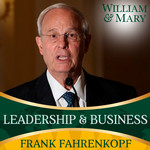 Frank Fahrenkopf is Co-Chairman of the Commission on Presidential Debates, the organization responsible for organizing the general election debates between presidential candidates. He founded the Commission in 1986 and chats on the podcast today about the organization, the current presidential race, and how they create the debates.