Matt Williams
Our ability to grow knowledge has now crossed over humankind's ability to assimilate that knowledge. It's growing faster than we can deal with as a species. And when we cross over that line, it fundamentally changes the world we live in.
Female Voice
From William & Mary in Williamsburg, Virginia. This is Leadership & Business, produced by the William & Mary School of Business and its MBA program. Offered in four formats: the full-time, the part-time, the online, and executive MBA. For more information, visit wm.edu.
Ken White
Welcome to Leadership & Business, the podcast that brings you the latest and best thinking from today's business leaders from across the world. Sharing strategies, information, and insight that help you become a more effective leader, communicator, and professional. I'm your host, Ken White. Thanks for listening. Well, as the world evolves, leadership also evolves. There's no doubt the leader of today and tomorrow will be different from the leader of the past. Qualities and approaches that defined yesterday's high-quality leaders won't work moving forward. Our guest today says a fundamental shift is occurring, and leaders must adapt. Matt Williams is a Clinical Professor at William & Mary School of Business and an experienced and successful leader. He's the managing director of Brand Federation and the former CEO of the Martin Agency, one of the top advertising agencies in America. He says in order to succeed, leaders have to change their way of thinking about themselves, their organizations, and their employees. Here's our conversation with Matt Williams.
Ken White
Matt, thanks for joining us. It's nice to see you. Welcome.
Matt Williams
Thanks for having me, Ken. Great to be here.
Ken White
It's been a few years, actually. The last time you were actually on the podcast. Once upon a time when I met you at the Martin Agency. It's been a few years, and it's great to have you here at the Mason School of Business.
Matt Williams
Yeah, things have changed, but it's great to be back.
Ken White
Great. And we had a class over the winter break, our winter break at William & Mary is long, and so I hosted a class called Leadership Forum, where we had CEOs and leaders come in and talk. And you were one of the speakers, and the students just greatly enjoyed what you talked about. And I thought, let's have Matt on the podcast to talk about some of that and share what you were discussing with the students, with our listeners on leadership, of course. And you started out with talking about the point of leadership. What is the point? Why does leadership matter?
Matt Williams
I think it's always mattered, obviously, but it matters through time for different reasons because the context shifts. The context within which we do business shifts over time. And I think right now, leadership matters especially much because of all the changes that are going on in the business world and in the world in general. So that if you think about the advent of technology, the societal disruption that goes on with the murder of George Floyd and Black Lives Matter, and the rise of values-based conscious consumption. Right. All of a sudden, leadership matters, not just because we have to run companies that are profitable and contribute to the world in the right way, but because things are asked of us as leaders that maybe weren't asked 30, 40, 50 years ago. Now we have to serve not just as leaders of commercial enterprises but we have to serve as leaders of communities because our companies have really taken the shape of communities. And that puts a whole different level of responsibility on leadership. And that's interesting to me.
Ken White
So do you see different types of people leading now versus maybe 10-20 years ago?
Matt Williams
I think so. I think there are people who are oriented toward leadership that is not just directive, not just operational, but values based. And it requires a different kind of relationship between the leaders and the organizations they lead now. It's not just do what I say when I say, and your paycheck won't bounce.
Ken White
Right, right.
Matt Williams
Now it's we need to work together to create a company that is commercially viable, and that represents a set of values we can all, as members of this commercial community, that we can all rally around and believe in. And that's a whole different level of responsibility for a leader than just an operational responsibility.
Ken White
A completely different mindset.
Matt Williams
Yeah. It requires a different relationship with the people, different relationship with your customers, different approach to how you work together with both those groups to move your organization forward. Much more collaborative, much more dynamic, much more creative, much more vulnerable in some ways. And it's interesting to watch.
Ken White
Yeah. It seems to me check the ego at the door today.
Matt Williams
I think so. And the expectations of leaders are different because of that. So not only are the activities that I, as a leader, have to display to the people I lead, the expectations those people have of me are different. So now it's not just I want to look to you as the sort of the stiff upper lip, forward, ever forward kind of person, but I want some collaboration from you. I want to see you as a human being who can have empathy for the things that I'm going through as an employee. And that's a very different level of expectation between a leader and the people they lead. So the things that I learned about leadership when I was coming up in the business world was all about strength. And this leader always knows where he or she is going or he it was usually a man. They always know where the organization is going. And I can look to them for granite will and strength. And now, if you bring those things, people look at you sideways and think there's something inauthentic about you.
Ken White
Yeah.
Matt Williams
And now they don't follow that as much as they used to. Now they follow that kind of vulnerability and collaboration, and humanity that a leader has to show. It's very different.
Ken White
Very different. A major shift. And you had talked in the class about how part of the shift is due to the fact that knowledge is outgrowing our ability to manage it. Can you talk a little bit about that?
Matt Williams
Yeah, there's a guy at Google. I don't even know if he's still there, but his name is Astro Teller. So he's an aptly named guy. And his job is basically just to think big thoughts about Google's moonshot unit and how they can change the world. And Teller has an idea that mankind's ability to deal with new knowledge rises at an upward but relatively slow upward slope. We're evolving as a species, and we're getting smarter. Our brains are getting bigger. But our ability to grow knowledge over time is increasing at a very rapid pace. Right. Not hard to understand. Technology is growing. All those things are happening. AI, you look at what's happening there. It's crazy. But the idea that he put into the world is our ability to grow knowledge has now crossed over humankind's ability to assimilate that knowledge. It's growing faster than we can deal with as a species. And when we cross over that line, it fundamentally changes the world we live in. Right. So where we used to be experts at things because we knew what there was to know in our discipline, and we could carry that expertise into the world, and people could trust us to know these things. Now even those things we think we're expert in are changing faster than we can keep up with. The organization and the category that our companies operate in are more dynamic and changing faster than our company, and our people can keep up with. And what it means is we have to completely change the orientation of our organizations and the way we lead from practicing the thing that we are expert in to always learning and acknowledging that we don't know everything that can be known because the knowledge, even in our area of expertise, is growing faster than we can keep up with it. So you see the rise of the learning organization. You see the acknowledgment that our brains have to be more plastic than they've ever been, and we have to find new stimuli that changes the way we think about the world. Because the world is changing so fast, we have to surround ourselves with people who know complementary things to what we know because we can't know everything. So we have to bring that knowledge in from different places and different people. So the way we populate teams and the way those teams work together has to change. All that has a tangible and fundamental impact on the way we lead.
Ken White
Absolutely. And the way we follow.
Matt Williams
Totally. Exactly.
Ken White
I mean, you think as a younger professional, you just wanted to know you had to have your area of expertise. That's what gave you the confidence to make you feel a little bit better. But now, that's not the case.
Matt Williams
No, that's right. And as a follower, I remember looking at these mentors that I had and thinking, okay, if I can just be more like them. Well, now the expectation is they're looking at their followers and saying, okay, help us out here. What can you bring to the table that I don't have? Because I don't have everything. And that's a really interesting dynamic. Now the expectations are different on both sides.
Ken White
You created four sort of pillars of leadership in the organization as we move forward. These shifts we have to make. And in the first one, you had talked about what regarded work-life balance, which is such a popular term. Right. Everybody talks about that, but you've got an interesting take on that. Can you share that?
Matt Williams
Yeah. It's rooted in the idea that in this world, that is so dynamic. If we look at the world, we're competing in. Our companies are operating in, the things that will set us apart from other companies are not the same things as they used to be. Right. It used to be things like access to raw materials and, access to capital, and even access to information, knowledge. Right. Well, now money moves around the world more than more seamlessly than it ever has. So access to capital is less differentiating. Access to knowledge is certainly not as differentiating as it used to be. It's growing faster than it's ever grown. So we can't know everything. And if I need a piece of information, I can go to OpenAI or Google and figure that out really fast. So it's not really that. Raw materials are moving faster around the globe than they ever have. Supply chains work outside of a pandemic. Supply chains work really well. It's not really that. The thing that will set us apart is whether we're able as an organization to do what's never been done with the things that everyone has access to. And what that means is we have to be more creative, we have to be more innovative. We have to see things that have never been seen in that which everyone knows, which is like my favorite Schopenhauer quote, actually. But we're in an age of creativity, and if our job as leaders is to unleash the creativity of our organizations, we have to change some things. Like, really fundamentally, we've learned the wrong thing. One of the things we have to change is this kind of futile pursuit of work-life balance.
Ken White
Yeah.
Matt Williams
And if you Google work-life balance, you're going to find 18 million hits because it's such a huge issue. And what I like is if I can lead an organization in a way that is less about helping you achieve work-life balance because I think it's a unicorn. I think it's almost impossible to do. But I can lead in a way that says my job as a leader is to help your time at this company contribute to the aggregate joy you feel in your life. That means I'm not buying a timesheet. I'm not saying give me 8 hours of your day. I'm saying give me the time you need to give me to do amazing work. That's the value exchange between us. And let's make sure that that work contributes joy to your life and to the collective life of our organization.
Ken White
Right.
Matt Williams
Let's do what makes us happy. If this makes us happy, we're going to do amazing things together, and you're going to have great ideas. And maybe those ideas are going to come on a Saturday morning. Maybe they're going to come at 02:00 on Wednesday. Maybe you're going to come and say. I need to take off on Thursday afternoon because my daughter has a dance recital. Awesome. All that's great. So rather than buying your timesheet, I want to buy your notebook. I want to buy what's in your notebook. That's the value you bring me. And if we can do that in a way that contributes to the joy that we feel of the work we're doing and the joy we have in our lives, and we can manage in a way that's flexible enough to allow that joy to happen where it needs to happen, and when it needs to happen, that's a better way to manage today.
Ken White
And imagine a lot of people are unhappy at work if there's some joy in work. Wow.
Matt Williams
Right.
Ken White
I mean, wow.
Matt Williams
Let's not kid ourselves. We do better work when we're having fun and enjoying the people we're doing it with. Let's try to do that.
Ken White
We'll continue our conversation with Matt Williams in just a minute. Our podcast is brought to you by the William & Mary School of Business. The world is changing like we've never seen before, and that means change for business and your role in it. You can sit on the sidelines and watch things evolve, or you can be a part of creating the future. If you want the tools and education needed to succeed in the years ahead, we invite you to consider the MBA program at William & Mary. Wherever you happen to be in your career, William & Mary has an MBA program for you. The full-time, the part-time, the online, and the executive MBA all taught by the number one-ranked MBA faculty in America. Take charge of your future. Check out the MBA program at William & Mary at wm.edu. Now back to our conversation with Matt Williams.
Ken White
Corporate families. That term is changing. That's your second point.
Matt Williams
Well, it's funny. We've all been in that meeting where we start on our first day, and the CEO or the head of our team stands up and says, welcome to the XYZ family. We're not a family. Let's not kid ourselves here. Right. A company is a set of people who believe the same things about what they do and have a shared definition of what great work is, and believe in the foundations of the culture of this company. How we work, who we work with, the way we work, the way work goes through the place. But it's conditional, right? Our relationship is conditional. I've got two kids and a wife whom I love unconditionally. I'm not going to lay them off if my revenue drops. The relationship between me and an employee or a leader and a follower is not the same. It's conditional. You expect some things from me as a leader, and I expect some things from you as a member of this community. If we satisfy each other in that value exchange, things are going to be great. We're not a family.
Ken White
Right.
Matt Williams
We're a community of people. And the membership in that community, membership of the leader, and the membership of the people in the community are conditional. So let's not kid ourselves here.
Ken White
Celebrate work.
Matt Williams
Yeah, we love to win. Nobody loves to win more than I do, and nobody hates losing as much as I do. Right. We all hate that. But I think we've gotten so focused on celebrating the wins that we've forgotten to step back and say the outcome, win or lose outcome, is part of what's important. Let's not kid ourselves about that, either. That's important. But what's also important is making sure that outside of the outcome, we have a clear shared definition of what great work looks like. And if we can objectively or as objectively as we can step back and say, let's not focus on the win or lose outcome, let's focus on the quality of this work. And regardless of whether we won or lost, let's decide whether this is great work, and if it's great, celebrate it regardless of the outcome.
Ken White
Right.
Matt Williams
Because I want to continually reinforce to the people on this team what great work looks like if we didn't win. It's not going to be quite as much of a celebration as it would be if we do win. And there probably are negative consequences associated with that. I don't want to be Pollyanna about that, but at the same time, I want to help my team look at the quality of that work outside of the outcome and say, this is great. If we do more of this, we're going to win a heck of a lot more than we lose.
Ken White
Culture.
Matt Williams
Yeah. Always important. Always has been important. I remember when I took over as CEO of the Martin Agency, the culture there is incredibly strong. It still is. It's incredibly strong. And my predecessor had codified sort of the values of the company, and they were beautifully done, beautifully done. But I remember talking to people, and they were saying we like the values, and we understand it, and we believe in them, but we don't know how they translate to our day-to-day behavior. So the team that I worked with kind of sat down and said, let's not change these values. The values are our values. They're inside us. But let's go further in how we translate them to expectations of day-to-day work. And we created a set of behaviors around them. Right. And they were, you know, creativity, collaboration, agility, and courage. Those are the four things that we said these values translate into every day. So creativity means we're going to celebrate the creative activity and the creation of ideas. That's our currency. We're going to celebrate that every day. Right. Collaboration. We're going to collaborate more deeply and more often with more people than we ever have. We're going to do that every day. Agility, we're going to move fast, we're going to learn, and we're going to act on that learning. And then courage is we're going to have a strong point of view, and we're not going to be afraid to stand up for it, but we're also not going to be afraid to admit when we're wrong. And those kind of behaviors connected with our values in a way that we could build them into performance reviews, we could build them into operationalizing these values in a way that people said, oh okay, I can walk out of the building at 530 and say, did I do this today?
Ken White
Yeah.
Matt Williams
I think I did. And that was really powerful.
Ken White
Yeah, that's a great advice. A great challenge for every organization, actually.
Matt Williams
It's not easy to do.
Ken White
No.
Matt Williams
Right.
Ken White
Excellent. We're going to shift gears a little bit. You're doing an interesting video podcast that our listeners might want to check out on YouTube. Tell us about beer and brands.
Matt Williams
Yeah, so my partner, Kelly O'Keefe, and I started a consultancy right after I left the Martin Agency about four and a half years ago. And we were sitting around thinking, how are we going to market this consultancy? And we were having a beer at one of the breweries in Richmond, and we were talking about creating content, but then it drifted into a conversation about brands and strategy and marketing, which is kind of where our conversations tend to drift.
Ken White
Sure.
Matt Williams
And then we realized, what if we just put a camera on this conversation? That'd be kind of fun. So we started a video podcast where we travel around from brewery to brewery in Richmond, and we talk about topical subjects related to brands and marketing strategy and advertising, and it's been really, really fun.
Ken White
And so the next one, who's your guest, and what's the topic?
Matt Williams
Well, the next one comes out this week, maybe early next week, and it's right on the heels of the Super Bowl. So our guest is a guy named David Muhlenfeld, who is an amazing creative director who I worked with at Martin for years, who's now running his own freelance creative operation, working with us at Brand Federation, our consultancy. And we got Dave together, had a couple of beers, and talked about the Super Bowl.
Ken White
Great, so anybody into marketing, into brand, any brand geeks would love this.
Matt Williams
It's fun. We have a blast doing it. It's called Beer and Brands, and it's part of our Brand Federation content.
Ken White
And just go to YouTube and hit and type in Beer and Brands.
Matt Williams
Type in beer and brands. Brand Federation, and it'll take you there.
Ken White
That's our conversation with Matt Williams. And that's it for this episode of Leadership & Business. Our podcast is brought to you by the William & Mary School of Business, home of the MBA program, offered in four formats the full-time, the part-time, the online, and the executive MBA. If you're ready to take charge of your future, check out the William & Mary MBA program at wm.edu. Thanks to our guest, Matt Williams, and thanks to you for joining us. I'm Ken White, wishing you a safe, happy, and productive week ahead.
Female Voice
We'd like to hear from you regarding the podcast. We invite you to share your ideas, questions, and thoughts with us by emailing us at podcast@wm.edu. Thanks for listening to Leadership & Business.



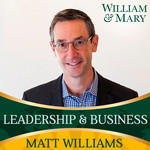 As the world evolves, leadership also evolves. There's no doubt the leader of today and tomorrow will be different from the leader of the past. Qualities and approaches that defined yesterday's high quality leaders won't work moving forward. Our guest today says a fundamental shift is occurring, and leaders must adapt. Matt Williams is a clinical professor at William & Mary's School of Business and an experienced and successful leader. He's the Managing Director of Brand Federation and the former CEO of The Martin Agency—one of the top advertising agencies in America. He says in order to succeed, leaders have to change their way of thinking; about themselves, their organizations, and their employees.