Ken White
From the College of William & Mary in Williamsburg, Virginia. This is Leadership & Business. The weekly podcast that brings you the latest and best thinking from today's business leaders from all across the world. We share the strategies, tactics, and information that can make you a more effective leader, communicator, and professional. I'm your host Ken White. Thanks for listening. In today's fast-changing competitive business environment, human resources is a critical function and profession. While human resource professionals have been working to attract, develop, and retain talent. They're also focused on several other critical areas, including managing salaries, reducing and managing costs, dealing with health care and retirement plans, utilizing technology and social media, and facing a generation of millennials who are embracing portable employment. Mike Burniston has been a human resources professional and leader for over 25 years. He's senior partner at Mercer, a global consulting leader, and talent health, retirement, and investments. He and his colleagues help organizations strategically approach and manage their workforce decisions. We sat down with Burniston recently in New York City and discussed the challenges and opportunities facing human resources professionals today. Here's our conversation with Mike Burniston, Senior Partner at Mercer.
Ken White
Mike, thanks for being here. Thanks for taking time out of your busy day to join us today here in Manhattan. Appreciate it.
Mike Burniston
Glad to be here.
Ken White
So you've been in this space a long time and especially working in the H R space. How are HR executives spending their time today?
Mike Burniston
Well, I think based on the conversations I have with our clients and, you know, HR executives would probably characterize it in three buckets. You know, first and foremost, strategies around attracting talent from sourcing all the way through, you know, exiting and everything in between the lifecycle of talent strategy. The second is actually doing that delivering on those services what it takes to actually make that happen efficiently seamlessly. You know operational excellence, whether it's using technology-enabled solutions or just unique strategies. So that's the service delivery piece, and then the third is not surprisingly driving cost either out of the organization reducing cost, eliminating costs and that, you know, that's just the reality. There's not a business function that doesn't have that accountability. So three big areas and certainly the strategic piece being the one that most HR executives would like to be spending their time.
Ken White
Right. But when you and I talked earlier, the whole the cost issue is just huge. How are professionals in the HR field dealing with that? What do they face today?
Mike Burniston
Sure, it really a lot depends on the type of organization, right? So if you're a well-established, mature large company, more likely than not, you still have you're still carrying defined benefit pension liabilities even if you froze a plan or haven't frozen a plan. So and if not managing defined benefit liabilities, you've got a health care spend based on employer-sponsored health care plans. You got a health care spend that just continues to go up even despite the Affordable Care Act. Big percentage of the total labor cost wrapped up in retirement and or health care expenses. So this gets serious attention, and certainly, finance executives are peeking into those expenses and liabilities like never before. So big topics. And then, on the other hand, if you're not a mature organization that has any of these legacy plans and you're either a relatively new company, or you've gone through a restructuring, or you tell you name it, you may not be saddled with a defined benefit pension liabilities, but you still have the health care cost issue, and you might have done some things differently than some of the older more established companies, but you still have expenses to manage and no doubt in many organizations you still have costs associated with just the talent acquisition side as well.
Ken White
Right. On health care and retirement, is there a number you know when we hear so we're going to offer so-and-so two hundred thousand dollars what amount then goes to retirement and health care? Is there a formula in the business?
Mike Burniston
No, it really is going to vary a lot on the combination of the sector. It's going to vary based on type level of position. I mean, a lot of these are all qualified plans, of course, so there's equal participation, but as a percentage, you know, look, the reality is like anything else, we want to manage our fixed costs as well as we can. Right. So what's the most fixed cost is salary. And certainly, we haven't seen salary increases much beyond two, two and a half, three percent if most in most industries. So you got that being managed pretty well. You got annual health care expenses going up, you know, anywhere between 4 and 8 percent a year. And it's been pretty steady, and we feel good about that, right? Employers say wow, guess what single-digit increases in health care. You know that's a win. Pension liabilities are, you know, really a function of interest rates and the census, you know, what is our employee population look like. And the recession has not helped pension plans now is coming out of the recession. You have the phenomenon of interest rates and fund performance working to your advantage, but there's nothing like our market crash that can change the position of a pension plan pretty quickly.
Ken White
Absolutely.
Mike Burniston
Pretty volatile expenses.
Ken White
What are HR professionals faced with in terms of attracting great talent? What are they looking at today? It seems so different with social media, of course. I mean, where are they looking to find the people?
Mike Burniston
Well, you know, I think probably the most challenging aspect of talent acquisition is really think about it from two perspectives. On the one hand, the continuing decline of STEM skill workers. Right. So finding people with critical skills, particularly in industries where science, technology, math skills, engineering skills are all really valuable to the success of the enterprise. So that's a shrinking pool. And at the same time, I've got all these things I just talked about right all these things I'm trying to pull all these levers try to maintain cost. I can't step outside of the boundaries of my peer group, particular if I'm a publicly traded company, right? I can't pay my people 50 percent more than my peer group because analysts are going to whack me for that.
Ken White
Sure.
Mike Burniston
I'm not gonna be I'm gonna be penalized for that performance. So what can I do to substantially differentiate my organization as a place to be? In a situation where the labor market is tight. Same employers going after the same people. And I'm trying to do that in an environment where a generation of workers are coming and saying. I'll try you out for a couple of years. Try me outright. I spend all this effort, and you're going to try me out. I would like you here at least three, four, five, six, seven years, and we know that from data that you know millennials are not interested in four or five, six, seven years at least not to talk about. So it's a real challenge to do all that. So the here and now is let's try to define the value proposition that gets us some advantage emphasized the things that really make us stand out. It's why so many organizations, you know, look to Google as a benchmark, right, and a CHRO of Google writes a book, and everybody reads it and says, let's try to do what Google does, although he'd be the first one to say if you just mirror my practices they might not work for you right. It's a combination of things like any recipe. So I think, you know, I think, the biggest challenge of acquiring talent is figuring out what is it that we offer. Emphasize those things and just continue to pound it into the organization. And how you do it right. So you and I, I don't know about your experience, but when I was still a student at William & Mary in the business school. I remember typing my resume and typing out individual cover letters and sending them out in the mail, and I'd get responses right from employers typed out, and you could tell which one were forms in which one we're actually thoughtful, you know, personally written. Well, imagine that in the world of social media now. So how do I, as an employer, just like a consumer brand positions itself, you know as, how do I get you to drink Pepsi versus Coke? It's the same thing. How do I get how do we attract your interest to my organization? So lots of stuff going on.
Ken White
Yeah, no question.
Mike Burniston
It makes it really challenging.
Ken White
So you acquire the talent, then it's retaining people. What are some of the strategies you're seeing with your clients? What are some of the issues?
Mike Burniston
The e-word engagement big topic, right? So it's one thing to get them in the door. It's another thing to capture their head, heart, and mind. You really really make it so that I'm getting the most out of my people and I'm giving them the experience they're looking for, and that that brings in the same customer-centric issue. So like a consumer brand, the employment brand has to play out even when people join. Now with all due respect to anyone who's listening to this in the world of technology, most organizations are not known for the technology-enabled Workforce Optimization systems and solutions. I assure you you could find somebody in almost every company that's going to complain about their IT-enabled solutions. Right.
Ken White
Right.
Mike Burniston
So that experience has to be perfect, right? Whether I from an HR perspective, I go to enroll in the annual health care enrollment process right, and I introduce online tools to do it. Well, if the system crashes or it's just a really lousy user experience, that's hard to then say I want to engage with you, right? So employees get frustrated if I can't do it on my smartphone. I'm not going to sit here in the office and do it on my desktop until, you know, 8:00 or 10:00 at night, trying to roll my health benefits right.
Ken White
Yeah.
Mike Burniston
So that whole issue is part of that engagement, not to mention just creating a culture that attracts people and keeps them.
Ken White
So developing talent is something the HR execs are certainly they want to do retain the talent, and control the costs. What would they like to be doing? I mean, these are things that they're sort of forced to do on the other side. Where would they like to be spending time?
Mike Burniston
Yeah. You know, it's interesting. I reflect on a Chief HR executive who I've known for quite some time. Big employer in the world 60,000 some employees. Clearly, a top-notch Chief Executive, chief HR executive known by reputation would say to me that even in his organization, where I'd rate their HR team as being really solid, some of the best people in the field he would say that we do a really good job in my organization. In this case, his company when our business leaders say I need 15 UX program user experience technology experts. I need 35 brand marketing people, and you know, just rattling off the specific functions and roles they need. And by tomorrow, by golly, our HR team will have the talent ready to go, you know, locked and loaded, and here they are. What we don't do really well is what he would say is we don't know five years from now what we're going to need. So somebody can articulate. I need 15 of them or 18 of those. But who's defining what them and those are? Right. So how do I anticipate from a workforce planning perspective, not only the volume, because that's kind of easy when you think about it? Right. It's tied to growth, and you know, I kind of figure out the ratios, and I know what I need from a capacity standpoint, but it's the skills, and you know, the great example that is somebody 25 30 years ago or maybe it's 40 years ago said you know if we put this magnetic strip on a piece of plastic we can execute a payment, a transaction. Well, what kind of skills do you need to figure out how do you do that? Well, in the payments and transaction space. Right. Financial transactions.
Ken White
Sure.
Mike Burniston
What is it that's going to be 15 years from now? You and I are probably not going to have a bank account. Checks will be completely wiped off. We may not be using a piece of plastic anymore. So what is it? And now, what do I need now to figure it out because it's going to take some time to figure out what those are. So that's the role that HR executives are struggling with is that if I'm really going to add value, I've got to be that business minded.
Ken White
Right. You've got to have a good crystal ball.
Mike Burniston
Like anybody else, but if you can figure out sort of the connection between organizational capability and organizational needs from a skill competency perspective, you know that's the holy grail for a chief HR executive. So may not lead the way to it, but at least punch it your own way to figure out, you know, I see where the business is going.
Ken White
Sure.
Mike Burniston
So fascinating stuff.
Ken White
You mentioned millennials, and you briefly mentioned the baby boomers getting ready to retire. What's going to happen? I mean, we've got some people who 65 is not old anymore. And then you've got millennials, as you say, a ten-year stint. No way. And that's not what you're thinking. What's your crystal ball say?
Mike Burniston
Yeah, well, you know clearly the as the population ages, the workforce ages, and interestingly you know, the great recession paused if not stalled retirements for logical reasons, right? 401K balances get depleted. You know, people see their expenses outpacing their projected income, so they work longer they put it off. Now that we're seem to be out of the Great Recession. You know I think there's a different phenomenon which is people saying you know I'm not so sure I really want to do this thing called retirement. They may want to control their time more which employers are starting to realize because with a real talent drain and, as I described it, at least with the critical skills. How am I going to replace all these people so quickly? Right. So maybe I want you to hang around a little bit. But guess what, retirees or retiree eligibles who don't really feel like they want to retire may not want to work, you know, a 40-hour week or, you know, who's kidding who 50 60-hour week.
Ken White
Sure.
Mike Burniston
And may want to do it on their own terms can be highly productive but may say I need some flexibility.
Ken White
Yeah.
Mike Burniston
So I, you know, just in the last week, I must have had three conversations with three different clients about revisiting flexible work policies. And I don't mean. You know, working from home, per se, you know that the policy is straightforward and simple enough it's what is it that we need to do differently to actually engage with a workforce that says I don't want those terms. And if you can't give me those terms, I can go down the street and go someplace else. Because by the way, my employment has become really portable. That's another issue that we deal with from an HR perspective because I can't differentiate so much right, and I've made all these defined benefit benefits become defined contribution. I've made it really easy for you to move. So I've got to come up with a way to be more flexible come up with more adaptive work arrangements.
Ken White
Yeah, it's interesting to have a millennial and a boomer in the room at the same time and talk about careers, and we see that a lot of times with our Executive Partners, who are often retired execs at the Mason School talk to our MBA students and an Executive Partner maybe 30 years at one company and the student says I can't even imagine. Do you think millennials, and I hate to generalize anything like that, but for many of them, a short tenure less than five years seems like a pretty good idea. You see that changing. How do you see that affecting work?
Mike Burniston
Well, you know, I have two daughters that have entered the workforce, you know, graduated from college have their first jobs. I've seen firsthand this interest in I want a job that, first off, I like. I want to like what I do. Second of all second, I see in both of my daughters the interest in having a job that they can define a purpose of the organization. And you know, and the third thing, and I have to say this is not a at all to suggest that they're not highly productive high performing people. They want to have fun. And if you can't have at least two of those three things, then the demerits start to add up against the employer. With a talent, you know, people in the labor market with talent that sees their opportunity as I'll go to the next best thing. Now if they can get all two or three of those things in one place, I don't know if they'll wake up in 4 or 5 years later, they're in the same place or not. So you know, I think it's sort of a generality to say what the survey data and research tell us tells us, which is they're not looking out much beyond two or three years. And as a parent, how would I advise them? I you know you talk about the executive partners. I think it's really hard for older people in the workforce to advise entering people coming into the, you know being recruited because I think the experience is very different, right? And depending on when you joined an organization and what circumstances were there were, you know, my personal story is I was influenced very much by a story by my grandfather who was injured on the job with the first employer that he had after he came to this country. And those are the days where there were no employee benefits. But the president of the company came and said you have a job for life here. And that was his benefit. And even though towards the end of his career he spent 35 years with the same company. Even at the end of his career, I can remember stories where he wasn't the happiest guy in the world. He would never think of leaving because of that loyalty that commitment. You know, you try to describe that to somebody today, and you know it's an interesting story, but it's a story, right? So interesting stuff.
Ken White
That's our conversation with Mike Burniston, Senior Partner at Mercer, and that's our podcast for this week. Leadership & Business is brought to you by the Center for Corporate Education at the College of William & Mary's Raymond A. Mason School of Business. The Center for Corporate Education can help you and your organization by designing and delivering a customized leadership development program that specifically fits your needs. If you're interested in learning more about the opportunities at the Center for Corporate Education, check out our website at wmleadership.com. That's wmleadership.com. Thanks to our guest this week, Mike Burniston, and thanks to you for joining us. I'm Ken White. Until next time have a safe, happy, and productive week.



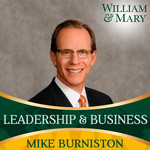 Mike Burniston is senior partner at Mercer, a global consulting leader in talent, health, retirement, and investments. He helps his clients approach and manage their workforce decisions. In this episode, we discuss the challenges facing HR today, how millennials have shifted the conversation, and more.