Ken White
From the College of William & Mary in Williamsburg, Virginia. This is Leadership & Business. The podcast brings you the latest and best thinking from today's business leaders from across the world. We share the strategies, tactics, and information that can make you a more effective leader, communicator, and professional. I'm your host Ken White. Thanks for listening. Well, the days of spending an entire career with one employer are long gone. Today professionals can expect to change their employers and career paths multiple times. According to CNN Money, millennials will change jobs four times in their first decade out of college. But with that in mind managing your career can be a real challenge. But if done correctly, you can have a great career in which you and your employer are happy. Karen Locke is the Pat and Margaret Walsh professor in leadership and ethics at William & Mary's Mason School of Business. She works with a range of professionals, from MBA students to seasoned executives, on, among other things, how to be the CEO of your career. She joins us on the podcast today. Here's our conversation with Professor Karen Locke.
Ken White
Karen, thanks for taking the time to be here today. We appreciate it.
Karen Locke
Sure thing.
Ken White
Tell us first off about what you teach the leadership class you teach in the MBA program and what that's all about.
Karen Locke
So the way I think about that class, it's not teaching about leadership. It is hopefully helping the students take some steps in their leadership journey, and students will come at it from a number of different places, obviously because they bring a range of experiences. But starting that journey out by really looking from the inside out. So thinking about what it is that they bring to the table not from their own experience of themselves but through a rigorous look at themselves so that they can understand that the way that they are going to move forward and show personal and professional leadership in the roles that they occupy is going to be different from the person sitting next to them. And that's okay. There is no single model. What they need to figure out is, personally and professionally, where are they going to be at their best. When they are at their best, what kinds of things are they doing? How can organizations find those valuable? And then how can they find and place themselves so that if they have, for example, a skill they'd love really intractable problems that have multiple stakeholders challenging them, then they're ripe for dealing with, say, complex problems in government if they want a career in consulting actually if they have that skill there probably isn't anywhere that someone wants to place them because dealing with intractable problems that are politically invested in by a range of different people is something that we're going to encounter anywhere in the organization.
Ken White
So looking inside out, someone really can't do that on their own. You do a number of assessments. And what other things do you do to help somebody determine what they can bring to the table?
Karen Locke
So we come at it a number of different ways. We do a number of assessments which give them some vocabulary a more refined vocabulary for looking at their behavior and looking at their inclinations. We also spend a lot of time emphasizing the importance of gaining feedback in the MBA experience. The students gain feedback from their MBA teams. We give them assignments where they go out and talk with people with whom they've worked before to give them their perspective, and then through the resource, we have our EPs. Our EPs will observe them and also provide their observations. One of the things though Peter Drucker, who is the touchstone really for this, was talking about this in the early 1970s, really before the notion of leadership development really took off in any large sense, was the idea of doing what our military students would call after action reviews on yourself. So if you are making a decision putting down in writing, he suggests what it is that you are thinking what your expectations are and filing that away and after whatever cycle of time it takes, he says 18 months. But he was thinking about strategic decisions. Whatever time cycle for the event that you've made the decision on his path, come back and look at it and see if it turned out positively. Is it because of the reasons that you believed were operative at the time, or did it turn out positively for something else? And so you can really test how you think about that. So Drucker says we basically feel like we know ourselves, but we really don't.
Ken White
Sure.
Karen Locke
It takes work to figure out and to confront ourselves with the consequences of our decisions. It takes work to figure out exactly what kinds of situations we're going to be best in and be able to make our greatest contribution in.
Ken White
You mentioned the MBA students dealing with the EPs. For those in our audience who don't know what that is, those are our executive partners here at William & Mary's Mason School of Business. A number of executives who help coach our students and I'm sure provide very good feedback to the students throughout these exercises, don't they? No punches are pulled there.
Karen Locke
Right.
Ken White
Yeah.
Karen Locke
And we start out by sort of giving the students we give them two phases. In the December, we talk about who shows up when you walk into the room. And the idea is not who shows up for you but who shows up for the other people. So to what extent does who you intend to be actually play out in the experiences of others? And then in, a little bit later on, we ask the students to think about what it's like to be on the receiving end of it. Just to sort of flip their point of view from now from the inside out, flipping it to what the experience of them on the outside is. So again, being rigorous about what it is that they bring to the table not from the story that they're telling themselves but from a range of outside ways of gaining data about themselves.
Ken White
Seeing what others see and experiencing what others experience, and that's on the MBA side, you do a considerable amount of work with companies and corporations all throughout the world. Is a different when you're working with them, or what do you do differently?
Karen Locke
It's not that different. I think one of the things that is increasingly obvious it's true of all of our experiences. We are all more and more busy. Our jobs have all expanded no matter what kind of role, what kind of industry what kind of occupation we're in. And I think the busier we are, the more difficult it is to pull back and really look at what is it that I am bringing to the table and how is the value that I might be able to bring going to translate in this situation versus just trying to get it done. And I think the busier we are, the more the orientation is. Just try to get to the next thing and the next thing and the next thing and not take a step back and say, okay, what am I contributing to getting it done? How might I contribute better? How might I get my people and if I know what it is that their strengths and talents are? How can I get them to take a piece of this and, in taking a piece of this, grow and develop themselves so that the whole organization is able to perform at a higher level than all of us just trying to get it done and me if I'm the manager driving to get it done unreflectively? So the personal growth story never stops.
Ken White
Now companies will come to the Mason School to the Center for Corporate Education and go through this. What if there is a professional listening, an individual? How do I find out how do I assess myself? What are some tools or some references you can share with some of our listeners that maybe a book or some programs that are out there to help assess? Where am I, and where should I be going, kind of?
Karen Locke
A program that's tremendously popular right now is strength finder.
Ken White
Right.
Karen Locke
Right, so strength finder comes from, and it's consistent with this whole sort of positive psychology notion, which we haven't talked that much about the idea that many of us have been brought up focused on a problem-finding mindset so that what we're trying to figure out is what are we not doing well and being able to perform is always looking for where are the holes where are my shortcomings and trying to plug those. Instead of the other way of thinking, which I've been alluding to, which is what are my strengths, and if I focus on those strengths, I'm going to get much more runway, so Strength Finder. It's quite reasonable it's available as a resource. The other thing I hear is an idea is to sit down with your peers and ask them to tell you. Ask them have a conversation on a recent project which is a debrief conversation. What is it that I did that was useful and don't allow them to get away with saying oh, that was fine? No, what in what you did was fine, and how did it help them? So you have your able to build the connection between actions that you take or abilities that you have and outcomes that matter to the organization. And then, similarly, what could you have done differently? What did you omit to do, or what did you perhaps not do in a way which would have helped them more? So sitting down asking for that feedback would be a second useful thing to do. And then the third thing is you can just practice that exercise that Peter Drucker talks about in managing oneself, which is to write down what are you doing, what you're deciding, why you're deciding what your expectations are from this decision is file it away and then resurrect it wherever the timeline is three months six months whichever is your business cycle for that decision and look at it and say well did I get it right. Did I get lucky? Did I mess up?
Ken White
We'll continue our discussion with Karen Locke in just a minute. Our podcast is brought to you by the Center for Corporate Education at the College of William & Mary's Raymond A. Mason School of Business. The Center for Corporate Education can help you get to the next level with its certificate in business management program. Coming up the last week of this month. It's a five-day program for the professional who lacks an MBA or wants to improve on critical business and leadership skills. Each day is devoted to a topic, including communication, leadership, strategy, managerial accounting, and organizational effectiveness. For more information on the certificate in business management program, visit our website at wmleadership.com. Now back to our conversation with Professor Karen Locke.
Ken White
Basically, when you're saying go to your colleagues and so forth, you're basically describing a 360 review. How do those go over? I'm guessing some people do want, in fact, to improve and do want feedback until it's not that great. What's your experience with 360s? I mean, you have to have a thick skin.
Karen Locke
It shows up actually the problem-oriented mindset versus the strengths mindset. Right. So a 360 instrument is going to give you information on a range of competencies, and then inside those competencies, they'll be specific behaviors like Karen is a good listener. Right. And then rate the extent to which you agree with that. Not at all, to a significant extent. And when I sit down with clients, and we go through the 360 invariably, they'll have the document in front of them, and I'll see the parts of it that are marked up of all of the places where there are negative comments.
Ken White
Right, of course.
Karen Locke
There is nothing marked up on what they did well.
Ken White
Right.
Karen Locke
So yeah, people are focused on an evaluation of a performance versus what are they learning, what can they learn about themselves, and in what they're interested in learning. We seem to be wired, and this is true from psychology, right? The negative holds our attention much more than the positive does.
Ken White
Absolutely.
Karen Locke
And so it can be a challenge getting people to understand the negative and say okay, so there is an opportunity for some learning here. But what are people saying about what you do well, and how does that translate into results for your business? And so, don't ignore the negative but understand the larger picture again who shows up when you walk into the room in whatever role that is that you occupy. None of us like to receive news that we're not perfect, amazingly.
Ken White
Of course. Fifty people can fill out a review all A pluses, but that one that you want to know who that one is right. You talk about being the CEO of your own career, but boy careers are changing so much now. People are going to have multiple jobs multiple areas as professions, as a matter of fact. How does the young person approach being the CEO of their career knowing that they won't be with the same company for 30 years?
Karen Locke
I think that first assumption. So if I start out with the assumption that I have to find a company to work for that's going to take care of me or basically house me professionally for the rest of my career. That's probably a starting place that is not available. The other mindset which is I'm going to be someone that is a bundle of skills and experiences that I can apply in a number of situations, maybe go and work for a company for a while. Maybe a part of my own organization, so I have quite a varied career path. Then the ownness is on me to be accumulating the experiences to be understanding who I am what I bring to the table, to be looking for where the matches are between what I can contribute and where new opportunities might be opening up. So I think of a model of self as a free agent where I am responsible for understanding what I bring to the table and for making sure that I'm aware of how I'm feeling about the contribution that I'm making and to reshape my career multiple times which I think is what's happening now and which is terrific so that I can have a satisfying career. Now on the other side for, organizations that presents them with enormous challenges.
Ken White
No kidding.
Karen Locke
Right, so all companies are dealing with the reality that what millennials want is a chance to grow and have a sense of purpose in what they're doing. So if they are find themselves in a situation where they don't see a path ahead, they don't see themselves growing, they don't feel that they're learning anything new, they're not going to stay.
Ken White
Right.
Karen Locke
And that's a challenge for companies today.
Ken White
Right, so knowing that are they are companies still making the investments in professional development and in teaching employees like they have in the past in your experience.
Karen Locke
Well, so here we are, seeing companies come to us and expressly talk about that and talk about it in two different ways. One is that they're providing growth opportunities and are helping meeting that need for continuous learning. The other is trying to shift their cultures for some of the companies that have been around here for a longer time, where managers understand that growing their employees is absolutely necessary for the company to survive. So if I'm a manager and I think about my subordinates as lucky to have a job, then that's going to create one kind of relationship versus I see my subordinates as an important resource to grow. And we're lucky to have them then that's going to create a very different kind of a mindset.
Ken White
And the subordinates certainly see that too. We hear all the time our MBA students I want to work for a company that cares about me and wants to help me develop.
Karen Locke
So it's finding that sweet spot between what I want what I can contribute, which is all a me story to where that overlaps with what the organization needs. The way I can contribute can make a difference for the company in both of us come out ahead is really what we're looking for.
Ken White
That's our conversation with Karen Locke. And that's our podcast for this week. Leadership & Business is brought to you by the Center for Corporate Education at the College of William & Mary's Raymond A. Mason School of Business. The Center for Corporate Education can help you, and your organization get to the next level with business and leadership development programs that specifically fit your needs. If you're interested in learning more about the opportunities at the Center for Corporate Education for you or your organization, visit our website at wmleadership.com. Well, thanks to our guest this week, Professor Karen Locke, and thanks to you for joining us. I'm Ken White. Until next time have a safe, happy, and productive week.



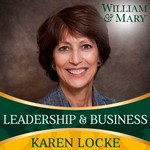 The days of spending an entire career with one employer are long gone. Today, professionals can expect to change employers and career paths multiple times. Managing your career can be a real challenge, but if done correctly can lead to a great career in which you and your employer are happy. Karen Locke is the Pat and Margaret Walsh professor in Leadership and Ethics at William & Mary's Raymond A. Mason School of Business who works with a range of professionals on, among other things, how to be the CEO of your career.