Brian Mann
What I worry about is there's going to be relegation. Some of these major conferences are going to look at those schools that they don't feel bring the same TV value same media value, and they're going to have some hard decisions to make.
Female Voice
From William & Mary in Williamsburg, Virginia. This is Leadership & Business, produced by the William & Mary School of Business and its MBA program. Offered in four formats: the full-time, the part-time, the online, and executive MBA. For more information, visit wm.edu.
Ken White
Welcome to Leadership & Business, the podcast that brings you the latest and best thinking from today's business leaders from across the world. Sharing strategies, information, and insight that help you become a more effective leader, communicator, and professional. I'm your host, Ken White. Thanks for listening. Well, some of college football's biggest and most influential teams and universities have decided to leave their longtime athletic conferences. For example, UCLA and USC, members of the Pac Twelve Conference for decades, are now a part of the Big Ten Conference. To the nonsports fan, that doesn't sound like much. However, the ripple effects of such moves are gigantic. While some universities have already joined new conferences, others continue to seek new affiliations. Why? Television and money. Brian Mann is the Director of Athletics at William & Mary. He previously served as Senior Associate Athletics Director at the University of California, Berkeley, a university at the time we recorded the podcast in search of a new conference. He joins us to talk about the business of college athletics, conference realignment, and where it all may end up. Here's our conversation with Brian Mann.
Ken White
Well, Brian, thanks very much. I know you're busy. In fact, you were just at practice. Tell us what you were doing.
Brian Mann
Yeah, it's been a fun day. Normally, as an AD, I don't get out to practice nearly as much as I would like. There's other things in the way, but we're just welcoming back all of our fall sports. And this morning, I had a chance to go out to our field hockey practice and talk to the team for two minutes and then spent about an hour out of football as well. So this is a fun time of year. There's a ton of energy. Everybody's undefeated.
Ken White
Yes.
Brian Mann
So there's all kinds of optimism, and it's a lot of fun for me to get out there and not only reconnect with the student-athletes that were away for the summer but also meet all the new ones joining our teams.
Ken White
Yeah, and all that's going on. And you've got major renovation going on at the same time.
Brian Mann
Yeah, there's an old sort of joke in college athletics if you don't have a crane on campus, you're not moving forward. And we've got that in spades right now. So we're renovating Kaplan Arena. We're expanding off the back to add the McAfee Sports Performance Center, which will be a practice court, another weight room sports medicine. We're really putting a significant effort into upgrading our facilities. And what I love about the way that we're doing it is all 500 of our student-athletes are going to feel this in a positive way. They're all going to have access to two renovated weight rooms instead of one. A brand new world-class sports medicine facility, a new academic lounge. All those things over the next year or so are going to come online as we move forward. And as an AD, that's really exciting.
Ken White
Yeah, very much. Well, you played college football not that long ago. Now you're an athletic director. And think of all the change, especially in major college football, that has happened in that relatively short period of time. But what's happening now is just amazing. Everywhere I go, people are talking about the Pac Ten is no more, and so forth. Did you ever think this was going to happen at this extent?
Brian Mann
I don't. First, if you could tell our current student-athletes I played not that long ago, I would appreciate it. They think I play with a leather helmet? No. And I think, as I was considering this before coming in today, I think one of the major tipping points was COVID, and a couple of things happened. Now, we could talk about conference alignment, which predates that, of course, but during COVID, a couple of things happened that I think have led to some seismic shifts at a speed that college athletics is not used to. You had student-athletes with a whole lot more time than they normally have, and they were able to get organized. At the time, I was at Cal in the Pac Twelve, and the Pac Twelve football players, in particular, organized in a way they sort of put like a Bill of Rights together to come to the leadership of the schools and the conference. We all remember what happened with the Big Ten when they were trying to get organized and play football, and it showed them that, hey, our voices are stronger than maybe we've realized at this point, particularly when we speak as one. The second thing that happened was they opened up the transfer portal, and it went from having to sit a year out. They call it a year in residence before you're eligible to play. They started awarding waivers to people based on being close to their family if someone was ill. COVID really opened the floodgates on that, and once it happened, they were never going to put that back in. This is not long after the Alston case was decided where we can start paying student-athletes up to $5,980 a year for education-related benefits. That was before COVID, but you take that with the organization of student-athletes alongside the transfer portal and then the name, image, and likeness effort that really propelled this forward, which means that there's more money than ever available to people involved in college athletics. And the movement around how colleges and conferences are organized was an inevitable change that was going to come as a result. So I think that though it's inside and outside of the COVID period, COVID exacerbated it and moved it forward in a major way.
Ken White
Yeah. Interesting. Very interesting. So as an AD at the FBS level, what are they looking for in a new conference? When you're thinking about a move, what makes it attractive?
Brian Mann
Well, I think there's a couple of things to consider, and it depends on what's happening in the environment. Meaning if you're in a stable conference and you've got multiple years in front of you of a media rights deal, even if you're thinking about a new conference, you can do so in a thoughtful, strategic way. I think what we've seen happen over the last couple of years is it's probably safe to assume Texas and Oklahoma took their time and were thoughtful and strategic. It's probably safe to assume that USC and UCLA did the same thing. But once that happened, everybody else started scrambling and looking for their seat at the right table. And it frankly comes down to resources. I mean, everyone wants to be associated with schools and groups that have similar missions or makeups. Are you a large public-state institution? Are you a small, rural, liberal arts, private? I mean, those are some of the extremes. There are some conferences that are built around that. It tends to be Division Two, Division Three more than anything else. But what happens is when the pace picks up, you start looking around, and you start seeing, okay, where can I get the resources I need to provide as much support as possible for our student-athletes? There's a lot that goes into how you use that support to make sure that it's actually going to benefit the right people, and it's going to move you forward competitively. But I think that's what we've seen, and frankly, I think since we started this podcast, there could be updates on what's going on right now. It's moving at light speed, lightning speed. And what I worry is that decisions are made without giving it the right thought and care, and we're going to see groupings that just don't make much sense.
Ken White
And so we talk resources. It's mostly television. The money coming from television.
Brian Mann
Yeah, that's right. And we had all assumed over the last several years that streaming was going to become a much larger deal than it has been. If you look at what Amazon, Apple, others are doing, they're being much more strategic in how they're spending those dollars. Amazon's going after Thursday Night Football in the NFL. Apple and others are looking at they're not as tied to United States sports as we might like them to be. They're looking at professional soccer. They're looking at f one. They're looking at international audiences that are going to drive subscriptions, which is what their bottom line is based upon. Whereas if you get ESPN or Fox or others that have a much more larger focus on US sports, they're going to think about how do we get content for Saturday afternoons and evenings where people are watching college football? So this idea that there was going to be an influx of capital from the streaming services hasn't worked out. The dollars that people are trying to get there are more available, but they are concentrating them more than ever. And they're not concentrating them based on traditional conference affiliations, which are based on geography, based on political affiliations. Right. Governors of state saying our two major state institutions are always going to be together. That used to happen, and there used to be political movement to force conference affiliation. Those days are just gone. And these television partners have incredible power because they have the resources that, if used well, can transform the experience of a student-athlete. And that's ultimately, hopefully, what we're all trying to do here. So they're the ones that are driving it. It's based on eyeballs and TV markets and everything else. And if you were to draw that up sort of on paper, it makes sense to go after different markets in every corner of the country. But then you look at practically what that means for your golf team because golf tends to compete on Mondays and Tuesdays because golf courses aren't giving up Saturdays and Sundays. They're now traveling on Sundays, competing on Mondays and Tuesdays, and traveling on Wednesdays because they can't get back quickly. And, oh, by the way, you're supposed to be looking at your studies and going to class. I mean, it's a really hard thing to do.
Ken White
Yeah, there's so many interesting things you just said there that the geography is one of the things that jumps out to me, how somebody at golf or lacrosse or field hockey has to go, who could potentially have to travel three time zones to play a game. Turn around, don't miss class, hurry up and get back in there. That's a heck of a lot on the student-athlete.
Brian Mann
And look, it's obvious to talk about the Power Five conferences, but that's affected us as well. We are no longer in a conference in all of our sports with Richmond, with BCU, with George Mason, right? Old Dominion, all James Madison, all these schools were geographically the rivalries. And luckily, we still play them in some sports, and there's still a lot of really cool things that happen, but it's affected us as well. And so we are now at a position where geographically, we're located sort of in the central side along the Atlantic coast, which is nice, but there's a lot of schools that aren't easy to get to. So we're still asking our student-athletes to travel long distances, whether it's on bus or plane, to be away from campus, away from school more than we would like. And that's not about television money. Right, we're not getting the Big Ten payouts. But other schools have made decisions about conference affiliation for some of those reasons, some competitive, some financial. And so it's not just those major conferences. We're all feeling it in some way.
Ken White
We'll continue our discussion with Brian Mann in just a minute. Our podcast is brought to you by the William & Mary School of Business. This year The Financial Times, Princeton Review, US News and World Report, and CEO magazine have all named the William & Mary MBA program one of the best in the US and the world. If you're thinking about pursuing an MBA, consider one that has outstanding faculty, excellent student support, and a brand that's highly respected, the William & Mary MBA. Reach out to our admissions team to learn which of our four MBA programs best fits you the full-time, the part-time, the online, and the executive. Check out the MBA program at William & Mary at wm.edu. Now back to our conversation with Brian Mann.
Ken White
What's the student-athlete look for in terms of a conference in your experience?
Brian Mann
I think there's a couple things. I mean, I think any student-athlete who's competitive at all is going to want to play sort of at the highest reasonable level, and then what we look for those student-athletes that want that division One world-class competitive experience, and they also care deeply about what happens in a classroom so they can take care of the rest of their lives. And that's what we're trying to find here. But I think they look for things like, do people care about their sport? Are they coming out and supporting it if they're going to go away from home? Is there a school closer to home that maybe will come play once or twice while I'm here so my family can be a part of it? Is it available on streaming? Can you get access to it? What have other people done who have gone to that school and played that sport before? Or what is that conference known for? The NCAA, for us, we're really lucky. It's really strong. It's far-reaching. We can go into New England or the coasts or down south to recruit student-athletes because we can say, you're going to play down at Charleston or Wilmington, or we're going to take you to Northeastern or Long Island once or twice while you're here, your family will be able to see you. So that's a lucky thing for us. But those are some of the things student-athletes work with. But the reality of it is and the challenges our coach faces, every single kid has a different set of priorities that they're trying to solve for. So it's partly why I'm not a coach. I don't know that I could do it as well. And it's partly why I'm so glad we have some of the coaches we do that have figured it out as well as they have.
Ken White
And mom and Dad could be involved too, which is another wow.
Brian Mann
Yeah. It sort of goes back. When I was in sales, I had a boss who told me the things you need to look for are pain, power, and purse. Right. So pain is, do you have what they want? The purse is obvious. Do you have the money for a scholarship, or can they afford it? But the power, like, who's really making the decision, is an ongoing thing that coaches have to figure out. Is it the student-athlete? Is it Mom? Is it Dad? Is it some combination of the two? Again, it's a never-ending thing that I'm glad we have the coaches we do because I sure would struggle.
Ken White
You mentioned the money, the revenue, especially from TV. At that level, it goes back to the student-athlete. For those who aren't terribly familiar with college athletics, what kinds of amenities, what kind of support does a big school like in a Pac Ten have to provide for a football athlete, for example?
Brian Mann
There's the things you have to provide, the things you want to provide, the things you aspire to provide. So some of the things that the NCAA requires are sports medicine, right? Athletic trainers, doctors, medical care. In that way, everyone's going to have strength and conditioning coaches. That's sort of moving into more of an athletic performance-based space. So it's not just lifting weights and running, but you're thinking about all kinds of ways to get your body prepared. More and more now, there's mental health. That's an incredibly important part, and that's a higher-ed topic of conversation in addition to athletics because we're also thinking not just about their mental health but their mental performance, which can really be a way to move the needle on the field or the track, the pool, whatever it may. There's nutrition, and some of the bigger schools have full cafeterias and full-time staff that are providing that to them. So one of the things you're hearing some of the schools in the West Coast talk about now is how do they enhance the nutrition that we're providing for our student-athletes. There's equipment. There's a lot of those things. For us, things like academic support matter a lot. And what that means to us is that we have a staff that's helping our student-athletes think about what is it you want to study. How do you get those classes scheduled at the right time? Because there are certain classes, you simply shouldn't take in season. It's a bad idea. Some of us learned that the hard way, which I did as an undergrad, and also help them think about their long-term plans of, hey, is graduate school right? Is the Mason School of Business going to be in your future? If so, here's how we got to make sure you're set up to get there as a junior or as a graduate student down the road. And all that, and I still haven't talked anything about a coach and X's and O's getting you ready for a field, what happens on the field. So it's a lot. It's growing. The NCAA is studying this, and they're looking at long-term care for injuries sustained as a student-athlete. They're looking at further mental health support, and they're going to start mandating greater support services and staff around our student-athletes, which is right.
Ken White
And it all takes money.
Brian Mann
And it all takes money.
Ken White
Yeah. You mentioned rivalries. Some of these have been around for decades and decades, and those games will quite possibly disappear. What does an athletic director and a university president what do they think about that as they're going through some of the negotiations and saying, maybe we're going to leave a conference, and no, we're not going to play Team XYZ anymore?
Brian Mann
Yeah, I hope that's a big part of it. I mean, that's part of what being at a particular institution is about, are the historic rivalries and the competitions that you have with places that people know, they're familiar with, they care about. I think about us and the University of Richmond, for example. We're only affiliated them directly with football. They're NCAA football, but we try to play them in anything that we can. We're in the middle of a four-year series in men's basketball. Women's basketball isn't playing this year, but we're going to try to get them back because that just means something to our fans and our alumni, and so they'll try to do that. The challenge when you get to the top levels are if you're not affiliated in the same conference, your out-of-conference schedule becomes an incredibly important piece of the puzzle. Either you're trying to play at a really high level to make sure that you're going to get the best postseason opportunities, the highest seed, whatever it may be, or you're about to go through a gauntlet in conference, and you want to make sure that what you're doing at a conference is maybe something where it's a more reasonable thing to think hey, I'm going to win this game. Right? And so if you look at some of those schools, I mean, the big ones right now are schools like Washington, Washington State, Oregon, Oregon State. And all those ADs have come out in some way or another and said, hey, we're going to try to keep this here. But the realities are going to start to set in at some point. It's going to be hard to do because you only have a couple of weeks of the year where your schedules overlap. Everything else is taken care of by the conference. So you have to prioritize that at a level where you're kind of rising above the traditional way you would look at a nonconference schedule, and that changes too because if you've got a brand new coach who's rebuilding, you're going to think about your nonconference one way, and if you've got aspirations of a national championship, you're going to think about it a different way. And good luck with football, because we schedule so far in advance, it's really hard to do that. But for basketball and other sports, it's much more of an annual reevaluation of those schedules. So even if you can keep it in football, it becomes harder and harder in some of those other sports.
Ken White
So, pulling out your crystal ball, where do you see major college football in terms of conferences going?
Brian Mann
Besides William & Mary and the Big Ten? Is that what?
Ken White
Let's do it. Let's do it. It's a lot of travel, though.
Brian Mann
Yeah. I don't know, and I don't think that anybody does. I could tell you without any hesitation that it's not done. And I mean both in the immediate future where's the four schools in the Pac Twelve trying to figure out what's going to happen with them, but these television contracts, a lot of people now, a lot of conferences are signing shorter-term deals, right? I think the Big Ten signed a seven-year deal. I think the SEC did something similar. The ACC has a much longer deal that goes through 2036. And that's partly why you're hearing some of these difficult conversations with schools that feel as though they're going to start to fall behind in a way that can never a gap that can never be closed. What I worry about happening is after this next round, continuing to expand is almost not possible because everybody's going to be affiliated with a major conference, and that will continue to happen. But what I worry about is there's going to be relegation. Some of these major conferences are going to look at those schools that they don't feel bring the same TV value, same media value, and they're going to have some hard decisions to make because you're spreading that pot equally in almost every instance, not every. And they're talking about doing it differently. But I worry that, at some point, the only way these conferences are going to continue to grow is something like that. And that's disheartening. What I could also see happening is FBS football, particularly as the top level of it, breaking away and forming their own affiliation in some way, the top 30 to 60 in some way, shape, or form. A lot of people are talking about the independent model, right? Notre Dame has it all. Their sports are affiliated with the ACC. They play their own football schedule. Cal and Stanford, I think, are kicking that around. I don't have any insider information. It's what I read. And that could be a path. But it has to be a path where there's a large enough number of schools doing it right. Because if you're an independent by yourself, ask BYU. UMass, I mean, it's a really hard road, and you end up traveling all over the country to the schools that will pay you the most money because you got to make your budget, and Notre Dame obviously has a different setup than that, but I could see that being a path that comes down the road as well.
Ken White
Either way, some interesting times ahead.
Brian Mann
Yeah. Hold on, right? And for those of us that are in the business, you know, I'm not even sure what to compare it to, but the minute we take our eye off it, we're behind. And look, all of this is coupled with NIL and the transfer portal, which continue to change college athletics, most of it for the better. I know that we need to have some more uniform approaches and insights into what's happening. I mean, we're participating in NIL in every way that we can. There's going to be more opportunities as collectives and other things continue to grow, particularly in our world. So get ready to take a deep breath when conference affiliation settles down, but then gear right back up for what's next, which is NIL and the transfer portal and collective bargaining and student-athlete rights and employee status. I mean, it's all right behind it, and it's not going to wait very long.
Ken White
That's our conversation with Brian Mann, and that's it for this episode of Leadership & Business. Our podcast is brought to you by the William & Mary School of Business, home of the MBA program, offered in four formats the full-time, the part-time, the online, and the executive MBA. Check out the William & Mary MBA program at wm.edu. Thanks to our guest, Brian Mann, and thanks to you for joining us. I'm Ken White, wishing you a safe, happy, and productive week ahead.
Female Voice
We'd like to hear from you regarding the podcast. We invite you to share your ideas, questions, and thoughts with us by emailing us at podcast@wm.edu. Thanks for listening to Leadership & Business.



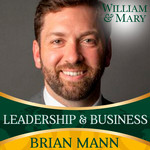 Some of college football's biggest and most influential teams and universities have decided to leave their longtime athletic conferences. For example, UCLA and USC - members of the PAC-12 Conference for decades are now a part of the BIG 10 Conference. To the non-sports fan, that doesn't sound like much. However, the ripple effects of such moves are gigantic. While some universities have already joined new conferences, others continue to seek new affiliations. Why? Television and money. Brian Mann is the Director of Athletics at William & Mary; he previously served as Senior Associate Athletics Director at the University of California Berkeley, a university at the time we recorded the podcast in search a new conference. He joins us to talk about the business of college athletics, conference realignment, and where it all may end up.