Ken White
From the College of William & Mary in Williamsburg, Virginia. This is Leadership & Business. The weekly podcast that brings you the latest and best thinking from today's business leaders from across the world. We share the strategies, tactics, and information that can make you a more effective leader, communicator, and professional. I'm your host Ken White. Thanks for listening. Well, many organizations invest considerable amounts of time, energy, and money generating their strategic plans. Yet those plans don't always prove to be successful in today's constantly changing business environment. Organizations must have the right strategy in order to succeed. Well, one organization that has embraced strategy development is Arcadis, a leading international consultancy design, engineering, and management services company. Arcadis employs 28,000 people in 40 countries. Julien Cayet is global leader business advisory at Arcadis. He has spent much of his career in strategy along with organization, performance improvement, and change leadership. He joins us on the podcast today to discuss strategy, its dynamic nature, and how it intersects with structure and culture. Here's our conversation with Julien Cayet of Arcadis.
Ken White
Julien, thank you for taking the time to join us today. You've spoken to a number of classes today, and we're not giving you a break at all. Now we're asking you to sit down in front of a microphone. Thank you for taking the time.
Julien Cayet
No problem. Thanks for having me.
Ken White
You've spent a considerable amount of time in the strategy space, and that's what you talked to our students about today. What is the role of a chief strategic officer in a company today?
Julien Cayet
As you know, there are many ways of defining what the roles should be, but the word that comes to mind is alignment. As someone who needs to align the various bits of your business around one shared vision one shared set of priorities. And the second word that would come to mind is engagement to make sure that people not only receive that strategy. That strategy doesn't land on their laps. They can really own the strategy and continue to drive the standard strategy not as a static object but as a real living animal.
Ken White
So the engagement is very people-oriented. Is the alignment more business unit related, or is that product or people when you say align?
Julien Cayet
No, the alignment, you get to align time horizons first with some issues or slow-moving issues or slow-moving opportunities, and you start to pave the way to capture those opportunities that are you know down the road. You've got medium-term issues and short-term issues, and especially in the case of listed companies like my company Arcadis you better consider long, short, and medium-term. So that's one level of alignment and alignment across the portfolio and industry by industry. But in our case, we've got very many different blends and breed of engineering, and they have different challenges, different opportunities, different competitors even, different degree of market maturity. So when you need to align, not as in one size fits all but as in you find something that brings all the parts together to make more than the sum of the parts.
Ken White
For a position such as someone who does strategic planning or leads the strategy for an organization. What type of person and what kind of qualifications and background would someone have?
Julien Cayet
It depends on what a company needs because there are different ways to fill the role. In my case, it was a new job creation new position within the company, so there was a bit of a need for someone that could create institution, create function. As if you would want to create a finance function or the HR function from scratch. So you need someone that has a bit of an entrepreneurial, a bit of a resourceful type of mindset to get things done starting from nothing without any blueprint or without anything to build on. It depends also on where the company is. You've got Chief Strategy Officers that are innovators because the company needs to drive fast innovation, so that there is a role for a Chief Strategy Officer to be an innovator. You get companies that are driving value by having a very disciplined capital allocation. So you need a chief strategy officer that will be very rigorous in the way he or she chooses to allocate capital and drive priorities from there. And in my case, there was a bit of all of the above. And is this challenge of reinventing the priority model reinventing the business model, and the sources grows of the company, so it's very a reinvention part of the strategy role?
Ken White
Interesting.
Julien Cayet
You can add them up. I mean, it's not mutually exclusive.
Ken White
You drew on the board for the students this morning three circles that intersected, and one was strategy. The second circle was operation slash organization, and the third was people and culture. Can you explain how those intersect and why those three are important?
Julien Cayet
Three, yeah, so strategy, structure, and culture. Well, I was relating to my own experience, as you recall. I came to become chief strategy officer, having been a strategy consultant for many, many years. So I had an inflated perception of the role of strategy in the success of the company. My strategy bubble was really big in my structure, and then culture bubble, especially the culture one where very, very small.
Ken White
Interesting.
Julien Cayet
Now having the benefit of a few years of experience and a bit of gray hair, I appreciate that it's all about balance. You need a clear direction of travel grounded in facts. Facts about market, competitors, technologies, and everything. And I'm not discounting the value of having a clear direction of travel. Then you need to ensure that your structure supports your direction of travel. So the structures should support the strategy. As mentioned this morning, you would be surprised how many companies have a disconnect between the strategic intent and the structure. Sounds like obvious, but it's a typical pitfall. And then the last one, and probably the most important one, I think it is Jim Collins in his book Good to Great who says that much better than him, I am going to say it. If you get the right people on the bus, you will go places.
Ken White
Right.
Julien Cayet
That's such a simple tagline, but if get the right culture to strategy might be okay. The structure never is never going to be perfect. If you get the right culture, you can go a long way and that's third bubble I recognized was a blind spot of mine, and I think it's a blind spot many top executives.
Ken White
Yeah, because if the people aren't on board, it's just not going to go anywhere.
Julien Cayet
Yeah, or yeah, people on board, and you know it's more than on board. They need to be ready. They need to understand the direction of travel. They need to be willing to take the direction that has been set, and they need to be able to take direction of travel. And if you don't check all three boxes, something's going to stick along the road, and you will need maybe different people, or you will need to maybe a bit of a wakeup call with your existing people.
Ken White
We'll continue our discussion with Julien Cayet in just a minute. Our podcast is brought to you by the Center for Corporate Education at the College of William & Mary's Raymond A. Mason School of Business. The Center for Corporate Education can help you get to the next level with its certificate in business management program coming up in late October. It's a five-day program for the professional who lacks an MBA or wants to improve on critical business and leadership skills. Each day is devoted to one topic, including communication, leadership, strategy, managerial accounting, and organizational effectiveness. For more information on the certificate in business management program, visit our website at wmleadership.com. Now back to our conversation with Julien Cayet on strategy.
Ken White
I can't think of too many organizations and businesses that don't have a strategic plan and spend considerable time talking about strategy in the future but yet still so many fail. What is it that you've seen? What is it that causes that after all that effort and time?
Julien Cayet
Well I mean it can be external and internal factors. Sometimes the assumption that you took at some point in time either change or prove to be wrong. So it can be in section on the track to the market. The assumption on the role of a new technology, an assumption on what competitors would do in reaction to your move in the marketplace. So you might find that your assumptions might be wrong, and then your strategy doesn't work because you took the wrong assumptions. Like, try again.
Ken White
Right.
Julien Cayet
But I think it's probably. I would suspect I don't have any stats on that.
Ken White
Right.
Julien Cayet
I would suspect that the issue comes from a different place in relation with the point which was discussed about strategy, structure, and culture. I think that the challenges come from having structured and all misaligned with a strategy and a culture that doesn't support the structure and strategy of the company. So that's I think that's where I see most of the implementation challenges. Having the wrong strategy that happens sometimes, but it's more the exception than the rule. It's not that difficult to the right strategy. It's very difficult to get it done.
Ken White
The people and the culture with today's organizations pretty much everyone's global. But so many companies have many cultures within their own culture. What are some of the lessons you've learned? Because you certainly have global experience in terms of strategy and so many cultures within an organization.
Julien Cayet
Yeah, it's very difficult. It changes very very slowly. I remember the former chief executive of Arcadis. He told me yeah I make a decision and then the ship doesn't move for months or years. It's like a supertanker. The culture is very much a supertanker-type challenge but the good news and it has been one of my insights to the past few years that there are interventions that can accelerate the cultural transformation and they are expensive and rare interventions, but they can be extremely effective. In Arcadis's experience, exactly a year ago, day to day today, 24 September, we rebranded the company globally. So which sounds like a bit of a cosmetic intervention, new logo, new colors, different tag lines. But the impact on clients, the impact on the staff, the impact on the culture eventually, and the way we project ourselves to the market has been a lot deeper and a lot faster than it was expecting. Of course, you can not rebrand every year.
Ken White
Right.
Julien Cayet
It's expensive, very confusing as well, but if you have this opportunity if the time is right. That's a very, very effective cultural intervention. And then the other one, which is maybe less effective but quite remarkable as well, is to rotate your top leadership. Every organization has a support role. You know, country role, product role, client-facing roles. And the more you rotate your leaders, the more you create like a collective understanding of the common good within the company.
Ken White
Right.
Julien Cayet
And more a deeper appreciation of what it takes to play the other role. But at the end of the day, we need to work together as a team.
Ken White
And it makes so much sense, and Arcadis really believes in that. Right. Moving people in various roles.
Julien Cayet
I think a lot of companies do that. It needs to be organized. It needs to it does involve some risk-taking as well. Sometimes you will move someone that does very well on the culture side to a market-facing role which might not be her or his cup of tea. But it is the right thing to grow a leader. Grow a real global leader that will take the company perspective, not only one slice of the company.
Ken White
Speaking of leaders, you mentioned the word leader or leadership a number of times when you were discussing strategy with the students today. What is the role of the leader in the strategy? I think there's many. How does a good leader embrace it?
Julien Cayet
I think there are common features of good leaders, but also a good leader for you get specific attributes that you need in specific situations as well. So I think a good leader has to be a good communicator. That goes without saying.
Ken White
Sure.
Julien Cayet
Being able to say a lot with words. Good leaders is to be able to engage someone that can truly engage with people. Can truly look at who you're speaking to in the eyes, really listen deeply inside the words. Real engagement. It is someone that is able to set a clear direction of travel, and the leader say where we go. That's the job. And finally, someone that can really hold his team and his company accountable for performance. Can make the tough calls when performance is not where it should be. Not shy of addressing issues. He's not, or she's not mincing his or her words.
Ken White
Right. You shared a look at long-term strategy earlier this morning. Some companies might go three years out. Arcadis doesn't believe that it believes on going way out, but your model was somewhat flipped and that you look at long term first and then work your way back. Can you tell us about that?
Julien Cayet
Well, Arcadis doesn't really go way out because a ten-year time horizon, I would say middle of the road. Time horizon a resource company would look 20 to 30 years down the road. So it's like really extreme, and consumer companies in a fast-moving consumer environment they would likely look at two to three years down the road less potential, and it's even shrinking. So Arcadis is somewhere in between these two extremes. And yeah, we look at long-term and medium-term, and first thing you're referring to is the approach of the strategy planning process two three years ago. I think it's fairly logical. It was fairly logical three years ago. Keeping in mind that we had to take a huge step back in terms of what the new wave of value creation would be for a company. So there was a need to take that step back first to redefine a bit what would be the new rules of the game. The new keys of success for the company and having redefined this framework discovered framework we could do the usual gig of finding the source of growth and then implementing those rules by allocating resources in a logical way.
Ken White
Can the strategic planning leader go too far? Is there a line they cross, and then they become a micro-manager? Have you ever experienced that?
Julien Cayet
It's a planted question. Yes, I do because, as a company, we went from not having any position of strategy officers to having an official position of Strategy Officer, which had been the first one to fulfill. To may be dictated by market condition, disappointing performance, a position where there was too many hands-on intervention of the strategy function. To a point that you would basically that would become detrimental in terms of people engagement, leadership engagement, and just leaving enough room to maneuver to the business lines all the operating units of the company. So it's always a fine balance because sometimes micromanagement is required by performance. And you have to accept you, step in and roll up your sleeves and join the fight. But it should remain the exception.
Ken White
Last question for advice for an organization getting ready to head into a new phase of strategic planning. What advice would you give them to help them succeed?
Julien Cayet
You never spend enough time thinking of the why. Why do we need to review, and what are the what? And then, beyond the why, what are the key issues? What are the right questions and you always have the usual set of questions that you can find in the textbooks, but every company is very or should have very specific question? And sometimes, the list is very long, but there are one or two questions that are I value questions. It takes time to learn those I value questions. And once you have the, I value question on the table. I would say half of the work is done because you know what problems need to be solved.
Ken White
That's our conversation with Julien Cayet. And that's our podcast for this week. Leadership & Business is brought to you by the Center for Corporate Education at the College of William & Mary's Raymond A. Mason School of Business. The Center for Corporate Education can help you, and your organization get to the next level with business and leadership development programs that specifically fit your needs. If you are interested in learning more about the opportunities at the Center for Corporate Education for you or your organization, visit our website at wmleadership.com. Thanks to our guest this week, Julien Cayet, and thanks to you for joining us. I'm Ken White. Until next time have a safe, happy, and productive week.



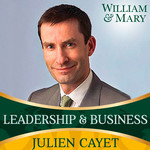 Many organizations invest time generating their strategic plans but those plans often don't prove to be successful. Arcadis is a leading international consultancy company in design, management, engineering, and other services. Julien Cayet is Global Leader, Business Advisory at Arcadis. He joins us to talk about strategy, the dynamic nature of strategy, and how it intersects with structure and culture.