Ken White
From the College of William & Mary in Williamsburg, Virginia. This is Leadership & Business. The weekly podcast that brings you the latest and best thinking from today's business leaders from all across the world. We share the strategies, tactics, and information that can make you a more effective leader, communicator, and professional. I'm your host Ken White. Thanks for listening. Well, for many professionals, the new year means a new job search, whether it's a move to another organization or to another industry. This month countless professionals are gearing up for a new career challenge before making the jump though it's important to have a strategy, and our guest today can help with that. For the past ten years, Phil Heavilin has served as a career coach after working with professionals in the legal sector. He now spends his time with professionals seeking careers in business. He's the Director of Career Advising and Education at the Center for Career Management at the College of William & Mary's Raymond A. Mason School of Business. He joins us with advice and guidance on launching a job search in the New Year. Here's our conversation with Phil Heavilin.
Ken White
Well, Phil, first of all, Happy New Year, and thank you for joining us. Looking forward to the discussion today.
Phil Heavilin
Happy New Year, Ken.
Ken White
So this is a time for many people when they think, you know, I need to think about my job, my work, my occupation. What do you hear at this time of the year? What happens in your line of work?
Phil Heavilin
This is a natural time for us to all be thinking in a reflective manner. It's the end of the year. We have a lot of time behind us. 2015 is just coming to a close. We're coming up on 2016 for many industries, maybe not for finance, but many industries, there might be a downtime for us to really have that moment to consider. Where am I, and where do I want to go? And so this is really a great opportunity for any professional to take stock and really consider what it is that I want to do moving forward. Do I like what I'm doing? Do I enjoy the work I'm involved in? Do I feel fulfilled? And if not, what considerations should I make before I make that next transition?
Ken White
Yeah. So what, where do you even begin? I'm not happy. I think I think I want to try something new. So where do I start?
Phil Heavilin
That's a perfect question. And the place you start is right here, and I'm pointing to myself. It really starts with yourself and considering do some self-reflection and really take stock in what is triggering these emotions. What is it that is making me feel like I need to make that transition? Maybe I'm no longer fulfilled in the work that I'm involved in. Maybe I hit a ceiling in terms of that work. Maybe I've done all I can. Maybe the company culture or the organizational culture isn't exactly in line with my own values any longer. Maybe it's a salary question. Maybe I'm prepared to take that next step and want to take a leadership position and earn that extra salary for my family. And it's family considerations as well. Maybe I started my career as a single individual, and now I have a family. What do I need to do moving forward to secure a position that is much more accommodating to my family life?
Ken White
So if I've asked those questions and then I have determined I want to step up, I want a leadership role, for example, or I think I want to change industries, then where once you've done that that as you say self-reflection where do you go from there.
Phil Heavilin
It's really important for people to be thoughtful about that next move. Oftentimes people will jump into, you know, maybe a program or a job and really didn't think about really think about what it is that they wanted to do, and that can backfire if you're in a position that you're unhappy about and you're just surfing the web looking for any kind of job posting that is going to help you get out of the position that can be detrimental. Think about what you want to get into rather than what you want to get out of. And that's a mindset that's really important to have because what you might do is you might actually make a lateral move doing something similar in a different company. Sure, it's a change. It's a different job, but you might realize, hey, I don't really like this either. And so the one factor that you didn't like about your current situation might have followed to the next job, and you want to avoid that because, by golly, you're gonna be in the same situation you were in before. So I really recommend once you identify an option is really to find a professional, find those individuals who are working in that area, working in that company, and really reach out to them and have a frank conversation, you know, take them out for coffee, take them out for lunch, and find out exactly what is it that they do you know give me some feedback give me some advice. This is where I think I'm kind of lacking in my current position. This is my thought going forward. This is why I'm reaching out to you. Am I on the right track? Am I off base? Can I get some feedback from you and that can be very helpful.
Ken White
And I'm thinking 99 percent of the professionals out there are more than happy to do that.
Phil Heavilin
Absolutely and that's why when I'm working with individuals, really tap into your, you know, your alma maters alumni network. Many of colleges and universities do offer career services for their alumni, whether it's through the career management center or through the alumni department. I would certainly reach out to those individuals because I think that's when you're starting to reach out to people you want to start with those individuals you have something in common with because that's going to be immediately build trust between you and that person who you don't know. So when you reach out to that individual, you can indicate that you maybe are also a graduate of that school or maybe you went to the same high school or anything you can find in common to break the ice. That individual on the other end is going to be much more receptive to having a sit down with you or a conversation, and that's one way to kind of make that meeting happen.
Ken White
So you do that. Self-reflection, you realize the whys, and I think that's great. What do I want to get into? Not what I want to get out of, and all the things are falling into place. And you've met with some professionals. This sounds like a pretty good move.
Phil Heavilin
Yeah.
Ken White
I would think most people immediately then think resume.
Phil Heavilin
Exactly.
Ken White
Oh boy, what do I do? It's been years since I've done one. I don't even remember half of the dates and so on. So what's the next step with the resume?
Phil Heavilin
Yeah. So you've done your due diligence right and you've gone and you've met with people in the functional role or industry that you're interested in. You think you have a specific job you want to target. Now it's really about how can I change my resume, my LinkedIn profile, my cover letter. It's really start developing that marketing plan where you're going to now do some outreach and really be more strategic where now it was information gathering. Now it's I'm actually targeted, and I'm going to focus on a particular position. The resume is still critically important. You know, I'm still waiting for the day recruiters will just say just send me a link to your LinkedIn profile. Hasn't happened yet, but I think someday it will.
Ken White
Right.
Phil Heavilin
You know most professionals especially if you get into a role for several years they haven't touched their resume in that amount of time.
Ken White
Sure.
Phil Heavilin
And a lot, especially nowadays, a lot of things change year to year, even from quarter to quarter, about what companies want to see on the resume. Technologies are coming on a regular basis. And so if you have experience using different software packages, you want to update that resume as soon as possible, so it's really important that professionals take stock, look at their resume content, and then make sure that it's up to date and again career services offices can assist you with that. So definitely reach out to those professionals. And once you have something that you feel good about and Google is great, you know there's definitely some online tools that students can use or alumni, or professionals can use to find out what's appropriate for a resume now. Make those changes and then go back to those individuals who you were networking before and just get their feedback. Give it to them, see what they think, and adjust it accordingly. But yeah, this is really the time. Even if you're not actively seeking a position at this point in your career, please go back to your resume. You won't regret it. Go back to it include the accomplishments that you've you've experienced over this past year. Make sure it's included in the resume, even if it's a quick documentation. You don't have the wordsmith it right now, but just put it in there make a what I call an inventory resume, just jotting down everything so that if you find yourself in a position where you are laid off, or maybe you are in a position was presented to you then you can react quickly and swiftly, and all you have to do is make some edits and some small changes and send it out.
Ken White
You mentioned LinkedIn because we've gone through the steps now the resume looks sharp. I've shared it with a couple of professionals who say, you know, go for it. Most likely, before I start applying, I should probably look at my LinkedIn profile is that correct before I start applying.
Phil Heavilin
Yes absolutely. The LinkedIn profile is absolutely essential for the job search but even not so much a job search. But just as part of your professional profile.
Ken White
Sure.
Phil Heavilin
You know many of the individuals who have LinkedIn profiles known as passively they're passive candidates. So these are individuals who have an interest in networking with other professionals in their field because, who knows, maybe something comes down the line that might they might be interested in. They are contacted via LinkedIn. So it's really important to have a strong LinkedIn profile. What I love about the relationship between resumes and LinkedIn is there's things on LinkedIn you can't do on a resume and vice versa. I love the fact that in the United States that it's taboo to have a photograph on your resume.
Ken White
Right.
Phil Heavilin
But of course, at the top of your resume, hopefully, you have a link to your LinkedIn profile, and you know, tell me what's essential in your LinkedIn profile. Well, it's a photo. And so there's things you can do on the resume that you can't do it in the LinkedIn profile, vice versa. So they're absolutely complements of each other, so once you get that resume ready to go and reviewed. The next step is then to go to your LinkedIn profile make sure that you are speaking to each other make sure they're sending the right message. If you have that job that you're pursuing, you've got the keywords, you've got the skills that they're looking for, what they want. You've gone back to your documentation, you're making sure that you have those keywords, you have the experiences that are relevant to what they're looking for, and they're highlighted prominently in those both of those two resources.
Ken White
Cover letter. How important are the are those today?
Phil Heavilin
Cover letters are an interesting thing. Many people ask for them, but everybody I speak to says I don't really read them, Phil. But I think with the cover letters, if they asked for them, you want to obviously provide them with one you don't want to be discounted because you didn't submit one. So if you're going to do it you really should do it well. And what I like about cover letters is I like to include the same header on my resume as I do on my cover letter, so there is this consistent branding between the two documents. I really like to take from the job descriptions. What skills what experiences they're asking for? And then I'll use that same language and I'll put that in the cover letter. But more importantly, I think it's candidates really need to pull out very specific examples that they have from their past experience that really illustrate those particular skill sets because that's what's really what recruiters are looking for is tell me how you're different, Ken, tell me how you're different Phil and those experiences. That's what makes us individuals, and that's what's going to help us stand out from others.
Ken White
The results so don't just say I managed this unit at this company from this date to this date. What did you do while you were there, right? So very results-driven resume.
Phil Heavilin
Absolutely. You know, the results is probably the single most thing that is missing from a resume or a cover letter. You know, on a resume, you start with that action verb. You tell me what you did. And so many people forgot to tell me, okay, so what. I always ask people so what was the significance. What was the impact on the company? Did it drive their sales? Did it streamline their process, and if so, what percentage and it might not have even been an impact in the company? It might have been the work had an impact on your own development. So if you gave presentations you can say how that you know developed your own public speaking skills and different. GMAC has a survey where they have about 20 or so different criteria that their recruiters are looking for from candidates in oral communication skills is at number two. And so that's an important piece to put on your resume. But those results are always missing. So when I'm working with individuals, I'm always asking that question, so what as a prompt to tell me what the results were of that particular accomplishment?
Ken White
Yeah. And you mentioned GMAC, which is the Graduate Management Admissions Council which is a business school kind of organization, but it has a website that has a ton of career focus. They're phenomenal researchers and as you said they constantly question research or employers and employers say these are the skills we're looking for. I'm sure this is probably a question you get because I get it, and I am by no means a career coach like you, and that is. What about gaps in my resume? I was either unemployed for two years, or I went home to stay with the children for a few years. What do you do with those?
Phil Heavilin
You always want anticipate what questions people might have when they look at your resume. And if you do have a gap that's going to raise a flag for the individual who's reviewing, they're naturally going to ask what did you do in that timeframe. And you need to have a response for that. You can't just say well. I binge-watched on Netflix. We can't do that.
Ken White
Right.
Phil Heavilin
So, for example, if you're an individual who perhaps you were out of the workforce for several years raising a family and you want to come back into the workforce. There's tremendous value in that experience that absolutely in that experience section of your resume I work with individuals on we're gonna, we're gonna put that as a position. It might have been a volunteer, but it's probably one of those toughest volunteer positions you're ever going to have. So raising a family, running a household, time management, event planning, coordination, budgeting there's a lot of skills that you can articulate with in a discussion with a recruiter, and they love that you know they just want to hear from you. Just explain to me what you did in that period of time that was that can bring. That was that helped you develop skills that are now valuable and transferable to what we're doing in our business. If you can articulate that, recruiters will love that and appreciate it.
Ken White
Yeah. Even if an individual or a professional is employed, a job search is a taxing exercise, isn't it? It's hard to stay up, it's hard to stay focused, and positive and you do a lot with MBA students. That's they're really focused on that big opportunity, and I know you're an emotional coach as well as a career coach.
Phil Heavilin
Yeah, that's right.
Ken White
How can people stay up? What are some of the what's the mindset they need to be in?
Phil Heavilin
Yeah. Yeah, you're right. The job search can be a taxing process. So we coach them on some of the tactical strategies to get noticed and be successful, but also it's managing the emotions, it's getting geared up and getting excited about the job search and and and it can you know other than the consternation of being unemployed. It can be fun to go out and meet individuals and get that information and learn from professionals in the field. I really encourage people to enjoy that process because I really love meeting people and I learn so much from having conversations with other professionals and there's a lot of value in that. So I really encourage individuals to really get jazzed about going out and meeting with people because there's so much value there. Really have is a strong support network around you. For example, going back to the you know someone who might be coming back into the job market, let your family know and make sure that they understand this is where I am now. I'm ready to, you know, maybe the kids are in school. I'm ready to re-enter the job market and let everybody know so that you now have that support system behind you. They're cheering for you. They're looking out for you. They're giving you leads. And what I think when I work with individuals when they're at the most depressing point of the job search it's when they feel like they've hit a brick wall. It's when they feel like, okay, I'm not getting calls back. I'm not getting any kind of responses from my resume and so that during those times is when we reconvene and we really think about other strategies we can use. Maybe there's other alumni maybe other contacts we can reach out to that you haven't tried before. Maybe these other companies or other opportunities maybe didn't consider, and that can oftentimes open additional doors that can snowball very quickly into opportunities coming their way.
Ken White
Yeah. And not only that, then you've got to deal with rejection because you're certainly not going to get every job you apply for.
Phil Heavilin
That's right. It's a sales position. So you have to get used to hearing no.
Ken White
Yeah.
Phil Heavilin
But if you keep pressing forward, if you have the grit. It always works out.
Ken White
That's our conversation with career coach Phil Heavilin, and that's our podcast for this week. Leadership & Business is brought to you by the Center for Corporate Education at William & Mary's Raymond A. Mason School of Business. The Center for Corporate Education can help you and your organization by designing and delivering a customized leadership program that specifically fits your needs. If you're interested in learning more about the opportunities at the Center for Corporate Education, check out our website at wmleadership.com. That's wmleadership.com. Thanks to our guest this week, Phil Heavilin, and thanks to you for joining us. I'm Ken White wishing you a Happy New Year.



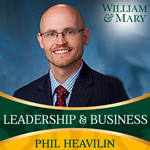 For many people, the New Year brings the start of a new job search or new career challenge. Phil Heavilin has served as a career coach for the past 10 years, and can help you create a strategy for seeking a career in business. Phil is the Director of Career Advising & Education at the Center for Career Management at William & Mary's Raymond A. Mason School of Business.