Female Speaker
From William & Mary in Williamsburg, Virginia. This is Leadership & Business, produced by the William & Mary School of Business and its MBA program. Offered in four formats: the full-time, the part-time, the online, and executive MBA. For more information, visit wm.edu.
Ken White
Welcome to Leadership & Business, the podcast that brings you the latest and best thinking from today's business leaders from across the world, sharing strategies, information, and insight to help you become a more effective leader, communicator, and professional. I'm your host, Ken White. Thanks for listening. To say Dan Akerson has had an exciting career is an understatement. He's held leadership positions such as CEO, Chairman, President, and Managing Director of top organizations, including MCI, General Instrument, Nextel, the Carlisle Group, and General Motors. He's been successful at each stop. He continues to be active, serving on the boards at American Express and Lockheed Martin. But it's his four years as CEO of General Motors that people remember best. He led GM from 2010 to 2014, where he orchestrated a major turnaround. He joins us today to talk about the auto industry and its supply chain challenges. He also shares a few stories about leadership, working with Vladimir Putin, and how to knock out a billion dollars in losses. Here's our conversation with Dan Akerson.
Ken White
Dan, thanks very much for spending some time with us. Welcome to William & Mary.
Dan Akerson
Well, thank you.
Ken White
Great to have you here. We can't help but talk about the automotive industry, and it's been a little while since, of course, you led GM, but boy, the automotive supply chain. I mean, it's all everybody seems to be talking about. And it always had been just in time, sort of the supply chain. The pandemic has really interrupted that. What's going to happen moving forward?
Dan Akerson
Well, you're right. It was a just-in-time inventory type situation because if you have a billion dollars tied up in inventory, that's not good. So you're going to do it, minimize as much as you can. I also serve on the board as lead director at Lockheed Martin. We see that supply chain it's affecting every aspect of any manufacturer of any type. You just have to play it close to the vest, do the best you can. I think it's good if you delve into your supply chain and provide some assistance, both managerial and financial, to help these companies stay in business. Hold up inventory if you can. But you can't just stand at the top of the pyramid and expect everything's going to function. You have to kind of through the stone, if you will, of a pyramid, fill the crevices, and get down and do what you can to help and keep your supply chain alive and vibrant. And that's going to tie up some capital, but it will be worth it when it finally comes full cycle.
Ken White
Are organizations doing that that you're aware of?
Dan Akerson
Yes, absolutely. I'm more current with Lockheed Martin. We're deep into the supply chain, and I speak routinely with the GM team, and I know they're doing that, but not to the level I do the board I'm on.
Ken White
What do you think the most challenging issues in managing inventories, especially in the automotive industry, will be in the next year, year and a half?
Dan Akerson
Well, I think I would be careful to build deep inventories, whether it was available or not because it'll come about. But I'd keep above a minimal amount and make sure that I could produce once it turns. You're not going to see a quick turn in automotive. It'll turn over, I think, a six to 18 months. So I'd keep inventory. Let's say I had 100 units prior to this. I'd probably keep 60 to 70 units or add thousands of that number. You're just going to have to eat a little bit of cost to maintain that when it turns. You're not waiting another year to catch up with your inventory and your competitions killing you.
Ken White
Yes. Samsung building a chip production plant in Texas. Does a facility such as this alleviate some problems for North American automotive manufacturers?
Dan Akerson
Well, I don't think it does. It's not as important to automotive as it would be to defense. You've got Taiwan Semiconductor. There's probably 100 billion dollars invested in infrastructure and buildings, and technology. I think America I think the Western countries need to recognize and can learn from what's happening in Ukraine today. Who would have thought six months ago, three months ago, that Russia would be so foolish as to invade an independent country? And I think it would be foolish not to assume that the Chinese are watching this very carefully. And having served in the Navy for five years graduated from a service academy Naval Academy. Geographically, it's much easier to assist or confront an aggressive foreign power such as Russia in this case. In the next potential case, if they were going to Taiwan, even Taiwan Semiconductor is also building a mega plant in this country, and I think we need to turn some of that resource, that industrial base, back to the United States. As we see, instead of a bipolar world, there are going to be likely a tripolar world. And can the United States confront two mega powers on the globe at the same time? And I think, quite frankly, China, which I spent my four years at GM, probably six months. We had twelve plants there, building a couple more. It's a huge market. We're serving it. But they are, believe me, I've talked to some senior people in their government. Taiwan is a renegade province. It belongs to China, and that will have to be resolved at some point in time.
Ken White
When you look at when you drive by car dealers, there's just not a lot on the lot right now. What are they thinking? How do they get through day-to-day?
Dan Akerson
Well, I know quite a few of them. They want to keep getting inventory, car prices, high demand, high price. That's what basics of economics. They'll take cars in before that they used cars that they would have just passed off and put on a lot somewhere to sell for, just to get their money out of it. They're now doing a little spiffing it up and selling it. So they're trying to get inventory of all sorts, and it just demands there. But I don't know. It's going to be a while. I think again. I think if we're lucky, you're going to see at least another year, maybe two, of this tightened availability.
Ken White
What did you like best about your role at GM? What really excited you about that job?
Dan Akerson
Well, I had the benefit of going on the board in 09 as they came out of bankruptcy, so I knew they had serious problems. I mean, it's hard to describe a company of that stature. The presumed givens were not there. For example, there were four different ledgers, accounting ledgers within the company. So we could barely close the books in the 90 day after the fourth quarter. Get it done before the end of the first quarter. Why? Well, it wasn't that the accountants didn't talk to one another, but it was like they all spoke a romance language. One subsidiary would speak Portuguese, another Spanish, another Italian, and one would be English. And the cross communications was so poor, and it took us two years and a lot of money to get everybody on the same balance sheet and the same income statement, and the same asset base. It was a nightmare. The fundamentals weren't there, so they had a good view of what was going on in the business. I'm proud to say the last quarter. I really was there. It was finished by mid-January of the following year, and that usually took until March 31st. And sometimes, there were some estimates in there that should have been firm numbers. So that just didn't know what's going on in your business. Payroll was separated in different subsidiaries. We're talking about subsidiaries. Opel was a $35 billion company, and we hadn't had a profit in there in eleven years. We were losing a billion dollars a year. We thought about selling it boldly. I went out and bought 15% of Puzo. We thought we could amalgamate the two companies and get some scale, and it was tough. And I sold transmission plan over there. I did it at an auto show where I said, Well, gee whiz, things are good in Europe, but I won't tell you the name of the auto company, but it was a high-end one. A quarter of our production of our transmission goes into their cars. I think that I got a call the next day from the CEO. I said, what are you doing? I says, well, you know, it's true. He says, yeah, but I had an agreement with your predecessor. And I said, well, I didn't see that, and I didn't. But I said I'll tell you what, we'll sell it to you. And he says, well, we got on the books for 400 million dollars. Well, I said, give me $100 million, and it's yours because I don't want all of the post-retirement healthcare and retirement and everything else. It's yours. It's all yours. Just give me $100 million in cash. And that cut our losses. And he really had to think. I thought I had a clear field I could do just about anything to improve. To give you an idea, we had four plants in South Korea. Well, the two of them were running at sub-performance with a volume that would not produce profit. And we had a half a billion dollars of inventory at sea every day, 365 days a year. And what did we build? We built Chevrolets that looked very comparable to the Opel equivalent. We'd ship it halfway around the world, land in Hamburg, and then we put them in the showroom against Opel, a Chevrolet built in South Korea. Bring it all the way around, having a half a billion dollars money tied up every day of the year. And so I said, we took a 700 million dollar write-off to get Chevrolet out. We shut down two plants. My life was threatened by the Korean Labor Union. And so I improved in Korea, and I improved in Europe, and we got it to break even. And that was a billion dollars in just losses. And we had to be creative, and we had to have a new sheet of paper and come up with a new idea.
Ken White
We'll continue our conversation with Dan Akerson in just a minute. Our podcast is brought to you by the William & Mary School of Business. If your organization is interested in retaining your best people, consider enrolling them in one of our MBA programs for working professionals. William & Mary's online MBA, part-time MBA, and executive MBA programs are designed for the professional who works full time. So both the employee and the organization benefit. Show your employees you care by investing in their growth. Check out the MBA program at William & Mary at wm.edu. Now back to our conversation with the former CEO of General Motors, Dan Akerson.
Ken White
Did you have fun doing that role?
Dan Akerson
Yeah, it was tough. I can honestly say I don't think I slept more than six, 7 hours a night ever in that four-year period.
Ken White
You're in high gear the whole time?
Dan Akerson
Yeah. In the middle of night, I'd wake up and write stuff down. I traveled a lot. We sold all of our airplanes. I actually met with Putin in Germany at one time. I mean, I'm sorry in Russia. And we had a plant in St. Petersburg, and I wanted to expand capacity, and they were giving us a hard time. And we were building the plant. We are building Opels, shipping them to a trade zone where they would reassemble them. So we get some break on the import tax. And I said, okay, we'll expand it, but we got to get some concessions to expand this plant. And Putin showed up. St. Petersburg has a version of Davos, only it's in the summer, and it's more attended. Davos is attended globally. This is more European. And I didn't even hear of it before, but I turned up, and I thought I was going to meet with the economics Minister. He had a different title, but that's what he was. And Putin shows up, and I'd been on the American Express board for almost 19 years, and he had retired, but we're friends. I asked him if he'd go over with me because I knew if he was there, I'd get the economics Minister there. I didn't think I'd get the economics Minister and Putin. And we walked out of there, and he says, Dan, he says, let me tell you, I can read this thing like fortune teller can read your palm. You don't want to meet again. It'll come out. I don't know if this is true. They want a kickback. And I said I'm not going to jail for this stuff. But it was an interesting job with dimensions to it you can't imagine. And I got very involved in the community. And we raised not literally a five-minute drive from the Renaissance Center. The neighborhood looked like something just demolished.
Ken White
Right.
Dan Akerson
And with Habitat for Humanity, I personally put in a large donor. I said I'd raised $25 million. Basically, I called their supply chain, said I put in this much. GM matched mine. So that's about 10% of what we're looking for. And then we ended up raising close to $40 million and rebuilt a neighborhood. It's amazing. And I think back. We had a foundation, GM foundation. And if you want to look like where the money went, all you had to do is look at the executives for the last ten years. And they were spending money to the colleges their children are going to. That had to stop. And I just said, look, we'll help. We'll match whatever you put in, then stop. That's one thing. They really weren't all that philanthropic in the good years or the bad years.
Ken White
And that's important to you.
Dan Akerson
Well, I think you've got to be part of your community. I mean, you got to play on the global stage. Heads of State, President of Brazil. I've met some characters. Argentina. There are some very strange people. There are some really unbelievable foreign leaders, too. But it was to me. I always felt a little bit guilty. I went to Annapolis. I served five years. God, and good luck I've had. And here I felt I had to pay something back. So not only did our family foundation, but the GM foundation helped our community. It was funny. A lot of executives that I hired, they were flying in every Monday. I actually bought a place up there. And I pay taxes there. And I even showed up for jury duty. They said, oh, you don't have to do that. I said I'm like everybody else. Of course, I'm the only guy that was there in a suit and tie, and of course, I didn't get past the first. I don't know what they call.
Ken White
They caught you.
Dan Akerson
What are you doing here? I was not representative, but it gets in the local paper. It was your civic duty. The fact that I didn't get selected for jury duty was lucky if I got on one, God forbid a murder or something. It could be weeks, and I couldn't afford that. But it was symbolism that I wanted to be part of the company. I wanted to be part of the community, and I wanted to be a change agent. And it was a wonderful experience.
Ken White
That's our conversation with Dan Akerson, and that's it for this episode of Leadership & Business. Our podcast is brought to you by the William & Mary School of Business, home of the MBA program offered in four formats, the full-time, the part-time, the online, and the executive MBA. If you're looking for a truly transformational experience, check out the William & Mary MBA program at wm.edu. Thanks to our guest, Dan Akerson, and thanks to you for joining us. I'm Ken White. Wishing you a safe, happy, and productive week ahead.
Female Speaker
We'd like to hear from you regarding the podcast. We invite you to share your ideas, questions, and thoughts with us by emailing us at podcast@wm.edu. Thanks for listening to Leadership & Business.



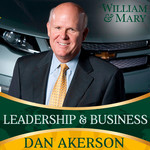 To say Dan Akerson has had an exciting career is an understatement. He's held leadership positions such as CEO, Chairman, President, and Managing Director of top organizations—including MCI, General Instrument, Nextel, The Carlisle Group, and General Motors. He's been successful at each stop. He continues to be active, serving on the boards at American Express and Lockheed Martin, but it's his four years as CEO of General Motors that people remember best. He led GM from 2010 to 2014 where he orchestrated a major turnaround. He joins us today to talk about the auto industry and its supply-chain challenges. He also shares a few stories about leadership, working with Vladimir Putin, and how to knock out a billion dollars in losses.