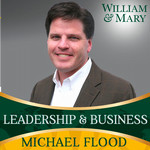
Michael Flood
Food banking, interestingly, is an American phenomenon started in Phoenix in the late 1960s, spread throughout the United States, and now has spread throughout the world. A way to sort of reuse an existing resource and having it benefit people who really need it.
Female Voice
From William & Mary in Williamsburg, Virginia. This is Leadership & Business, produced by the William & Mary School of Business and its MBA program. Offered in four formats: the full-time, the part-time, the online, and executive MBA. For more information, visit wm.edu.
Ken White
Welcome to Leadership & Business, the podcast that brings you the latest and best thinking from today's business leaders from across the world. Sharing strategies, information, and insight that help you become a more effective leader, communicator, and professional. I'm your host, Ken White. Thanks for listening. About one in every ten American households is food insecure. That's according to the US. Department of Agriculture. That means 10% of American households are uncertain of having or unable to acquire enough food to meet the needs of all members of the family. In addition, households with children have a higher rate of food insecurity than those without kids. A big problem like food insecurity requires a big solution. Michael Flood is part of that solution. He's the president and CEO of the Los Angeles Regional Food Bank. A former all-American soccer player at William & Mary, he visited campus for a soccer reunion, and he visited us to talk about food insecurity, food banks, and leading in the nonprofit space. Here's our conversation with Michael Flood.
Ken White
Well, Michael, thank you so much for being here. Welcome back to your alma mater. It's great to have you here.
Michael Flood
Oh, it's my pleasure to come back. It's been a little while, and to see the new facility here is really incredible. I have not been in this building, and it's phenomenal.
Ken White
Yeah, our listeners know, I often say on the podcast, you just walk in every morning and say, wow, how grateful to work in a place like this. You just spoke to a group of MBAs. How'd that go? What'd you talk about?
Michael Flood
It was great. I presented about my work, which is in the nonprofit world. I work for the Los Angeles Regional Food Bank. I'm the president and CEO there, and so I thought it would be good to come back and talk about how, while I got an MBA back in the late 1980s from the program here, I decided to go the nonprofit route. And very pleased I went that route. It's been a great career choice for me personally. That's what I presented to kind of my work and, how I got into it, and some of the challenges in the nonprofit world.
Ken White
What was it about the space that opened your eyes or got you interested?
Michael Flood
So, I came to William & Mary as an undergraduate and have a government degree. Political science, they call it government here. It's an old college. Right. And took history took a lot of courses. I came here also for soccer. I played soccer here, which was also a great experience. I did work in the newspaper industry for a bit of time in the 1980s, and I was trying to figure out really what I wanted to do. I discovered I didn't really want to go into government per se, so I had the opportunity to come back and go to the program here, the MBA program here. Coach for my old coach, Al Albert, as the assistant coach and the MBA program, I knew it was going to give me skills that would be helpful, but I still was undecided in terms of what I was going to do. There was a class while I was here that was taught by Dr. Harrington Bryce, who I think has retired recently. And it was about nonprofit management. And it was in that class. I bought the book, and it was in that class. I thought, you know what? This is interesting. I think this is something I want to pursue. And when I graduated from the MBA program, I moved back to California, where I'm originally from, and went into the nonprofit world, specifically food banks. I work for the Los Angeles Regional Food Bank and have for the last 20 years or so.
Ken White
In this era where people tend to work two-three years for an employer and move, as you said, two decades, what is it about it that makes you stay and like it so much?
Michael Flood
Well, there's so much variety to the work. And that's part of what I talked about this morning in the class. We have our feet in the food world the agricultural world. We have donated food coming in. So fascinating what's going on in the domestic food industry. Of course, we're in the philanthropic world. We're a nonprofit. We have to appeal for funds community engagement. The volunteer program is huge. We're involved in policy decisions made in DC. Sacramento, which is our state capital locally, have a big impact in our work. Nutrition and health is an important component of our work. Research. So you go down the list, and there's a lot to keep someone busy and engaged in this work. And that's why I've stayed. And it's just been fascinating, not to mention how the external environment has changed over that time. Most recently, of course, the pandemic upended things as it did for everybody. So, demand through the roof. The organization responding to that. It's been very interesting and rewarding work. And in the end, the bottom line for us is what is the community impact? How are we improving the lives of people? So it's a different bottom line, right, than a typical business bottom line. And I think that really is what drove me into the nonprofit sector and looking for that type of sort of reward, personal reward for work.
Ken White
But in one hand, you're the CEO of a business. It's a major business.
Michael Flood
Yes. I mean, there's $250,000,000 worth of revenue and expenses, the value of the food coming in and out, large distribution centers, logistics, trucking, and the like. So, all the factors of planning and budgeting. IT, HR, I mean, everything, yeah, it's the same in terms of having that type of discipline. Because in the end, for a nonprofit, you go out of business just like any business. Right. In terms of if the enterprise isn't managed well, you're going to be in trouble.
Ken White
How'd the MBA help you?
Michael Flood
The MBA helped me in terms of finance and that side of things because, again, that's an important aspect of running an organization. Of course, we have a great CFO and a great finance team, but having that knowledge in my role is important. Spent time here in marketing. Marketing is very important for a nonprofit. You have to attract the resources. For us, it's funding, it's food donations, it's volunteer, it's in kind. That has been important. Organizational development was very helpful here. In the end, there's both leadership in terms of providing the leadership for the organization, but there's also managing the enterprise, managing the operation, attracting talent, retaining talent, determining how to build an organizational culture that people are going to want to stick around. So, there were a lot of things here that I found beneficial. There was a real estate class I took. Well, we bought real estate as the food bank. So, a lot of things that provided me again, I think that foundational knowledge that has been very helpful to apply.
Ken White
And we mentioned you were an athlete and a good one. How does sports, how did that prepare you and athletics for your role?
Michael Flood
So, my parents immigrated from Ireland to the United States. They immigrated to Los Angeles. And for my brother and I, just sports was an important part of growing up. We played all different sports. And soccer is the one that I gravitated to. And as I mentioned, played here was all American. The team was a good team here had good success under our coach, Al Albert. Sports, for me, teamwork, competitiveness, resiliency, learning to lose as much as learning to win. Right. How do you bounce back? Right. And parts of leadership come into play. Sports has been very helpful. I had a brief professional career in soccer and then coached for quite some time. As I mentioned, I came back and coached here for a couple of years but did a lot of volunteer coaching and training right. Because I had really good coaches when I grew up, and that was my sort of give back right to hold coaching trainings. This would be in California, coach my kids, who played also as youth players. And yeah, I think sports has been very helpful for me in terms of the overall kind of just learning leadership skills, and you know, teamwork skills and related areas.
Ken White
I'll often ask our guests this question, and that is, was there a day, a time, a moment when you said, I want to be a CEO? I'm ready for that. Did you ever make that decision?
Michael Flood
That's a really good question. When I went into the nonprofit world, things were a bit smaller. It's grown. It's a big sector. If people aren't aware, the nonprofit sector in America is a huge, important sector doing important, critical work. I think when I got into it initially, it was sort of in an operations logistical role. And I probably thought early on, yes, I want to progress. I would like to lead an organization. So I had a great mentor in that first food bank I worked with in Northern California, guy by the name of Larry Sly, and then moved to another food bank to become the executive director or CEO, as they're called, in the nonprofit world. So, yeah, I think it was sort of a natural kind of evolution for me. Yeah, early on, I thought, one, I want to stay in this work, I'm enjoying it. And two, I would like to progress in my career.
Ken White
And I'm sure it feels pretty good to make a difference every day.
Michael Flood
It does. Even in the most difficult days, great work is going on. People are being helped. There's headaches in any job. Anywhere you go, there's challenges that you deal with. That, for me, was, again, sort of a primary driver, is that I'm a hard worker. I apply myself. It's important for me. And again, seeing the end result day in and day out is very satisfying.
Ken White
We'll continue our discussion with Michael Flood in just a minute. Our podcast is brought to you by the William & Mary School of Business. This year, the Financial Times, Bloomberg Businessweek, Princeton Review, and US News and World Report have all named the William & Mary MBA program one of the best in the US and the world. If you're thinking about pursuing an MBA, consider one that has outstanding faculty, excellent student support, and a brand that's highly respected, the William & Mary MBA. Reach out to our admissions team to learn which of our four MBA programs best fits you: the full-time, the part-time, the online, and the executive MBA. Check out the MBA program at William & Mary at wm.edu. Now, back to our conversation with Michael Flood, president and CEO of the Los Angeles Regional Food Bank.
Ken White
Where does most of the food come from? Corporate folks? Where does it come from?
Michael Flood
Yeah, you know, so the United States, we're a prolific grower and producer of food, which is great. It's good to be in a position not all countries are. We export a lot of food, and from that, there's a lot of food that's just left over. Nutritious food wholesome food that never makes it to market, either in the retail sector or in the food service restaurant sector. So that's how food banks got going many years ago. Our food bank celebrating its 50th anniversary this year. Food banking, interestingly, is an American phenomenon. Started in Phoenix in the late 1960s, spread throughout the United States, and now has spread throughout the world. A way to sort of reuse sort of an existing resource and having it benefit people who really need it. So that has been sort of the working model of sort of food banking since the beginning. There have been a lot of sort of tentacles out from that working model, but that still remains the core work.
Ken White
What about families and individuals? How much of the food comes from that group?
Michael Flood
Food drives, that type of thing can be helpful, I think. It's not a big part of food, but it helps on the engagement side, especially like schools. And that's where the volunteer program is very important. We want high schools, colleges, businesses, universities to come in, and it's a great engagement piece, too. People tend to come back because they feel like, for 3 hours, they're getting something accomplished. Right? So I would say the food drive part is kind of a smaller component, but again, helps, I would say, in just getting people involved and getting people engaged in the issue.
Ken White
So those people, the volunteers, quote-unquote, how many, how much of your time do you spend with volunteers?
Michael Flood
Yeah, so we're organized where we have a team focusing on the food donors, a team focusing on financial donors, a team focusing on the volunteer side of things. So those are sort of three teams that are focusing on various inputs. 16,700 volunteers coming through on an annual basis are at a big number coming on-site to our two distribution centers are helping at the mobile distributions throughout the community. So it's very large. And then the food bank is serving 600 other nonprofit organizations, and they have also a huge volunteer army helping at that level. So this work, in terms of providing help to people, the volunteer component is very important.
Ken White
Food insecurity in the United States. How big of an issue?
Michael Flood
It's been with us for a long time. It tends to increase or decrease depending on what's going on with the economy and also what's going on with government policy. That's why we focus on policy. It's very important. Decisions made in DC. Sacramento, for us, our state capital local, have a big impact in our work, and you know, the pandemic has seen pushed food insecurity rates up significantly. And once the employment situation improved two years into the pandemic, then the impact of inflation came into play. So, in Los Angeles County, about 30% of people are struggling with food insecurity. Doesn't mean they're necessarily going hungry every day. Some are, but it means they have a measurable shortfall of food accessing food for themselves or their family. So it's a big gap. And that's part of what the food bank is involved with in helping fill that gap, not just through food donations and our work, but the policy work also because the resources that federal government and government has is massive and dwarfs what we can do in the nonprofit world, even though we do a lot. So that comes into play and is a very important aspect.
Ken White
So what type of policy, when you're going to DC and Sacramento, what are you looking for?
Michael Flood
I do some, but we also have a team, you know, part of this, you know, finding people who are, again, bring sort of a skill set to the work and getting them engaged and the like. But yes, I do go to DC. And also we'll see electeds down at the food bank or at our partner agencies or volunteering sometimes. So that's an important part of educating them of kind of what is going on in their local community.
Ken White
Yeah, absolutely. Someone who mid-career, early career, late career, who says, yeah, I've been thinking about nonprofit, I've been thinking maybe about food bank and those types of industries. What advice do you have for them?
Michael Flood
I would say that get involved. If you're working full-time in business or whatever the case may be, you can get involved now as a volunteer. Nonprofit organizations have volunteer boards of directors. We need smart, experienced, talented people who are committed to the work. So there's an entree already, and that can give you a little bit of an insight of, like, what's this world like and is that something that maybe I do want to do full time, or if not, you're contributing in that fashion. So, getting in as a volunteer, not necessarily right away as a board member, get in and be that working hands so you can see the operation of whatever nonprofit is firsthand that will give you some insight into the work. And I would just encourage people find things that you're passionate about, whether it's education or health care, mental health, children, seniors. I mean, there's all sorts of causes and great nonprofit organizations across this country. The nonprofit world is really an American phenomenon. There are NGOs throughout the world doing important work, but we have a nonprofit sector here that really is unmatched. And that's a great sort of credit to sort of America and our view of contributing to community and our volunteerism, our response to disasters, right yeah, we rely on the government. But as we've seen in disaster after disaster, people don't wait. They organize. They start helping their neighbors right away.
Ken White
That's our conversation with Michael Flood. And that's it for this episode of Leadership & Business. Our podcast is brought to you by the William & Mary School of Business, home of the MBA program, offered in four formats: the full-time, the part-time, the online, and the executive MBA. Check out the William & Mary MBA program at wm.edu. Thanks to our guest, Michael Flood, and thanks to you for joining us. I'm Ken White, wishing you a safe, happy, and productive week ahead.
Female Voice
We'd like to hear from you regarding the podcast. We invite you to share your ideas, questions, and thoughts with us by emailing us at podcast@wm.edu. Thanks for listening to Leadership & Business.



 About 1 in every 10 American households is food insecure. That's according to the US Department of Agriculture. That means 10% of American households are uncertain of having, or unable to acquire, enough food to meet the needs of all members of the family. In addition, households with children have a higher rate of food insecurity than those without kids. A big program like food insecurity requires a big solution. Michael Flood is part of that solution. He's the President and CEO of the Los Angeles Regional Food Bank. A former All-American soccer player at William & Mary, he visited campus for a soccer reunion. And he visited us to talk about food insecurity, food banks, and leading in the non-profit space.