Bill Rosenthal
For me, quote-unquote leadership is more of really helping people do their very best, because I believe everyone comes into work every day wanting to do their very best, and making sure that they have what they need and you get the obstacles out of the way.
Female Voice
From William & Mary in Williamsburg, Virginia. This is Leadership & Business, produced by the William & Mary School of Business and its MBA program. Offered in four formats: the full-time, the part-time, the online, and executive MBA. For more information, visit wm.edu.
Ken White
Welcome to Leadership & Business, the podcast that brings you the latest and best thinking from today's business leaders from across the world. Sharing strategies, information, and insight that help you become a more effective leader, communicator, and professional. I'm your host, Ken White. Thanks for listening. Bill Rosenthal is not a typical leader, and Midnight Oil is not a typical creative agency. Rosenthal is President of Midnight Oil, an agency located in Los Angeles. Its clients include Netflix, Hulu, HBO, and other streaming services and studios. Rosenthal and his team design and build highly creative and unique displays, billboards, and other media that grab people's attention and get them talking. He earned his bachelor's degree in business at William & Mary, and later his MBA at the University of Southern California. He's worked at some top organizations, including Goodwill, Deloitte, and Disney. He joins us on the podcast to discuss working and leading in a creative organization. Here's our conversation with Bill Rosenthal.
Ken White
Well, Bill, welcome to campus and welcome to Miller Hall. Absolutely great to sit down and talk with you. Thanks for being here.
Bill Rosenthal
Thank you for inviting me. It's really great to be back on campus 35 years later and seeing so much that hasn't changed, but yet so much has changed at the same time. So it's been a bit of a mind rush.
Ken White
I was going to say, what a feeling, right?
Bill Rosenthal
The bricks are still there and the buildings are there, but there's so much more here and there's so much construction going on, but it still feels the same, exactly the same.
Ken White
That's great. Well, it's great to have you here. Midnight Oil, I want to call it an ad agency. I don't know if that's appropriate. How do you define it?
Bill Rosenthal
We're a little bit of everything. Midnight Oil is part of a larger company called the Imagine Group, and it really was four independent mom and pop printing and fabrication companies that were brought together under this one umbrella. Midnight Oil is a little bit unique from the other locations because we are fortunate enough being in Los Angeles; we work with all the major studios and streamers. And so we get the opportunity to produce work that's a little different than the rest of the locations that we're part of, and the ability to do things in out-of-home space in a very big, fun, over-the-top way. We do all the standard printing that everyone else in the organization does, but we are fortunate enough to really go beyond that, which is a lot of fun.
Ken White
Can you share a campaign in the last year or two that strikes you as, man, that was fun and effective?
Bill Rosenthal
Yeah. As I said, we're so fortunate. We work on so many great programs. We just finished one for Warner Brothers' Final Destination, and for the campaign, we put together a billboard that had. That movie is really known for all of these crazy scenes of how people get hurt. And so we did a scene with the folks putting the billboard up. They were mannequins. No one got hurt. Where they're falling off the billboard board that's being constructed. And the reaction that we got from that was just amazing and a lot of fun. And what's really interesting about some of the work we do is oftentimes, the number of people who actually will see the work in person in Los Angeles or New York, in another major or Metropolitan is relatively small relative to the folks who might see it when it gets perpetuated online and through earned media. And so the real thriller to me is when you read the comments of people that see the work, and they're really excited by its mind-blowing.
Ken White
Yeah. So it'll go viral.
Bill Rosenthal
Yeah. Viral is a relative term. It will definitely garner a lot more eyeballs in the earned world. So, on top of being seen from the freeways and elsewhere along Los Angeles and big cities, there is a much bigger reach. And that's really, I think, the interesting power of creativity in the out-of-home space, particularly, is that it can broaden beyond who actually sees it live.
Ken White
Do you have competitors or are you very niche-like?
Bill Rosenthal
Everyone has competitors. So, yeah, we definitely have our competitors. I think that we have a unique expertise that garners the work to come to us. But anyone in the business world who thinks they don't have a competitor is probably fooling themselves because we all do.
Ken White
So our dean, Todd Mooradian, had seen you in Los Angeles, and you gave him the grand tour, and he kept talking about one of the displays, for lack of a better term, with a boxing glove.
Bill Rosenthal
Yeah, that was a great one.
Ken White
Can you talk about that?
Bill Rosenthal
Yeah. One of our clients, Netflix, has moved into the live arena in a very big way. So last year, they were doing a big promotion around the Jake Paul Mike Tyson boxing match. The fight was going to be in Dallas, and they wanted these oversize boxing gloves to be part of all the marketing activity in and around the venue. And so we built these, I don't know, I think they were 12 feet tall and 6 feet deep boxing gloves to be placed at the venue, which was really great. And then there were a series of accompanying billboards that happened as well, mimicking the boxing glove, going through a billboard. So it was part of a larger campaign, but it was great. And we had one in our building. It actually ended up going to Jake Paul. He wanted it, so we shipped it to him.
Ken White
How big was this thing?
Bill Rosenthal
I'm 6 feet tall. It was probably 12 feet tall, maybe, and probably about 6 or 8 feet wide, roughly. It was big.
Ken White
Where's the intersection of the intelligence, the data that you have, and the creativity? How does that come together?
Bill Rosenthal
A lot of what we're doing is part and parcel to a much broader campaign of, usually, television in theater and in other places. It's all pieces to their overall marketing campaign. And so the out-of-home portion of it goes along with the television, the online, and all of those things. So it's one component. My opinion, it's one of the more fun components because the ability to be really creative is there are limits and there are restrictions and guidelines you need to do, but the ability to really come up with things that have never been done is amazing.
Ken White
So you're working with other organizations, right, in the larger campaign. What are those relationships like? You got to clear things with them. How does that all work?
Bill Rosenthal
It takes a lot of people to bring these together. First and foremost, it's with the clients, and their marketing teams, and all the great folks that we work with across our client base. But then it's the out-of-home companies that we're working with, too. It's coordinating with houses that might be doing the artwork. It might be an advertising agency that's doing part of the campaign. It's usually a lot of different partners and a lot of. You get on a conversation call to talk about the campaign, and there are more than a few people there to talk with.
Ken White
How do you measure success?
Bill Rosenthal
I think it's a couple of ways. One, it's always great when whatever we're promoting, whether it's a movie or something on a streaming platform or something outside the entertainment category altogether, which we also do stuff there as well. Number one, great if the show or movie or the brand gets the lift that they're looking for, that's always fantastic. Is what we're doing the primary or the only reason for that? Of course not. It's one piece of the ecosystem. But it's great when you see it all come together, and you could think we were a part of that, maybe even just a small part of it. But to be a part of that is really rewarding. It's a lot of fun. It's a culmination of a lot of work from a lot of people in our organization and across the entire marketing effort.
Ken White
How do you ensure that it's going to work? Testing it? How do you go about that?
Bill Rosenthal
Some stuff is just tried and true, and we know it's going to work. But when you're doing things in a three-dimensional way, there's a lot of R&D that goes into it to make sure that it will function, whether it's specialty lighting or motorized movement, neon, or if you're building and fabricating something of size, making sure the weight and the physics will work. And then also factoring the fact that when you see something from a distance, it looks very different than it does up close. There's a lot of artistry that goes into it all, because when you look at something up close, you might see one thing; you put it outside, it looks very different.
Ken White
Yeah. So, the people, who are the people you work with? I mean, what types?
Bill Rosenthal
Oh, the expression that takes a village is really true. We have an amazing group of creative folks that come up with great ideas. We have an amazing group of fabricators and artists that can bring that creative intention to life. And then you're working with a lot of people, making sure it keeps everything on track and on time. It's a large group of people to bring these things to life. It's a lot of coordination with people, internal and external. It's a tremendous amount of coordination and collaboration with our clients. We're very fortunate. We have clients that want to push the envelope, and being given that opportunity to push the envelope really opens up a lot of opportunity.
Ken White
What do you like about your role?
Bill Rosenthal
I've been in the marketing and advertising space since about '96 when I started at Disney, when I moved out to Los Angeles. But this is the first time and first place where we actually build and fabricate in our building. So when you walk into our facility, you see it coming to life, versus in previous roles at agencies, we would deliver a digital file or maybe a proof or maybe a small mockup. But here we build it to scale. I walk around our facility a couple of times a day just in awe of all the work that we're doing, and how it's all coming together because it's something I couldn't personally do. I don't have that artistic vision. I don't have that fabrication skillset, but I just watch in awe the folks that make it happen every day.
Ken White
We'll continue our discussion with Bill Rosenthal in just a minute. Our podcast is brought to you by the William & Mary School of Business. When it comes to choosing an MBA program, people sometimes look to the rankings, among other things, for guidance. Well, the William & Mary MBA program is ranked among the best in the world. The Financial Times includes William & Mary's full-time MBA program in its global top 100. Fortune ranks the executive MBA in its top 20, and US News & World Report lists the online MBA program in its top 20. If you're thinking about pursuing an MBA, check out all the indicators of quality, like a world-class faculty, unparalleled student support, and a brand that's highly respected, the William & Mary MBA. Reach out to our admissions team to learn which of our four MBA programs best fits you: the full-time, the part-time, the online, and the executive MBA. Check out the MBA program at William & Mary at wm.edu. Now back to our conversation with Bill Rosenthal.
Ken White
You work with some well-known organizations, Goodwill, Deloitte, and you mentioned Disney. What did that experience at Disney? How did that affect you and your career?
Bill Rosenthal
Yeah, Disney was really a great opportunity for me. I was living in Boston at the time, working with Goodwill. Ironically, it was really hot down here in Williamsburg today, but it was really cold in Boston for an entire winter. I think we had the most snowfall up to that point in one season. Folks from Disney called and said, Would you be interested in coming to California to interview with us, and I was like, Yeah, sure. I hadn't moved my car for two months because I've been buried in snow. One thing led to another, and the next thing I know, I'm packing up everything and moving to Los Angeles. It really gave me the opportunity to break into the marketing advertising space. The folks at Disney, it's a great collection of brilliant people. It introduced me to the entertainment industry, which is where I've now spent the vast majority of my career. It really was the door opener and really introduced me to some really phenomenal folks who were not only coworkers, but mentors and just really great guiders.
Ken White
What is your role as president? What do you do?
Bill Rosenthal
I joke that my job is just to make sure that we meet and exceed our clients' expectations. Try to boil it to make it simple. The other thing I joke with people is my job is to get to yes. How do we get that done? Whether it's people, whether it's equipment, whatever it is, how do you clear obstacles, how do you help get things done? That could be any number of things on any given day.
Ken White
But you're a leader.
Bill Rosenthal
That's what they say. I think that for me, quote-unquote leadership is more of really helping people do their very best because I believe everyone comes into work every day wanting to do their very best, and making sure that they have what they need and you get the obstacles out of the way. If that's what leadership is, then okay. But to me, it's a very big collective joint effort.
Ken White
What do you do to get to know those people and interact with them to make sure they're good and things are rolling in the right direction?
Bill Rosenthal
As I mentioned, I try to walk around the building as much as I can. I think that having your eyes and ears aware of what's going on is really critical. There are a lot of conversations that happen spontaneously. As we've emerged from COVID, and a lot of younger workers don't really, ideally, want to be back in the office, they'd rather work remote. I think that that's a really big disservice to folks, not because I'm old school and I want people in the building, but I think there's so much learning that happens in person that is much more difficult to happen if you're phoning into a Teams or a Zoom call all day long, full-time. I think it's really just very difficult. I worry that a generation of younger workers will get to that next level of their career, their middle of their career, and not have all the skills that we were able to acquire because we had more in-person mentorship and leadership and just on-the-job training. Because I didn't go to school to do this. I mean, what I'm doing today, none of this. It was all just learned over 20 years. That wouldn't happened in a online environment, I don't believe.
Ken White
When you think about your career and other leaders to whom you worked with, anyone, more particular, not names, but things they did that you thought, oh, yeah, that works. I'm going to adopt that.
Bill Rosenthal
I've been very fortunate. In every company I've worked at, I've had at least one memorable and impactful mentor or boss or coworker who really helped me pull things together and really learn and grow professionally. Just watching different people. You talk about how they handle difficult situations in particular because they come up. I think that how you handle those stressful moments is really important. I had a couple of folks in particular that were really very instrumental in showing me what works better than other things. I have one mentor in particular who really taught me about when you have to make a really tough decision. Sometimes there's no great decision to be made, and you're trying to make the best of the worst, the least bad decision. I remember her very vividly talking to me about the process she went through to make a decision that she knew maybe no one would be happy with, no matter what it was, and that happens. That was invaluable.
Ken White
Yeah. Aren't those people incredibly valuable, right?
Bill Rosenthal
Amazing.
Ken White
Wow. Imagine life without those kinds of mentors and leaders.
Bill Rosenthal
I can't. I don't think that people have the opportunity to reach their fullest potential if they don't have mentors in their career, because I don't think you get there on your own. There's no way to get there on your own. That's the exception, I believe.
Ken White
I ask pretty much everyone on the podcast about AI and how that's affecting the industry. What do you see?
Bill Rosenthal
For us in the creative space, it's definitely something that we're talking about a lot. I think that in the creative space that we work in and the complex files that we work with, this idea that you can push a button and you can change creative and make it 15 different ways is a little unrealistic at this moment because the layering and the complexity of files are such that that wouldn't work. We also work with a lot of folks in the entertainment industry who had a strike over many things, including AI and the use of AI in the industry. I think that that industry in particular probably will be a little bit more cautious about the use of AI. But there's a lot of places that you can use AI that really just fundamentally make your life and job easier. Most people use ChatGPT. Within seconds, it can tell you and tweak something for you and make you sound smart or make you sound like you're very coherent. I have very mixed thoughts about that. But those kinds of tools that in a blink of an eye can do something and the ability to say, oh, make it more humorous, make it more this, make it more that, and it can do okay, and then blurt out a whole new thing in seconds. It's amazingly powerful. What it means long term, it's anybody's guess, I think, but it's got great potential.
Ken White
Yeah. But some artists and other creators that I've talked with are a little concerned about it.
Bill Rosenthal
Yeah, absolutely so. I think that the space around intellectual property, I think, and creativity, I think, is one of those areas where AI... I'll be curious to see how it evolves and how much and to what extent it can be used in a responsible way that everyone can be okay with.
Ken White
If someone's listening and saying, I'd love to do somewhat like what you do, the field, whether it's entertainment, advertising, marketing. What advice would you have for somebody starting out?
Bill Rosenthal
I tell everyone that, one, I didn't go to school or think this is where I was going to be 35 years out of school at all. So I'm a big fan of just being open to opportunities. I'm also a very big believer that whatever your role is, whatever your job is, I was always the one who raised my hand and volunteered for whatever. Can you go travel here? Can you take this job? Can you do that? Would you do this? I always said yes. And that gave me opportunities that no one else wanted necessarily. It usually created some professional goodwill, and it put me in situations that I wouldn't otherwise have gotten into. And I think that all of that cumulatively helps form how and where I got to today, just always leaning in.
Ken White
That's our conversation with Bill Rosenthal, and that's it for this episode of Leadership & Business. Our podcast is brought to you by the William & Mary School of Business, home of the MBA program offered in four formats: the full-time, the part-time, the online, and the executive MBA. Check out the William & Mary MBA program at wm.edu. Thanks to our guest, Bill Rosenthal, and thanks to you for joining us. I'm Ken White, wishing you a safe, happy, and productive week ahead.
Female Voice
We'd like to hear from you regarding the podcast. We invite you to share your ideas, questions, and thoughts with us by emailing us at podcast@wm.edu. Thanks for listening to Leadership & Business.



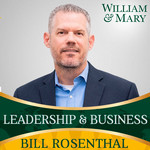 Bill Rosenthal is not a typical leader, and Midnight Oil is not a typical creative agency. Rosenthal is President of Midnight Oil, an agency located in Los Angeles. Its clients include Netflix, Hulu, HBO, and other streaming services and studios. Rosenthal and his team design and build highly creative and unique displays, billboards, and other media that grab peoples attention and get them talking. He earned his bachelor's degree in business at William & Mary, and later his MBA at the University of Southern California. He's worked at some top organizations including Goodwill, Deloitte, and Disney. He joins us on the podcast to discuss working and leading in a creative organization.