Jim Solomon
Getting the human assets in the right place, making sure everybody has a path forward, it's become a focus or maybe even a passion for me.
Female Voice
From William & Mary in Williamsburg, Virginia. This is Leadership & Business, produced by the William & Mary School of Business and its MBA program. Offered in four formats: the full-time, the part-time, the online, and executive MBA. For more information, visit wm.edu.
Ken White
Welcome to Leadership & Business, the podcast that brings you the latest and best thinking from today's business leaders from across the world. Sharing strategies, information, and insight that help you become a more effective leader, communicator, and professional. I'm your host, Ken White. Thanks for listening. It's a subsidiary of one of the largest machinery manufacturers in Japan, Sumitomo Machinery Corporation of America. Jim Solomon is its CEO. Solomon oversees the company's locations in North, Central, and South America while staying in close contact with corporate headquarters in Japan. It's an interesting leadership role in that Solomon finds himself interacting with different cultures regularly. Before becoming CEO, he came up through the finance function and says today he has a particular interest in human resources. He joins us on the podcast to discuss leadership in a global organization, balancing different cultures, and the importance of investing in your employees. Here's our conversation with Jim Solomon.
Ken White
Well, Jim, thanks so much for taking the time to stop by. It's good to see you. Thanks for being here.
Jim Solomon
Glad to be here, Ken. Appreciate the opportunity.
Ken White
You and I, obviously, have known each other. I'm fairly comfortable and know Sumitomo quite well, but your role with the organization as CEO, what does that entail?
Jim Solomon
Well, first of all, I work as part of Sumitomo Industry Corporation of America. So that is the Americas-based region for Sumitomo Heavy Industries, the division that we're in, which is the power transmission and controls division. We're based in Chesapeake, Virginia, for those of you that are not familiar with that part of the country. We're right in Norfolk, Virginia Beach area. We're the corporate headquarters for all of North and South America.
Ken White
And so your role as CEO, where do you spend your time? What do you do?
Jim Solomon
In a lot of different things. I would say a lot of my time is spent on the human resources side of the business. I started at Sumitomo 25 years ago. I came in as an assistant controller. My background is finance, but I've, over the years, had a lot of connection to human resources. With this role, because of what I see as the importance of getting the human assets in the right place, making sure everybody has a path forward, it's become a focus or maybe even a passion for me as well.
Ken White
Any idea what triggered that?
Jim Solomon
No, not really. Other than, I think, with some of the other companies that I've worked for, I started out in public accounting, then I ended up at a utility company based in Pittsburgh. A lot of the audit work that I was doing was tied to human resources. Then I transferred down to the Virginia area to one of their subsidiary companies, and also had a lot of connection to that same part of the business. And finance, of course, is where I'm the most comfortable, but the human resources aspect touches everything. And I've seen where if you have the right people in the right place, how well it can go, and if you don't, where your problems can develop. I have always found that area to just be so beneficial to the organization as a whole, that it's not something that can be neglected, I guess.
Ken White
You invest time and money into the people who report up to you?
Jim Solomon
Yes, because from our company, if you look at the way our ages are spaced out, we have a lot of management that is getting very close to retirement. Then we have a relatively large gap. Then we have some extremely talented young managers and directors, and some other members of our executive team. But there are still some things that are necessary to bridge that gap that we have. That's why I think we got involved with William & Mary early on, is trying to fill what we needed in that gap as far as leadership skills, leadership development, because it was something that we really couldn't do internally. We do have a lot of training opportunities internally, even with senior leaders. We have a very specific program for that, and I think that gets everybody up to a certain point. But to get to that next step, there were some things that I thought were very important. Working with William & Mary, it is a time commitment for sure, and bringing people in from all over the country, and as you know now from other countries with our most recent group of participants, but it's been well worth it because it's been an opportunity for them to not only learn from some of the things that you're helping them with here at William & Mary, but also these groups, because each them have been so small, they're bonding. We saw that with the very first group of six people, how they walked out of there with such a close bond as coworkers that maybe they wouldn't have had otherwise. So for least for myself, I see that to be just invaluable.
Ken White
An effect on culture. Is there also an effect on retention?
Jim Solomon
I think there is an impact on retention. And if you look at our company in general, we don't have much turnover. A lot of that is tied to the culture. We're, of course, Japanese-based company, and there's a lot of that culture from Japan that bleeds into what we do here in the United States. A lot of the good things, the respect for human dignity, is probably one of the most important parts of the Japanese culture. And definitely one of the things that brought me to Sumitomo all those years ago and has kept me there. I am convinced that that's what helps with our retention. Because when you're looking to develop younger managers for these roles into the future, the last thing you want to have happen is to get to a certain point, and then they decide they want to go somewhere else. I mean, it's going to happen, but if you can work to avoid that, it's for the company's benefit, for sure. Part of my goal is to it for their benefit. I want this to be a mutually beneficial situation between them and the company.
Ken White
I can imagine people are trying to envision in their minds, what's it like to be working with a parent company who speaks another language? What's a typical meeting like? I mean, they're not speaking English.
Jim Solomon
Always speaking English.
Ken White
Always?
Jim Solomon
Yes. We've never had any issues because they are very good, for the most part, with speaking English. There are occasional meetings where it's in Japanese, and typically, there will be some type of interpreter that will translate it for us. But I would say 95% of the time, it's in English, and it's never been a real issue. And same thing for Latin America. When we visit our locations in Mexico, in Central, and South America, the meetings are always in English. So it's not really been any issue at all.
Ken White
Anything when you were newer and first were introduced to the different cultures that took you by surprise?
Jim Solomon
Well, when I started there, I had absolutely zero background in Japanese business and Japanese culture. And going to Japan, the very first time. I have to say it was a little bit intimidating because I did go by myself. And I think that was part of the process to learn how to get around, learn how to manage when you're in Japan. Nobody's there to help you. But other than that, no, I would say it's a lot of the same things as an American company, but there are a lot of things that are better about the culture because the decision making sometimes is slower, but maybe that slower decision making or the time you spent discussing the topic at hand turns out to be advantageous in the long run. I can't say there aren't opportunities that we miss out on occasionally, but when you think long term, it's probably a real benefit. Our parent company is well over 400 years old, so there's something to be said for that.
Ken White
We'll continue our discussion with Jim Solomon in just a minute. Our podcast is brought to you by the William & Mary School of Business. When it comes to choosing an MBA program, people sometimes look to the rankings, among other things, for guidance. Well, the William & Mary MBA program is ranked among the best in the world. The Financial Times includes William & Mary's full-time MBA program in its global top 100. Fortune ranks the executive MBA in its top 20. And US News & World Report lists the online MBA program in its top 20. If you're thinking about pursuing an MBA, check out all the indicators of quality, like a world-class faculty, unparalleled student support, and a brand that's highly respected, the William & Mary MBA. Reach out to our admissions team to learn which of our four MBA programs best fits you. The full-time, the part-time, the online, and the executive MBA. Check out the MBA program at William & Mary at wm.edu. Now, back to our conversation with Jim Solomon.
Ken White
You said you came up through finance. What kind of advantage did that give you, do you think, from finance to CEO?
Jim Solomon
For myself, it was a great advantage. Out of college, I started in public accounting, and most of my time was spent in auditing. With that, you get exposure to so many different industries, so many different types of companies. I had worked an internal audit for a couple of companies in between before joining Sumitomo. My first year was very intensive as far as working on the financial situation for our company. A lot of time spent in the Latin American countries. At the time, technology was a lot different. We used to get the financial information sent in by fax, and we'd have to compile it on a spreadsheet. A lot of times, that information was not very detailed, so we really had to understand what it was and investigate to make sure that it was accurate. When you start to dig in, especially a couple of the countries, we knew that there were some things that weren't exactly right. Having that financial background, especially audit, really paid off because it was days at a time just going through certain accounts to make sure that they were accurate before they started to roll up to the parent company. As far as now, the benefit of it, I can't see that there could ever be a negative to having a financial background, because when you're looking at the results every single month, let's face it, that's what every company is doing. What's your profit for the month? What's driving it? The pluses and the minuses. What's happening with your margins? What's happening with your operating expenses? If you understand all that, it's just a bonus. To be able to understand how all of that rolls in and out of the balance sheet really has been a super benefit for me.
Ken White
When you look back, was there anybody or a group of people who had quite an influence on you in terms of you becoming a leader?
Jim Solomon
Oh, definitely. So when I started back in 2000 at Sumitomo, my boss at the time was from Japan. He had worked in the United States, maybe for a couple of years in the 1990s, and went back to Japan. And then he was sent back here a couple of months before I started. His way of understanding the business and really looking at it, how do I make improvements, was very unique. There are many times you could go in his office and you wanted to talk about something, and maybe he didn't necessarily agree with it. I always remember he would put his head down a little bit. He'd put his hands on his forehead and say, One moment. And one moment meant a couple of things. One moment meant, okay, I hear you, but I need to think about it, or meant, That's just a terrible idea. I need more time to grasp it and to tell you no. So I really learned a lot from him because he was extremely humble, and he would take a step back before he would ever make a decision. I think that really paid off. He went back to Japan five years after I started there. And then the boss that I had subsequent to him was an American. He came to Chesapeake, Virginia, from California, where he was in charge of sales. And I worked with him really until he retired. It was a great opportunity for me because he was President first, and then two years after that, I believe, he became the first American CEO for Sumitomo Machinery Corporation of America. With that autonomy, that was a lot of responsibility, too. We were able to work together on so many different parts of the business where maybe I would not have had that opportunity otherwise if I was just solely operating as a CFO. And that helped me to transition into this current role because I've been working on different things with him that helped me once he moved into retirement.
Ken White
What do you like about being a CEO?
Jim Solomon
For now, I would say the thing I like the most is looking out into the next few years and trying to picture what this organization should look like. I'm getting closer to that point in my career where I'm going to be retiring, and I want to make sure that the right people are in the right place. That gets back to some of the things that we talked about earlier, the leadership development programs that we're working on. But the other thing I really like, too, is we have an incredible team throughout the whole organization. It's just an amazing group of employees. Something that we started when I first became CEO was we created the leadership team concept, and we meet Friday morning every single week for an hour and a half, sometimes longer, and we cover very specific issues, mostly customer-related issues. But that has allowed us to become much more focused on what's important. Everybody's got so many different responsibilities, but that's the only time in the whole week where we're all in there talking about the same thing and making sure that the highest priority items are being addressed. I enjoy that aspect of it. I like the succession planning part. Another area, too, closely tied to succession planning, is one of the things that we started doing is having a one-on-one session with some of the directors and managers, just with me. I've not had that opportunity before, but it gives me a good chance to see what's important to each of these young leaders and what they want from the company. We've all been in that position at some point where you're at a certain age and you're thinking, what's my future, what's my direction? To give them the chance to talk about that and for me to understand what they want to be doing really helps. We talk about some things, even on a personal level, that I would never have known otherwise. That side the role I really, really enjoy.
Ken White
That's our conversation with Jim Solomon, and that's it for this episode of Leadership & Business. Our podcast is brought to you by the William & Mary School of Business, home of the MBA program offered in four formats: the full-time, the part-time, the online, and the executive MBA. Check out the William & Mary MBA program at wm.edu. Thanks to our guest, Jim Solomon, and thanks to you for joining us. I'm Ken White, wishing you a safe, happy, and productive week ahead.
Female Voice
We'd like to hear from you regarding the podcast. We invite you to share your ideas, questions, and thoughts with us by emailing us at podcast@wm.edu. Thanks for listening to Leadership & Business.



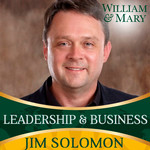 It's a subsidiary of one of the largest machinery manufacturers in Japan: Sumitomo Machinery Corporation of America. Jim Solomon is its CEO. Solomon oversees the company's locations in North, Central, and South America while staying in close contact with corporate headquarters in Japan. It's an interesting leadership role in that Solomon finds himself interacting with different cultures regularly. Before becoming CEO, he came up through the finance function and says today he has a particular interest in Human Resources. He joins us to discuss leadership in a global organization, balancing different cultures, and the importance of investing in your employees.