Ken White
From the College of William & Mary in Williamsburg, Virginia, this is Leadership & Business. The podcast that brings you the latest and best thinking from today's business leaders from across the world. We share the strategies, tactics, and information that can make you a more effective leader, communicator, and professional. I'm your host Ken White. Thanks for listening. Shawn Boyer is a successful entrepreneur. He was the founder and CEO of Snagajob America's largest hourly employment network for job seekers and employers. He also founded and serves as the CEO of GoHappy, a social messaging platform for private groups that focuses on positive sharing and collaboration. For Boyer being an entrepreneur often means identifying an unmet need. His approach to entrepreneurship is methodical. He took similar approaches and steps to launching both Snagajob and GoHappy. And it's a formula you can adopt. Here's our conversation with the founder and CEO of GoHappy, Shawn Boyer.
Ken White
Shawn, thanks for taking time to join us on the podcast. It's great to have you here today.
Shawn Boyer
Yeah absolutely. Thanks for having me.
Ken White
So let's talk about sort of the start of your business as it kind of goes back to the Internet and what was happening in the Internet. And it's hard to believe for many people there was a time where there was no Internet.
Shawn Boyer
Right.
Ken White
Of course, right. But in the 90s it picked up, and in the late 90s it picked up. But you saw something you felt there was opportunity there.
Shawn Boyer
Yeah, I did well, and I was probably late to it in comparison to some of my friends and so forth. So I was I remember I was in law school. So I went to law school.
Ken White
Right.
Shawn Boyer
Because I thought I wanted to be a commercial real estate developer and number of people, I talked to who'd done well at that suggested that after undergrad, I go to law school. And get out practice with a law firm for five to seven years doing commercial real estate and then you know go do my own thing at that point. So I was in law school, and I remember they issued us e-mail addresses. I was like email address what am I going to do with an email address? And you know several of my other buddies you know we're very much into it, and then I remember several of my buddies to being at the computer terminals, and they were looking at scores and things on ESPN. I was like, huh, what is this? But I never you know I would use it occasionally.
Ken White
Wow.
Shawn Boyer
But not like to the extent that the number of other people did. And then, when I got out of law school, I was practicing law and was doing that for a couple of years, and at that point in time, this was kind of 97 98 99.
Ken White
Hmm-mmm.
Shawn Boyer
It felt like everybody and their brother was leaving whatever their job was to go start an Internet company, and I was in D.C. at the time, and I was like man I am missing the boat you know. And I never wanted to be an attorney my whole life anyway. And you know I'm just gonna start writing down every idea that I have, and so I literally did. I was writing them down, putting them in this manila folder these little yellow legal sheets of paper you know they're full of different ideas. Most of which were terrible, but I was dating this girl at the time, and this is now in April of 99, and she was getting her Ph.D. in medical anthropology at American. She was a William & Mary undergrad, and she asked me if I'd go online and do a search for her because she was having a hard time finding an internship for that summer. And so I went online at work. She didn't go online because she didn't have internet at her home, which again is so funny to think about now.
Ken White
Right, it is.
Shawn Boyer
And I didn't see that many sites that were geared towards internships. There were a lot that were geared towards salary level positions, so monster.com was the 800-pound gorilla. CareerBuilder which was another big one
Ken White
Hmm-mmm.
Shawn Boyer
was headquartered in the D.C. area. So I knew of that, and there were a number of others but not that many on the internship side. I thought you know what that seems like a void. I talked to my parents a few days after that, and they had a retail store, and they said as I was telling them about it, my dad said you know what we have a really hard time finding good hourly help for the store. Are there any sites that are geared towards that market because we put an ad in the newspaper, and it's pretty expensive doesn't really work that well Monster and Careerbuilder we've tried did not work well for us. I was like no I don't know like I worked my way through school like I don't remember seeing anything I would just ask my buddies, hey where are you working
Ken White
Sure.
Shawn Boyer
Or see the sign in the window kind of thing. So I went back online and looked, and there was nothing, and I thought I'm missing it. Somebody has got to be doing it, and I kept looking. And nobody was doing it. I thought all right well it just must not be a very good idea, right. Otherwise Monster, Careerbuilder, whomever would have come down market
Ken White
Right.
Shawn Boyer
And started to do it well or somebody else who knew what the heck they were doing would have started something. But you know the more I thought about it, the more I thought you know what. Maybe there is something here, and just nobody has focused on it. So I just started calling you know McDonald's and Walmart, and you know different retailers and fast food types of companies asking them what they did to you know make people aware of the fact they're hiring. All of them said put a sign in the window. If it gets really bad, we'll put an ad in the newspaper, but we really try not to do that because you know that's just expensive.
Ken White
Right.
Shawn Boyer
And we tap into our employee base right and ask them to refer their friends. And then, I was talking to guidance counselors at high schools and career counselors offices at colleges and asking them. Hey, what do you do to make your students aware of the fact that these hourly jobs exist so that they can work their way through school, not talking about internships? Like you know what you want to do after you grow up?
Ken White
Sure.
Shawn Boyer
You know, while you're in school like well, we may post something on the bulletin board in a career office, but we really don't do anything. I just thought you know what, that's a gap. So then I started talking to the students and asking them. How do you find jobs? And I got it's a pain in the rear.
Ken White
Yes.
Shawn Boyer
You know I've got to drive around, and you know I walk into a place that has a sign on the window. And then they say that they're not hiring, and then I’m not sure if they just didn't like the way I looked or not or whatever it might be. So anyway, long good way of saying that's how I became interested in just the space itself and to the impetus for what then ended up becoming Snagajob.
Ken White
How did you even start that? I mean, you need technical expertise. I mean, this is a small business. This was a big deal with a lot of technology.
Shawn Boyer
Yeah, and that technical expertise wasn't coming from me.
Ken White
Right.
Shawn Boyer
Unfortunately.
Ken White
Yeah.
Shawn Boyer
I wish I had that kind of brain, but I just don't. Also, the first thing I did before I left the job where I was, I literally took out every credit card I could. And I've got I keep it for posterity sake, I guess. But whenever I look at it, it gives me anxiety. These yellow again legal sheets of paper that have all the different credit cards that I had where I was transferring from one to another. Where you know you get this promotional thing in the mail and say you know hey you can transfer this for the next six months for zero percent interest. So I took out every credit card I could before I left because I know I couldn't get one, you know after I left the law firm. I took out all my 401K money, and I deferred all my law school loans, and then I started going to friends and family because I knew that little bit of money that I'd been able to save up and take out of 401K was not going to be enough to go contract with a web development shop to build out what it was that we needed to have.
Ken White
Yeah.
Shawn Boyer
Because I didn't, you know I couldn't afford to hire you know an army of people to go do it felt like you know contracting it out would be the best bet. So you know my parents put in money, my Uncle Bobby, my Aunt Vicky, my college roommate from William & Mary, you know my sister, you know friends of friends and so forth and that was a super stressful time. Maybe come back to that but those first several years, and we weren't sure whether we’re gonna make it or not but we contracted out the initial build of the site with a firm to get ourselves to the point where we could launch the website. So we launched in May of 2000, in fact, we just celebrated our 19th what we call snagaversary last Thursday. And then what we realized is okay now we got it out there, and you know these different things that we're learning from people and now want to incorporate into the website. It's starting to get really expensive working with this outside development shop. So we then made the decision to hire a developer who thank goodness was amazing, and he's still there at Snagajob. 19 years later, almost 19 years later so John joined us in the beginning of August in 2000. This guy John Moon and John Moon was a one-person technology shop for Snagajob for the first several years.
Ken White
Wow.
Shawn Boyer
And again thank goodness he was as good as he was because that was
Ken White
Yeah.
Shawn Boyer
Kind of how we were able to make it.
Ken White
Yeah, and a big success story. And then a few years later it's GoHappy.
Shawn Boyer
And then several years later, yeah. So yeah. Kind of fast forward through that 16 years we ended up you know raising D.C. money after six years at the time we raised our first round we were 20 some people in 2006 we grew to 100 people in six months. And then I stayed on with the company through well as the CEO until to the end of 2013 which time we were about three hundred and some people we then had 60 million members of the website about 400,000 companies that worked with us around the country and then stayed on as a chairman for the next couple of years and now we have 80 plus million members and work with about 600,000 businesses around the country. So when I left, I wasn't sure what I wanted to go do necessarily next, and you know you kind of go through that period of time where it's like okay do I want to start something again.
Ken White
Hmm-mmm.
Shawn Boyer
Do I want to totally pivot and coach and teach because I know I love being around students and kids? And you know, do I want to go do this commercial real estate thing I still kind of have that you know hankering to go do that? Do I just want to be an investor slash board member, you know, in different companies? But I took a year off. I just had such an urge and not just an urge. I think just such a need to be a part of something again and to try to go create something with a team of people. That you know, we have this shared mission, and there's that unknown element of it of okay we want to go do this. We think that you know whatever people need this.
Ken White
Yeah.
Shawn Boyer
Or you can solve a pain point, but can we really. And so going back to Snagajob because it was really the impetus for the idea for GoHappy was those first five years when it was so stressful and not sure whether we're gonna make it or not. I just totally neglected friends and family.
Ken White
Right.
Shawn Boyer
I just you know I literally I didn't go to my best friends, who from growing up, Mom's funeral because I was too busy and she'd been like a second mom to me growing up. One of my buddies from undergrad at William & Mary, we literally traveled Europe together for a month after we graduated, and then I stopped returning his calls because I was so busy. You know, trying to grow this thing, and he got married, and I didn't even know it. And I called, and I was like, did you get married I didn't even know you're engaged. He was like you never return my calls. So that was really a wakeup call for me at that point to start to become much more focused on my relationships, and so I was doing it in this really manual way putting down my list of most important people putting goals next to them that were you know these annual goals broken down into quarterly and monthly goals putting stuff on my calendar sending outlook invites and the whole thing just felt manual and sterile, and I didn't really have the time to go look for something that might fit me better or at least I didn't take the time to do it. But when I left Snagajob, I was like you know what I want to find an interactive tool to help me do this. And I just didn't find anything, and so that got my wheels spinning around. Okay, there should be maybe you know maybe there is something here right maybe other people desire the same thing and so when I decided that you know I wanted to go do something again. Then I started doing more formal discovery sessions with people and just asking them, hey, how do you think about your relationships. How do you try to be intentional about them? Do you set goals in them, and that then led to GoHappy. Or initially, actually, it was even called DieHappy, which go figure people didn't like the word die. We thought it made sense because like live happy die happy.
Ken White
Right.
Shawn Boyer
But we ended up changing it because so many people hated it. And the whole premise for it is to help people build better relationships so that they can live happier lives and helping people share life with each other when they can't be together trying to really act as a tool to help them facilitate get-togethers. And then third thing is helping people be intentional about the things that they're important people care about, so helping them remember important dates and you know almost being in the way the CRM tool for people for their personal relationships.
Ken White
We'll continue our discussion with Shawn Boyer of GoHappy in just a minute. Our podcast is brought to you by the Center for Corporate Education at William & Mary School of Business. In order to retain top employees, the best companies and organizations invest in their people by offering high-quality professional development, and some of those top companies and organizations turn to William & Mary in our Center for Corporate Education for their needs. The Center for Corporate Education offers professional development programs for all levels of employees, from executives to managers to emerging leaders to new hires. The programs are taught by William & Mary's MBA faculty. The faculty ranked number one in the nation by Bloomberg Businessweek magazine. To learn more, visit our website at wmleadership.com. Now back to our conversation with Shawn Boyer, the founder, and CEO of GoHappy.
Ken White
You almost sound like you can't help it right. There's this entrepreneur thing inside you that just keeps coming out. You have to create, is that accurate?
Shawn Boyer
I think so, and maybe it's stupidity. I don't know where. And I love this, and you know I encourage people to do this regardless of whether or not you end up going and do anything with it. But I just think there's so much value. And when you see, or you experience something that is a pain point for you or where it's something that's just not optimized to not just say well that stinks and deal with it right. To think about all right well, how might that be different. And is there something that I or maybe that someone else could go do about it and go solve for that. And some of those things that you identify and start to write down will come to nothing right. Maybe some of those somebody's already doing it and you just didn't realize somebody else was already doing it. But I guarantee you some of those things you'll look at, and you'll do the competitive landscape analysis and decide you know what nobody is doing this, and somebody should be doing it. And maybe you'll have the passion, the fire to go do it. Maybe you won't. But it's still this really interesting exercise to go through
Ken White
Yeah.
Shawn Boyer
And I think just helps you look at the world a little differently. And so I love doing that. No question.
Ken White
So it's a solution-driven kind of philosophy.
Shawn Boyer
I think so, yeah.
Ken White
Find the answer.
Shawn Boyer
Yeah, trying to again, I know this sounds totally cheesy, and maybe there's a better, less cheesy way to say it, but you know trying to make the world better, you know by experiencing these things that are less than ideal and trying to figure out all right. How could it be better?
Ken White
Yeah, you grew up, and you mentioned your parents had a business when you were in high school. did that. How did? We've had several of our guests on the podcast who were CEOs and leaders and entrepreneurs who did grow up in a family business. How did that What were some of the lessons you learned? How do you think that affected you?
Shawn Boyer
That's a great question. So yes, so I grew up a pastor's kid until I was 16 grew up out in Oklahoma, my dad, his pastor. But he always had a desire to start his own business. And so when I was 16, and I guess he was 46 at the time he and my mom decided you know what if we're gonna start this thing this business, then we better do it now, or we're never gonna do it. So my brother was getting ready to be a freshman in college at the University of Oklahoma I a younger sister who was going into third grade I was going into my sophomore year of high school, and they were from Virginia, and they decided you know what we're going to move to Virginia, and we're going to start a jewelry store of all things. They had no jewelry. I still don't really understand why they decided jewelry but was either jewelry or a bookstore I guess they figured you know there was more margin involved in jewelry. Thank goodness they did do jewelry instead of books because of Amazon. But anyway, so they started this jewelry store, and they were amazing at letting me see kind of the underpinnings of the business part of it was by just necessity because I had to work there because you know we didn't have the money to be able to afford to hire other people. So I worked on the sales floor. I worked in the back room, you know, and could help size rings. I helped them price jewelry. I got to go to jewelry conferences where we were buying stuff, and so I got to see all these different pieces of the business. Customer service element how do you deal with somebody when they come into the store irate about whatever their diamond fell out of the ring and hey lost it, and you know what are we a bunch of idiots you know. And then you get a deal you know on the sale side dealing with people who were buying you know pretty expensive stuff, and so they were amazing at exposing me to that, and I look at it now and like I would never let my 16-year-old do that. So kudos to them for doing that. But they were also amazing at shielding me from all the anxieties that I now realize they were facing right.
Ken White
Interesting.
Shawn Boyer
Like are we going to be able to make payroll? Are we going to be able to pay our mortgage? Are we going to be able to pay you know our son's tuition in college because they were just scraping by? Never let us experience that, but I now know that they did. And so that for me, I think was a huge pivotal time where I don't know if I would have had the same burning desire to be an entrepreneur if I had not seen them do it.
Ken White
Yeah. So your parents did it. You've done it many people listening would like to like to try something. What advice do you have for them? They just they're just not willing to pull the trigger just yet.
Shawn Boyer
Yeah, I would say you know the biggest thing I think goes back to identify what the pain point is and you just start going and talking to whoever the target audience is to see in fact okay do they have this shared pain point that you seem to have discovered yourself or through somebody else and then just start thinking about all right well what B B proposed solutions to that. Right. And just start sketching them. Right. Having conversations with people about it, you don't have to actually go build anything right, whether it's a piece of technology or it's a you know piece of you know tangible product that people are touching. It doesn't have to be that it's just doing these really quick iterative discovery sessions with people we're picking our brains. What about this. What about this. What else would you do? And then I think you get to the point where you realize okay there's either not really a pain point here or it's not a big enough target market right for me to go do what I want to go do, and then you start to get to what a proposed solution might look like. Inevitably whatever the final solution looks like if there ever is a final, it ain't going to look like what you thought it was at the beginning right because you're gonna be learning and iterating. But I would just say get out and start talking to people and then get that first iteration of what it is into people's hands. If you're still so excited about it and there appears to be this market for it after you've gone through those initial discovery sessions.
Ken White
That's our conversation with the founder and CEO of GoHappy Shawn Boyer, and that's our podcast for this week. Leadership & Business is brought to you by the Center for Corporate Education at the William & Mary School of Business the Center for Corporate Education can help you and your organization get to the next level with business and leadership development programs taught by the William & Mary MBA faculty. The faculty ranked number one in the nation by Bloomberg Businessweek magazine. If you're interested in learning more, please visit our website at wmleadership.com. Finally, we love to hear from you regarding our podcast. We invite you to share your ideas, questions, and thoughts with us by emailing us at podcast@wm.edu. Thanks to our guest this week, Shawn Boyer, and thanks to you for joining us. I'm Ken White. Till next time have a safe, happy, and productive week.



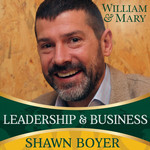 Shawn Boyer is a successful entrepreneur. He was the founder and CEO of Snagajob—America's largest hourly employment network for job seekers and employers. He also founded and serves as the CEO of GoHappy, a social messaging platform for private groups that focuses on positive sharing and collaboration. For Boyer, being an entrepreneur often means identifying an unmet need. His approach to entrepreneurship is methodical—he took similar approaches and steps to launching both Snagajob and GoHappy. And it's a formula you can adopt.