Ken White
From the College of William & Mary in Williamsburg, Virginia. This is Leadership & Business. The weekly podcast that brings you the latest and best thinking from today's business leaders from across the world. We share the strategies, tactics, and information that can make you a more effective leader, communicator, and professional. I'm your host Ken White. Thanks for listening. Workplace diversity. It's an issue that's been with us for years. And as the world becomes increasingly diverse, companies and organizations have learned that they must embrace differences in gender, race, age, sexuality, and other areas if they're going to succeed. Meanwhile, the millennials are bringing a generation to work that is increasingly diverse. In fact, over 40 percent of millennials belong to a minority or ethnic group. So how are companies dealing with the changes in the workforce in terms of diversity and inclusion? Well, our guest today has the answers. Sharon Wood-Dunn is the owner of S. Wood Wilson Associates, a consulting practice that's been working with companies and organizations for over 25 years. Helping them succeed in terms of human resources and corporate culture. She joins us on the podcast today to discuss the state of diversity and inclusion. Here's our conversation with Sharon Wood-Dunn.
Ken White
Sharon, thank you for spending time with us. You're a busy person, and I appreciate you being here today.
Sharon Wood-Dunn
It is a pleasure for me to be here today. Of course, you know Mason School of Business is very important to me as an Executive Partner. I have spent probably my best days with young people.
Ken White
That's great.
Sharon Wood-Dunn
With students in this institution and I get to influence them in some way. So thank you for the opportunity to be with you this afternoon.
Ken White
Well, dealing with those students every day, I know how much they appreciate you and the executive partners. It is an amazing it's an amazing program. So tell us what do you do. How do you help companies and organizations with diversity and inclusion efforts? What do you do?
Sharon Wood-Dunn
Well, there's two types of companies that I work with. One, of course, the companies that have already realized the changing demographics in our country. Those companies that want to make sure they're in step with new and innovative business practices as well as technology. And so those companies will ask me to review some of what they have already done and look to help them be more proactive. Now, this is in terms of recruiting the right kinds of individuals and skills for their businesses. It is also looking at ways that they can really touch their employees as well as their customers. And it all does involve the diversity and inclusion issues that we have currently in our country. So that is one type. They are proactive, and they've done their homework, and they want to enhance their business. The other type of companies that I work with are more or less either they've had employees who have complained that their jobs are not what they thought it would be when they were hired, or they feel that in some way their rights have been violated through a hostile workplace environment. And that also centers on the either the lack thereof of inclusion or the lack thereof of diversity in the workplace. And in that case, I've had attorneys call me because they want to avoid lawsuits and they want to be able to make the best out of a bad situation in that case. And so we worked very hard to make sure that we're encompassing all the needs of the employees as well as the managers and the company heads in that area.
Ken White
So literally, two different types of groups seems like a little more proactive versus maybe a little reactive, right?
Sharon Wood-Dunn
Absolutely. And that's exactly the way it is.
Ken White
Interesting. Well, you know, in the past, when you talk diversity and inclusion, it seems like many companies introduced it.
Sharon Wood-Dunn
Yes.
Ken White
And then it's for some, it just sort of ended. Where is it today? What's going on today?
Sharon Wood-Dunn
That's an excellent question. Back in the 60s and the 70s, and the 80s, most companies had a big commitment toward diversity, but my belief is at that time, it was really an introduction. We needed to understand what the different dimensions of diversity were. How did race and gender and sexual orientation, and ethnic heritage how did all of those dimensions fit into the workplace because they were available to be hired? But how would they actually work within the given corporation or organization? So the focus then, and I was a part of that, with AT&T. The focus then was to educate was to make sure that we were tolerant. I don't necessarily like the word tolerant, but that's what it was then and then really just to understand or try to understand how all of these differences could coexist within the structure or the culture that was already there. And so I believe they did a fair job of trying to make that happen. But as you know the reality is we need a little bit more than that.
Ken White
Right.
Sharon Wood-Dunn
It's not just getting the numbers of people in underrepresented jobs or not just not putting women in traditionally jobs cited for men. It was all of those factors. But how would all of them work together to produce a product? To enhance the company and to enhance the careers of those individuals. So I can appreciate what was done back in the 60s and 70s and 80s, and of course, as you know, the Civil Rights Act of 1964 Title 7 you know really encouraged government contractors to have these programs in place and a lot of emphasis on training. And so I was a part of that. I did a lot of training back in the 70s and 80s regarding that. But here it is now. You know, we have strikingly information from our Census Bureau that tells us this country and the world at large is changing has changed and will continue to change. And so when I look at companies right now who are proactive in realizing what they need to do or at least attempting to bring individuals into their ranks at all levels to make the transition and going forward the success that they want in the workplace. So I'm delighted at this point because the word inclusion really begins to resonate more so than diversity in terms of hiring and filling positions and accepting or even understanding the differences.
Ken White
Interesting. And what happens when you're at an organization and the mission says one thing, the culture says another? How do you deal with that? How do you guide them?
Sharon Wood-Dunn
So often do we find that, well, you know, usually though there that means there's a breakdown in leadership in some way because the mission is something that most companies spend a lot of time and effort to articulate, and they actually believe that once they have a mission there and goals and objectives that people are going to follow suit. What happens is that we see this at the top, and as it goes through the ranks, there's something that gets in the way.
Ken White
Absolutely.
Sharon Wood-Dunn
What gets in the way is actually the culture. And so when we look at culture, when we look at defining culture, I have a very simple definition. It's basically the way we do things around here. That's our culture.
Ken White
There you go.
Sharon Wood-Dunn
You know, and so, of course, they will look at what they are doing and either say, well, we haven't had any issues here, or we're making our numbers.
Ken White
Right.
Sharon Wood-Dunn
We're successful. Why would we need to change our culture? So in some ways, it's a lack of vision. As we look forward as to what is already at our fingertips but truly I think the constant effort in getting our numbers. The constant effort in making money sometimes will just override the very easy way mission and values that we proclaim that we have.
Ken White
Our conversation on the state of diversity and inclusion with Sharon Wood-Dunn will continue in just a minute. Our podcast is brought to you by the Center for Corporate Education at the College of William & Mary's Raymond A. Mason School of Business. If you are looking to improve your leadership and business skills, the Center for Corporate Education has a terrific program scheduled in April. The certificate in business management. It's a five-day program that covers strategy, accounting, operational effectiveness, communication, and leadership. A great program for the professional who needs business and leadership skills but lacks an MBA. For more information go to wmleadership.com. Now back to our conversation with Sharon Wood-Dunn on the state of diversity and inclusion.
Ken White
In your experience, do most professionals, the people you meet, and maybe those you don't work with. Do they understand that you get the best out of everyone when you have an inclusive culture?
Sharon Wood-Dunn
Well, in theory, they do. You know, I can't tell you that I've been to any company that does not say that, and it is just the practice, and let's be honest, if we've been doing things one way and it's working. You know what is the incentive to change? Unless we are really, we really understand that change is coming, and we need to be ahead of that, and we need to address that.
Ken White
If a listener is saying you know, I just don't feel like I'm being included, and it's because of a diversity or inclusion reason, what should they do? What advice do you have for that individual?
Sharon Wood-Dunn
And, of course, I do work with those individuals all the time and there's a few things going on there. The difference is in terms of age, or even experience comes into play. Of course, I advise individuals to use the methods or the guidelines that companies have in place to address issues that are not of their liking or where they feel they are not doing the best in their jobs. And I tell them to or ask them to make sure they speak with those people that are really involved in what's going on with them. Let them know that they are not they feel they are not being utilized as they should be. Let them know that at one conversation at a time, give them specific examples of where they feel they have not been included or where this violates even the job description that they have that says they should be doing this and that, and yet they are not given the opportunity to do so.
Ken White
Right.
Sharon Wood-Dunn
Most times, when someone, an employee, can calmly articulate what it is that's going on with specific examples of what's happened, most times the management, the supervisor, the executive will take a look at it and make some changes over a period of time.
Ken White
Right.
Sharon Wood-Dunn
Now we know no change happens overnight. And so patience is involved as well. But in the most egregious cases if that is the case then of course the legal options or opportunities are there as well. If it's a violation of any of the employment or civil laws, state or local laws, then absolutely that needs to be addressed fairly differently than just having a conversation.
Ken White
A document, like you, said, and use the right channels. I mean, that's the way.
Sharon Wood-Dunn
Always have guidelines. I've had cases where companies have anonymous guidelines online. You can go one anonymously online, make a complaint or praise someone as well.
Ken White
Sure.
Sharon Wood-Dunn
Not just complain.
Ken White
Yeah sure. When you and I spoke earlier, actually, before we started to record, you know you said we've come a long way, but we're not quite there yet. And a lot of this has to do with millennials. What did you mean when you were when you're telling me that before we recorded?
Sharon Wood-Dunn
Yes, that is so true. You know, we know basically how to bring people into an organization and give them a job. However, for that individual to on a daily basis work through the. Culture that already exists and feel as though they are contributing as they thought they would or would like to. That is where we have the issue that is sometimes what's going on. So when we're talking now about multiple generations coexisting within an organization, you can get someone like myself. I'm a baby boomer; I'm not too sorry to say so. My whole mode of communicating interpersonally is a little different than I even see with my sons, who are certainly representative of the greater group that we're now having into the workplace. So I might even say you know it's wonderful if I could hear your voice rather than read your texts but they're more comfortable texting. So when it gets to how we work out our everyday activities, there are some differences there, and we need to acknowledge on both sides what is expected in a position that's going to make you successful in this organization or in this company. And what is it that you have to do that might be not too comfortable or not exactly what you would like to do, but how can those two differences come together so it works for the betterment of each other as well as the organization and ultimately the company?
Ken White
And we've talked about millennials on this podcast a couple of times now and in that group as affecting diversity what do you see when you see them? What kind of comes into your mind?
Sharon Wood-Dunn
Well, you know, let's look at some of the numbers because if the numbers are really staggering when you think of those being born between 1980 and 2000.
Ken White
Right. The Millennials. Right.
Sharon Wood-Dunn
Right. They represent more than a quarter of our population of the U.S. population. This is coming from the Census Bureau back in 9th. I think it was 2014 which was the last one that was taken. They outnumber the baby boomers, you know, and so here we have baby boomers and others still in the workplace, still in decision-making positions, many of them. Working with this new group who's seeing and acting and hearing things a little differently but because they are generally speaking, more educated, generally speaking, more driven to success because they've experience success a lot through their parents, those that have been very successful there. And so now they're thinking they're going to be millionaires, you know, much sooner than others, and their daily activity in their mind doesn't necessarily mean they have to be there from 8:00 in the morning to 12:00 at night.
Ken White
Right.
Sharon Wood-Dunn
They want a vacation. They feel I need me time and they feel they can get the job done in less than half of the day.
Ken White
Sure.
Sharon Wood-Dunn
And do other things, you know, and so it doesn't mean that they are not interested that they don't have the commitment. They are also not looking at staying with a company for the 20 30 years that myself and some other baby boomers have you know so their mindset is different. Yet it is absolutely welcoming in the sense that they have a greater sense of where things are going in business. They remember they have studied and so they know the global marketplace. They know technology even though baby boomers might have discovered technology to a degree. They have taken it to the highest heights and they're still doing that. So they have so much to contribute, and we really need a meeting of the minds between those two forces to get the best, you know, the baby boomers can bring the leadership in terms of being able to communicate culture and being able to communicate business disciplines and the others can come in and say well yes that's true. But let me tell you, let me look at it this way. You know, what do you think about looking at it this way, and that is weird? That's the beauty of that.
Ken White
That's our conversation with Sharon Wood-Dunn on the state of diversity and inclusion and that's our podcast for this week. Leadership & Business is brought to you by the Center for Corporate Education at the College of William & Mary's Raymond A. Mason School of Business. The Center for Corporate Education can help you and your organization by designing and delivering a customized leadership development program that specifically fits your needs. If you are interested in learning more about the opportunities at the Center for Corporate Education, check out our website at wmleadership.com. That's wmleadership.com. Thanks to our guest this week, Sharon Wood-Dunn, and thanks to you for joining us. I'm Ken White. Until next time have a safe, happy, and productive week.



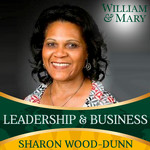 Workplace diversity is an issue that has been with us for years and as the world becomes more diverse, companies and organizations are embracing diversity in order to succeed. Sharon Wood-Dunn is the owner of S Wood Wilson Associates, a consulting practice that works with companies and organizations to succeed in human resources and corporate culture. She discusses the state of diversity and inclusion and how companies can succeed in those areas.