Ken White
From the College of William & Mary in Williamsburg, Virginia. This is Leadership & Business. The weekly podcast that brings you the latest and best thinking from today's business leaders from all across the world. We share the strategies, tactics, and information that can make you a more effective leader, communicator, and professional. I'm your host Ken White. Thanks for listening. Well, thanks to technology, this is an exciting time for marketers. They have incredible tools at their disposal today to reach and connect with prospective and current customers. Digital Marketing allows businesses to really know their clients. It provides the tools necessary to engage with customers on customers' terms, like on their laptops or cell phones, and measuring digital marketing effectiveness helps marketers spend their budgets in an intelligent manner. Mike Savage is Vice President for Marketing Solutions at DirectMail.com. He's a career marketer who's worked with and counseled some of the world's top brands. We sat down with him in Northern Virginia, where he shared his insights on digital marketing, its future, and how it affects customers and businesses. Here's our conversation with the Vice President of Marketing Solutions at DirectMail.com, Mike Savage.
Ken White
Mike, thanks for taking the time to join us today. We really appreciate it. You work in such an interesting space. You know, digital marketing it's just exploding. Some people get it some people have no idea. Why don't we start by what is it you do in your job?
Mike Savage
Sure. Well, thanks for having me. This is a great opportunity I appreciate it.
Ken White
Well, thank you.
Mike Savage
I work for a company called DirectMail.com. So it sits right at the intersection of online and offline. And so we work with non-profits, commercial entities across a number of different industries, and we help them get new customers and engage existing customers. And we do that through a number of different ways. My personally my role there is VP of Marketing Solutions which is really kind of at the front end of our sales and marketing with our team to really help engage our customers understand their opportunities or challenges and leverage data and insight and bring that data and insight to bear across you know not just direct marketing which is honestly a still a growing space in a number of sectors but how consumers are engaging with their brand throughout their lifecycle. So oftentimes, you hear folks talk about, you know, a customer journey and a lot of trends right now, especially around the digital side or understanding that customer journey when they're making buying decisions. Who their influencers are. When to make appropriate offers and sort of the combination of the consumer journey and the marketing it, you know coming together it's a highly complex world right now. So that's what our company does we're a privately held business. Prior to this, I've been here for about three years. I've worked in a large holding company environments, and companies that have helped large brands like Geico and Dell and P&G, and Direct TV put data and infrastructure technology in place, and the analytics in place to kind of help drive these new customer acquisitions. These customer portfolios, I'll call them. So it's been a fun ride so far, and it's ever-changing the digital landscape. I think we're all trying to figure it out as we go. And the best place to learn is just to jump in the deep end and work with your clients because your client's going to help you know they help make us better every day. So it bring new ideas to the table.
Ken White
How do you? You mentioned direct marketing. How do you define direct marketing versus just, say, marketing in general?
Mike Savage
Yeah, direct marketing classically speaking, direct marketing was direct mail, but that's evolved. In fact, a lot of the age-old principles of direct mail marketing from the 70s and the 80s are really being adopted now by digital marketing. So really I would define as anything that has a response mechanism or response channel. That's how I would define direct marketing. So in a lot of ways, digital marketing is direct marketing because it's you can understand a response rate very quickly, and you can measure that, and then you can adjust, and marketing is all about testing and learning and adjusting to get the highest response rate to improve ROI. Whether that be through customer acquisition campaign we're trying to grow this year organically at X rate, how many new customers do we need to kind of fill that portfolio, or hey, we've got a high churn rate with our business, and we're trying to figure out how to kind of shore up that churn rate and get folks to stay with us longer. So there's an engagement process that you employ over time. And the great thing about digital it's highly measurable, and it's, you know, in terms of it is the classic one-to-one, you know, you can literally bring content up that's relevant to Ken, and that might be different for Mike. Based on my attitudes, my segments, my profile and, I can adjust that.
Ken White
Yeah, absolutely amazing. You mentioned measurement. That is such a huge evolution. I mean, 20 years ago in, marketing was really very, very difficult to measure. Besides measurement, what do you think is one of the major changes that you've seen since you've gotten into the space over the years in terms of digital marketing?
Mike Savage
The well, I would say there's a couple; actually, there's three that I've really kind of focused in on.
Ken White
Yeah.
Mike Savage
One is, and I'll just kind of summarize them and maybe go into them in detail. One is what I call omni channel. One is the ability to communicate with a consumer across multiple channels. The challenge that creates an opportunity for smart firms that are looking for ways to continue to grow is to understand how to really farm the data from those channels and build a single view of the customer. So that's sort of, I'll just kind of put that out there, and we call that omni channel, omni channel marketing. The second is integration. And many, many of our clients and whether it be, you know, a Fortune 100 brand as a large overall marketing budget or a mid-sized regional bank. We work with a few of those as well. They're struggling with this idea of integration. So integration in terms of budget integration working in silos internally. Organizational integration. So oftentimes, the consumer how the consumer wants to be marketed to or how they want to engage with your brand. They're oftentimes out ahead of the actual brands' ability to move quick enough to implement those state-of-the-art mechanisms, and a lot of it comes down to people, process, and technology. You know, those things are, you know, have been talked about for years and years. It's just the complication of those things with technology enablement, with big data and analytics, and with content and versioning because it's not let's create one website, one webpage a month. It's how do we version hundreds on a daily basis to match up to our various segments. So that's that idea of integration is brands are struggling with that and continuing to try to work out the internal silos. Politics still exist in clients, and everyone's trying to vie for those budgets because, in a digital world, it's all about attribution, right? I just spent a dollar to get a customer, and that dollar came in through the email channel, and I want credit for that attribution versus we sent them a direct mail piece got them interested. They went to a landing page simultaneously. We hit their Facebook page. We did some Facebook marketing, and then they responded online. So who gets credit for that?
Ken White
Yeah, sure.
Mike Savage
I don't know. You know, so does it really matter who gets credit for that? Right. In a pure world pure sense, we've got a new customer, and then let's try that formula again to get the next customer.
Ken White
Right.
Mike Savage
So that idea of integration takes on a lot of a lot of areas. The other is, I'd say kind of CRM, customer relationship management. There's an exploding space around tools and technologies, and for students coming up today, business leaders today really understanding kind of what sits behind the brand and what kind of makes that brand tick from a technology perspective and infrastructure perspective. A large portion of marketing budgets are getting allocated to tools, whether it be Salesforce.com, Marketo, something that sits on top of their database. The data to support it and the analytics infrastructure. Analytics 20 years ago was, hey do I have a statistician that I can help build a response model? Today there is human capital associated with building those response models and those analytical tools, but so much of it is automated. So the analytics are really in the hands of marketers. And so as a skillset, you know marketers of tomorrow, the marketers who want to reinvent themselves today, really need to embrace this idea of understanding how to engage with analytics, whether it be looking at a response report, how do I make sense around decisioning about how to spend my next best marketing dollar based on what I'm learning and that doesn't require a Ph.D. in stats or a Master's in math. Marketers really are trying to take that and really own that function of marketing analytics where it should be.
Ken White
What I'm hearing from a lot of colleagues across the country. Yes CRM absolutely love it totally understand it. Man, that's expensive. How do you balance that with clients and with the people you're working with and coaching?
Mike Savage
Yeah. At the end of the day, you start with you know what are the economics to acquire a customer or to retain a customer, and every business every industry has those economics. And you can kind of work through those, so what's the cost to acquire a new student? If you're Strayer, like next door, or new insurance policy for Geico and the economics associated with those depend on their supply chain. Right.
Ken White
Right.
Mike Savage
And so so for every industry, there's a strategy associated with CRM. Oftentimes it's an in-house solution.
Ken White
Yeah.
Mike Savage
You know, leverage your internal IT folks, and maybe there's a legacy system you can kind of get started, but the idea is to get started. There's, you might be a level one where you're, you know, in infancy in terms of understanding your customer data, but at the end of the day, you really do want a central view of your customer. Understand the messaging and the content that's going to get them to respond. So understanding those economics upfront for your industry and for your vertical will kind of be a good starting point to build your strategy map for CRM. But yes, CRM it can be expensive, but it's all relative. If you're if it helps enable you to drive more profit and more customers, then it was probably well worth it.
Ken White
Yeah, great investment.
Mike Savage
Exactly.
Ken White
Yeah.
Mike Savage
Yeah.
Ken White
It's interesting you mentioned you know there's that number in your industry to acquire a customer. What about in your experience? Is there a number of what an organization should be spending on marketing?
Mike Savage
You know the, I think if you look, this will be generalized across many commercial industries. A good gauge is about 10 percent of total revenue, and I think that pretty much holds true for the Fortune 50 all the way into the Fortune 5000. You know obviously on a different scale. And then it kind of looking and digging into the digital right now. There's a lot of noise out there around where budgets are going and kind of where they're moving. But generally speaking, a good benchmark is about 25 percent is going towards digital of that 10 percent.
Ken White
Right. So a quarter of the marketing budget goes the marketing online.
Mike Savage
Exactly. Exactly and there's some, you know, obviously, there are some variances across industry by vertical. But I think that's a pretty good gauge. Now the more interesting part is what's happening within that 25 percent. So if you look at sort of think of traditional marketing and think of digital and like what are the general categories under that, so you have direct marketing, TV, radio, billboard, event marketing sponsorship. So that represents 75 percent of company A's marketing budget.
Ken White
Right.
Mike Savage
You know those, some spend is relatively flat across most of those areas except, you know, maybe up 3 to 5 percent. That's kind of the growth rates. At least a recent report I read from, I think, 4-star Gartner said those are going to be up a little bit single digit but if you look at the digital side you know they're projecting 17 to 25 percent growth rate within that 25 percent. So if you look at where money's moving, you know it's into the digital side. And then if you kind of drill down a little further like what elements of digital are really getting some buzz or really getting some projected growth in the future you know, it really comes down to mobile, it comes down to social, and it comes down to content. Those are really the three big areas that are growing and those three words are huge words in terms of if a client came to say I need a social strategy what do I do.
Ken White
Right.
Mike Savage
There's its sale divides across all three of those channels, but there's a ton of money going into social, and I think Gartner projects that the share of social budgets is probably going to double in the next ten years, so social channels, Facebook marketing, you know multiple other areas are popping up. And then the other complicating factor and the other opportunity that I see and that we see with our clients is really really around mobile.
Ken White
Yeah.
Mike Savage
So it's not mobile texting. I wouldn't say that that's the hot area we're seeing. It's really understanding how your consumers are engaging with a device, right? So whether it's our cell phone, whether it's how we absorb and consume content at the end of the day. And so that is it's there's own table of contents around mobile and how to derive content deliver content on a mobile device. Making sure that content is responsive, responsive web design a lot of web firms or you know, going to market with that service and rightfully so because you know we're spending way more time on the mobile device whether it be reading an email or browsing for our next best purchase versus our desktop.
Ken White
Absolutely.
Mike Savage
And so, I think content is king as it relates to optimized for mobile device.
Ken White
All marketers say content is king. And when I was in that space it is all about content generate content. It's such a big thing. I mean, we hire people who do nothing but generate content. Are the consumers able to keep up with the content?
Mike Savage
I think the consumers are able to keep up with the content because a consumer, I can recognize if I'm being spoken to in a voice with a creative, with an appeal, with an offer that's relevant to my interests, my needs at that particular time. And really what sits beneath the content discussion is really the idea of big data for marketing. It's not operational data. It's not purchase. You know transactional information. It really is understanding what segment your consumer sits in and what messaging, what content, what creative, what offer will drive the next best response.
Ken White
Right.
Mike Savage
And so the idea of kind of the left brain marketing and right brain marketing coming together it comes together right in that content discussion because there's data that sits on beneath that and understanding how to segment those those those consumer groups out, and then it's deploying strategies. Now it used to be. You know, the big Madison Avenue agencies, they're in some degree. They still are they're in a big idea business, right? It's understanding hey which big idea is going to mobilize a group of consumers to be drawn to our brand get them excited like what's our brand promise? You want to get them excited. But really, today, the true vision of one-to-one is coming to fruition because you can target that information directly to consumer. The challenge that's creating the folks who are doing the chief creative folks at the big agencies or at the midsize agencies or wow, I was used to, you know, deploying this creative on a 30-day rolling basis. Now I've got to this is just cell divided on me so on a daily weekly basis. I've got tons of segments and cells in which I need to create new versions. So the idea of marketing asset management technology to support those high versioning, high creative deployments is yet another area that's growing like crazy, and that marketers need to understand how marketing engages with these technologies.
Ken White
Yeah.
Mike Savage
So it makes it more complex, but it makes it more exciting.
Ken White
Oh, no question. Yeah. What do you think is the next big thing? What's it seems like there's a next big thing every week. But if you have a crystal ball, what do you think might be on the horizon?
Mike Savage
You know, I think the it's hard to predict what the next big thing is for marketers because there's so many big things happening right now.
Ken White
Yeah.
Mike Savage
And so if you kind of look at who are the horses that you would place bets on. You know it really is around social and around content and understanding those that are marketing automation tools and technologies. But the next if you sit on the other side, if I went to the other side of the table and said, as a consumer I would hope the next big thing is getting having marketers get more and more smart and targeted around the contact strategy. The contact strategy, I would say it is just a critical process that kind of sits beneath all these topics we've discussed today, and it's really at what time, what cadence, what frequency is the brand going to reach out to me, and through which channel. And so that really is the next big thing. It's really contact strategy. It's taking all this information. It's all this creative content and all this data and technology and really bringing it down to an individual level to drive a response. And so yeah I would have to say contact strategy is probably the next big thing.
Ken White
For someone, a CEO, a small business leader doesn't really get marketing and you're spot. That's a tough person to deal with when they just don't see it right. They just don't quite grasp it. Where does someone where would you recommend someone just start? How do I even begin to put my arms around this if I just don't get it? What are you trying to tell people in that position?
Mike Savage
You know marketing and sales are kind of interrelated, and every executive responds well to a conversation around growth. And so at the end of the day, our organizations want to grow whether it be organically through mergers and acquisitions or whatever those metrics are. And so, the best way to understand growth is understand your existing customers and why they engage with your brand. So understand your customer, sit with the customer service folks, and listen to some calls. I've done that numerous times in my career. It's invaluable. Understand their pain points and then go talk to your folks that are in marketing today and say hey what are we you know what's working, what's not working? What are the roadblocks, and those roadblocks are going to be, you know, silos internally, organizational politics, budgets that are allocated separately and not brought together. And so if you're going to understand the voice the customer talk to your current marketing folks and go on some sales calls or sit and understand how you're your customer transacts with you. Take all that in. That would be a great way to start.
Ken White
That's our conversation with Mike Savage, Vice President of Marketing Solutions at DirectMail.com, and that's our podcast for this week. Leadership & Business is brought to you by the Center for Corporate Education at the College of William & Mary's Raymond A. Mason School of Business. The Center for Corporate Education can help you and your organization by designing and delivering a customized leadership development program that specifically fits your needs. If you're interested in learning more about the opportunities at the Center for Corporate Education check out our website at wmleadership.com. That's wmleadership.com. Thanks to our guest this week, Mike Savage, and thanks to you for joining us. I'm Ken White. Until next time have a safe, happy, and productive week.



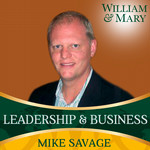 Mike Savage is Vice President for Marketing Solutions at DirectMail.com. He's worked with some of the world's top brands. In this episode, he shares his insights on digital marketing and how it affects customers and businesses.