Ken White
From William & Mary in Williamsburg, Virginia, this is Leadership & Business, the podcast that brings you the latest and best thinking from today's business leaders from across the world. We share the strategies, tactics, and information that help make you to a more effective leader, communicator, and professional. I'm your host, Ken White. Thanks for listening. Leadership is tough. For that matter, just about every job today is tough; the hours, the effort, the competition, the people, the pandemic. Success today requires a certain level of mental and physical fitness. As a result, exercise is key. And while it's important, it can be challenging to find the time to work out regularly. Well, if you're ever in need of some motivation, look to Strauss Zelnick, the chairman, and CEO of Take-Two Interactive Software and founder of the private equity firm Zelnick Media Capital. A successful leader, entrepreneur, and executive, he's in his 60s, and he's often called America's Fittest CEO. He's the author of Becoming Ageless: The Four Secrets to Looking and Feeling Younger Than Ever. Zelnick believes, if he can do it, you can do it. He visited the William & Mary School of Business last month as part of the 10th annual McGlothlin Leadership Forum. He joins us on the podcast to discuss the connection between success and fitness. Here's our conversation with Strauss Zelnick, America's fittest CEO.
Ken White
Well, Strauss, welcome back to William & Mary. And thanks for joining us on the podcast.
Strauss Zelnick
Thanks for having me.
Ken White
So in terms of fitness, what were you like as a kid? Into sports, not into sports?
Strauss Zelnick
No, I wasn't particularly athletic. I was a student. I played guitar. I wrote music. And athletics just weren't a primary interest to me.
Ken White
How did you get into it?
Strauss Zelnick
Well, I did run, and I lifted weights when I was a teenager because I was so skinny. I wanted to put on some bulk, and it seemed to be impossible. There was nothing I could do. I think when I was 17, I think I was 5'10" and weighed about 115 pounds. So you get the idea. But I sort of got into weights as a result of trying to address that. And then what really motivated me was I was in grad school, and I was hanging around with some friends one night, and my buddy Ted looked at me and said, "Strauss, you have a ponch." My response was, "No, I don't. I'm skinny. I've always been skinny." And he said, "Well, you may be skinny, but you have a ponch." And I looked down, and I thought, wow, that's probably not so far off the mark. And the next day, I decided to get involved with fitness. And I went to the gym at school, which wasn't much of a gym, and developed a very rudimentary program and started really slowly.
Ken White
And isn't that the key for people who are new starting slowly?
Strauss Zelnick
I think so. First, you have to be realistic about your goals, and the media doesn't do us any favors here. So when you see a website that says, take this pill and you can have perfect body in three weeks, everything in that sentence I just said is not true. A pill won't do it. You can't have a perfect body, probably ever, and certainly not in three weeks. And the second thing that you're told or people feel they're told often is do this program for three weeks or four weeks or 90 days, and you will be transformed. That's also not true, but it's actually worse than that. If you take someone who is sedentary and ask them immediately to engage in robust exercise, their mind may discipline them to do that for a week or two, but that's about it. You just can't do it for longer than that. It's just too hard and unpleasant. So what I recommend is start very slowly and gently and be kind to yourself. And if you're not getting any exercise now, start by walking one day a week for 15 minutes, preferably with a friend or a partner, to make it more enjoyable. And as you get used to that, maybe bring it up to 30 minutes and make it two days a week, and do that for a few weeks. And your body will ease into it. And your body will let you know when you're ready for a bit more. And then maybe add a day of calisthenics. So some push-ups and sit-ups for five or 10 minutes at home. Add that. So now you're walking two days a week, and you add one day of calisthenics. And then, if that feels okay, add a second day of calisthenics. And maybe at that point, you go either do an online fitness program, which is super easy to do. Just go to YouTube, and I can give you some recommendations and maybe add a bodyweight fitness class. And then, if you're motivated, join a gym and meet a trainer. But what I just described that period of induction, if you're not doing anything right now. That should probably take you two or three months. And if you push it and you make it go faster, you run the risk of abandoning the program.
Ken White
Or injury, and then you'll never get back again, right?
Strauss Zelnick
Exactly.
Ken White
You mentioned cardio and strength. Important to do both, in your mind?
Strauss Zelnick
I think unquestionably as you move along the process. When you start, however, anything that you do to start is okay. Whatever feels best.
Ken White
So how do you work when you're at home, not traveling? How do you work your workouts in? What's your plan?
Strauss Zelnick
So I schedule my workouts like a meeting. I treat my workouts with the same respect that I would treat having a cup of coffee with a friend or having a meal, or having a business meeting. So as I look at my calendar for the upcoming week, and I do plan ahead with flexibility as things have to change, I'll make sure that my workouts are scheduled. And by scheduling those workouts, I have a sense of the variety that I've built in or lack of variety sometimes. I do a lot of weightlifting.
Ken White
Preferably, are you a morning lifter? Evening? What do you prefer?
Strauss Zelnick
I like to get exercise in the morning. I generally do, but not always. And then sometimes I'm fortunate enough to get back to the gym and do some more exercise in the evening.
Ken White
What about when you travel?
Strauss Zelnick
Pretty much the same. I'm pretty good. This morning I missed my workout. It was a late night last night, and I knew that I needed more sleep than I needed more exercise. But I'll work out this evening when I get home.
Ken White
You'll push a little harder tonight to make up for missing this morning?
Strauss Zelnick
Maybe or maybe I won't. Maybe I'll just give myself a break and understand that I've already worked out a lot so far this week.
Ken White
So you've touched on it a little bit in terms of what do you do. What would be a typical workout for you?
Strauss Zelnick
A typical workout would be high-intensity interval training where I'm lifting weights and doing some cardio, often with a timer with other people for somewhere between 40 and 60 minutes. Another typical workout would be a weights workout built out of supersets. So one exercise followed immediately by another exercise before you take a rest.
Ken White
Twice, you've mentioned other people. Is that important to you to work out with others?
Strauss Zelnick
Very much so. I think working out by yourself is boring and a missed opportunity to connect with other people and enjoy their company and in a low-stress, natural way. So I think it's why people play golf with other people, and it's why we go to the movies with other people. It's nice to pursue leisure with other people, but no matter what kind it is. And lifting weights can be boring and painful, so if you have someone else there, it takes the edge off.
Ken White
Yeah. I assume you've worked with personal trainers?
Strauss Zelnick
I have and still do.
Ken White
What do you think? How do they help you? I guess number one.
Strauss Zelnick
Well, their expertise helps, and you definitely want to work with someone who knows what they're doing, who's not going to get you injured, and who's going to help you along your path. They're also motivating, and I often train with my trainer. So not always I have a trainer I'll be training with Friday who does not train with the group. In other instances, though, the trainer actually will work out with me, and that's beneficial in two ways. First of all, it's motivating. Secondly, I seem to do better when I see something done, as opposed to listening to the words about how it should be done.
Ken White
Yeah. So how does fitness, physical fitness help you as a professional?
Strauss Zelnick
I think fitness is really tied to leadership. First, I think to lead people. You have to convey energy. And being reasonably fit will help you feel energetic and appear energetic. Secondly, I think looking your best is a sign of self-respect and respect for others, and it's probably not popular to say that, but I believe that. And I think if you show up feeling fit, feeling energized, feeling young, even if you're not and I'm not and looking the best you can look, these things are consistent with doing a good job in business, doing a good job in relationships. It's a way of showing up for yourself and others.
Ken White
We'll continue our discussion with Strauss Zelnick in just a minute. Our podcast is brought to you by the William & Mary School of Business. The great resignation of 2021 continues as record numbers of people are leaving their jobs. Gallup Reports, almost half of all professionals in the US have their eyes on other opportunities. Well, if your company or organization wants to retain your best people, consider enrolling them in one of our MBA programs for working professionals. William & Mary's part-time MBA, online MBA, and executive MBA are designed for the professional who works full time so both the employee and the organization benefit. Employees want to feel supported by their employers. Show them your organization cares by investing in their growth. Check out the MBA program at William & Mary by visiting wm.edu. Now back to our conversation with Strauss Zelnick.
Ken White
How does it affect your mental health and your attitude?
Strauss Zelnick
Oh, hugely. Once you get into exercise, it's hard not to do it. If I don't exercise for more than a day, and I have to force myself to take a rest day. If it goes on for more than a day, then I start feeling low. And even my wife will say, you should probably go to the gym even though she thinks I work out too much. So getting exercise really is an emotional boost.
Ken White
Those who work for you, do you try to promote it verbally or by example?
Strauss Zelnick
Everything comes from the top, good and bad. I don't need to promote fitness. What I do say to people is, at all my organizations, look, no one will ever criticize you for leaving the office to go watch your kid play music or play sports. No one will ever criticize you for taking an hour to go to the gym during the day. We encourage you to have a personal life, and they know that I do that. And they know that I go to the gym and I work out with my colleagues sometimes. But I stopped well short of saying because I like this, you ought to do it. So any more than I would say because I like I don't know. I like to read nonfiction about US history that you should do that. But when the leader of an organization is doing stuff that's positive for him or her, that comes across that. People see that. And so, as a result, we have pretty fit organizations, but it's not demanded. We also pay for gym memberships or partially pay for gym memberships. And at our biggest company, we have an array of fitness-oriented programs because the team likes them, and we're happy to provide them. Actually, my biggest company, I lead two workouts a week on Zoom that people join from wherever they are in the world, and I usually have somewhere between 60 and 100 people show up.
Ken White
Wow, what that does for culture is going to be fantastic.
Strauss Zelnick
Certainly for the people who come.
Ken White
Yeah. Now food, of course, is critical. I think of my friends who work out. Food might not be terribly important. You pay attention to that. How did you get interested in food? And how did you start looking at food?
Strauss Zelnick
Well, I don't pay meticulous attention, frankly. I try to eat a healthy diet because, again, that's consistent with feeling good and longevity and health, and we ought to pay attention to it. And you know what's good for you? In the book that I wrote about fitness and health, there's a whole section on food and diet, but it's relatively straightforward, which is there are certain things you just shouldn't put in your body, like soda. Diet or otherwise or fruit juice, because fruit juice is just sugar and water or vegetable juice, same thing. You shouldn't drink your calories. It makes no sense. You should shy away from as much as possible; highly refined carbs and fried foods. But I eat dessert, so I mention that just so people don't think I'm misleading anyone. You should eat a lot of vegetables and salads. And I have a salad before lunch and dinner every day and keep the dressings as light as possible. You should eat whole carbs more than refined carbs. But again, some refined carbs are okay, too. And then lean protein. And then the truth is, if you put too many calories in your body, then you're going to gain weight. If you manage the calories you put in your body, you will either maintain or lose weight. And that's pretty much what any dietitian will tell you. You can spend lots of time and write lots of pages, but that's pretty much what people will tell you.
Ken White
So many people will say I work out so I can eat. So that's difficult to get on that healthy eating path for many people. Do you recommend they do it slowly like you recommend starting a fitness program?
Strauss Zelnick
Yes. Again, if you decide, I'm going to go on a keto diet tomorrow and some extreme diet. You can lose weight quickly. You'll probably gain it all back. If you are aiming to lose weight, the only way you can lose it and keep it off is with a very gentle approach. And it's easiest to just understand there are certain food groups that you have to eliminate or limit strictly, and then you have to watch your portions. Those are the easiest ways to look at it. In terms of I work out to eat. Well, you better be working out a whole lot because working out really doesn't burn calories. If you're running a whole lot, you will burn calories. But I'm talking about someone who runs for hours. If you go and run for 20 minutes or 30 minutes, you burn 300, 400 calories. That's one and a half candy bars. That's it. You can't really outwork your mouth. You got to control what you put in your body.
Ken White
You mentioned your book. Why did you write it? What got you to sit down and actually do that?
Strauss Zelnick
Well, I have a lot of friends in the fitness business. And my friend Dave Zinczenko, who runs his own media company and was formerly responsible for Men's Health magazine, encouraged me to write a book. And his label published it through Simon & Schuster. I think the motivation was that I've been doing this for a long time. I'm now in my 60s, and his view was, you have a great story to tell about how you can look pretty good and feel very good and be very energetic well into an age where a lot of people don't think that's possible. And so the book is called Becoming Ageless. And it's about taking care of your health. It does mention diet. It talks about exercise as well and then having a spiritual life, which I think are the four tenets to a healthy and happy life at any age.
Ken White
Yeah. We've had many guests who've written books on the podcast. I always have to ask, how did you write it? Because I know we have a lot of listeners who can write books. What was your process?
Strauss Zelnick
Well, I had a co-author on this. I've written two books. One, I did not have a co-author on. This one, I did, Zack Zeigler, who is a great writer and is editor in chief of Muscle and Fitness. And so Zack did a great deal of the writing with me. He interviewed me. The interviews were transcribed that formed the basis of a lot of what's in the book. I then physically wrote a bunch of the book, but he also wrote a lot of it and edited it carefully. And he had a great deal to do with the sections on specific exercises and specific diet plans. So that was a help. But basically, we spent about a couple of months doing interviews. I spent perhaps six or eight months writing, and then we spent about a year working on the editing the final copy and the design.
Ken White
Now you're here at the business school. You've met with a number of undergraduate business students and MBA students as well. Man, these are busy people who do like working out, but it might be the first thing to go when their list is heavy. What advice do you have for them and for all professionals who might say, I'll skip that workout, and eventually they're just not doing it?
Strauss Zelnick
Look, you can't have it all. You have to decide what your priorities are, and it's a uniquely American fantasy that we can be all things to all people at all times. We can't be. And there are times in one's life where certain things do have to take a backseat. And you have work to do. You're going to school. You have kids at home. You have partner with needs. These things may have to take precedence at times. However, you also have to know what you want. And truly, to show up for yourself and others, you do have to take care of yourself. You have to engage in self-care. And for me, exercise is part of that self-care. So I think there are times in one's life when you can easily create a priority around fitness, and there are other times when it will be harder. I think you have to be gentle with yourself. But I think if you're really not going to get exercise for more than a week or two or three, then you're going to pay a price that probably will be more costly than finding time to exercise along the way.
Ken White
That's our conversation with Strauss Zelnick. And that's it for this episode of Leadership & Business. Our podcast is brought to you by the William & Mary School of Business. Companies, organizations, and businesses are seeking professionals who think strategically, communicate effectively and manage ambiguity. You'll learn those skills and more in the William & Mary MBA program offered in four formats the full-time, the part-time, the online, and the executive MBA. Check out the William & Mary MBA program to learn more. Finally, we'd like to hear from you regarding our podcast. We invite you to share your ideas, questions, and thoughts with us by emailing us at podcast@wm.edu. Thanks to our guest, Strauss Zelnick, thanks to you for joining us. I'm Ken White, wishing you a safe, happy, and productive week ahead.



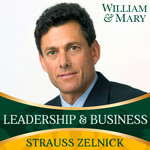 Leadership is tough. For that matter, just about every job today is tough; the hours, the effort, the competition, the people, the pandemic. Success today requires a certain level of mental and physical fitness. As a result, exercise is key. And while it's important, it can be challenging to find the time to work out regularly. If you're ever in need of some motivation, look to Strauss Zelnick - the Chairman and CEO of Take-Two Interactive Software, and founder of the private equity firm Zelnick Media Capital. A successful leader, entrepreneur, and executive, he's in his 60s and he's often called "America's Fittest CEO." He's the author of "Becoming Ageless: The Four Secrets to Looking and Feeling Younger Than Ever." Zelnick believes that if he can do it, you can do it. He visited the William & Mary School of Business last month as part of the 10th Annual McGlothlin Leadership Forum. He joins us on the podcast to discuss the connection between success and fitness.