Ken White
From the College of William & Mary in Williamsburg, Virginia, this is Leadership & Business. The podcast that brings you the latest and best thinking from today's business leaders from across the world. We share the strategies, tactics, and information that can make you a more effective leader, communicator, and professional. I'm your host Ken White. Thanks for listening. The end of another year. A good time for reflection, a good time to examine your life and career. In terms of your profession, one question you may want to ask yourself is why. Why do you do what you do, and is it the right fit? Our guest today encourages others to take time to examine their why. Quimby Kaizer is a Principal at KPMG. She recently spoke to MBA students at William & Mary about their why and the way it connects with their what and how. The point being when the three are aligned, you feel happy, fulfilled, and successful. Here's our conversation with Quimby Kaizer, Principal at KPMG.
Ken White
Well, Quimby, thanks for being here. It's great to have you back on campus. How does it feel to be back here?
Quimby Kaizer
Oh, it always feels great. Feels like home.
Ken White
Yeah, and you just talked to a huge group of MBA students. What kind of what was that experience like for you?
Quimby Kaizer
Great to come back to think about being a first-year MBA again. It's a great opportunity to sort of put myself in their shoes, you know, two decades after I went through that process myself. So quite a treat to talk with them today.
Ken White
And it was a career symposium, so that was you were the keynote, and the whole idea was talk about career. What did you share with them?
Quimby Kaizer
I shared a couple of core messages around really owning your journey, owning your career, and to accomplish that. You have to be very clear about who you are and what drives you, what inspires you, what your purposes as an individual, as well as what you're trying to achieve, and hopefully, it's not always something that everyone focuses on when they're going through school but hopefully helping people pause and spend some time getting clear on those things so that they can communicate that to others.
Ken White
And you talked about the why, the how, the what can. Can you walk us through that?
Quimby Kaizer
Yes. So for those that might be familiar. Simon Sinek wrote a book, Get Your Why, and has provided guidelines on how exceptional leaders get clarity on and come from a place of why versus the what and the how and I guess just to maybe thumbnail sketch it for people you know every single organization and individual has you know three elements the what the how and the why that drive them that really make up their existence again as an individual or an organization. Everybody can clarify and point to the what's because that's what you do right. It's what you get up every day. You get in your car. You go to work. This is what I do. So it's the products and services you sell. It's the subject matter that you know those type of things.
Ken White
Right.
Quimby Kaizer
The how is more about how you bring those products to market. And so all organizations have, and I use my own example of management consulting because that's the industry that I'm in. You sell, you're doing business development, you're developing proposals, you have to hire people, although all organizations have to do that. You might have some secret sauce that you say hey, we do this how better than anyone else. You know you can differentiate yourself with your how, but truly exceptional leaders and truly exceptional organizations focus on the why. The center of his what he calls the Golden Circle and the why is really what inspires you, it's what drives you, it's your purpose, whether that purpose is you as an individual, which is, of course, what we were talking with the students about today but it's the why that can also rally an organization as well and give it meaning to give it purpose. And so we've talked about really needing to be clear on two things what your why is and what your goal is. And having that help drive your career journey.
Ken White
And trying to get the why or purpose and the goal on the same page.
Quimby Kaizer
Correct.
Ken White
So they intersect.
Quimby Kaizer
Right, because if you can get it on the same page, if you know what it is when you'll see it, when you'll recognize it when you see it out there in the world, and you also can start to align it with what you know the conversations you're having now we were talking about getting a job right.
Ken White
Yeah, sure.
Quimby Kaizer
And getting and having a career. So if you know what drives you, you can start to see options in the you know in the environment about how your why can be applied, and if you don't, then you may end up focusing on the how or the what, which will be less effective.
Ken White
How important is that why? I mean to someone's success.
Quimby Kaizer
I think is critical because it drives your satisfaction with what you do. It's your contribution to the world. It's how you serve others, and you'll be motivated by that regardless of whether you know it or not. Right. So if there is alignment and you're aware of it, you can look for opportunities that help you live your purpose live your passion. If you don't, then it's what I said that the students you could be miserable, right? You could be restless in your career. You don't like what you're doing. You don't understand where the alignment is with organization or with the things that you're doing when there's alignment with the why, the how, and the what. That's sort of true authenticity. That's when you're getting the most impact right in the world, and in your contribution, the best leaders in the premise, which I do believe in is that when you lead with your why and the how and the what are aligned to that, you can build trust, you will get customers you'll sustain your customers you'll retain employees because there's purpose there's clarity of purpose.
Ken White
And be happy while all this stuff is going on.
Quimby Kaizer
Yeah, love what you do. We were talking about how wonderful it is to come to work every day because we love what we do, and we're excited about it.
Ken White
I've asked a number of people on the podcast this question. I'll ask you how critical is it if someone wants to be successful. What's the role of passion? How passionate do they have to be regarding what they do?
Quimby Kaizer
I think you have to be passionate because you want to be motivated, right? You want to get up in the morning with a spring in your step and not be dreading right having to go to work right. There may be moments that you dread, right? You may have a difficult conversation or, you know or an employee you gotta have a talking to or things like that, but I think, and this is what I also tell my staff as well, go where your passion is because you're gonna do it anyway right. You're your it's the things you're going to do without thinking about doing it. And you'll have more energy. You'll have more attention. You're going to go the extra mile when it's lined to your passion than if it's not. And you can start to see as you develop your career you start to see where that passion is, what do you do that you do even if no one's watching right. What do you pay attention to? And I think the passion is critical.
Ken White
You know I have a great opportunity to meet students constantly, not just at William & Mary but all over and whether it's an MBA or a senior who's an undergraduate. I think they get that why they get that purpose and the passion, but that salary is just is right in front of them, and they see that all the time, and you're a certified coach. So if one of those students came to you and said I know what I want to do, I don't see how it's going to be lucrative. How do you balance that? What kind of advice do you share with them?
Quimby Kaizer
You have to know what your goal is right. And so if your goal is to make a certain salary, then you should be aware of that, of course, right, because that could be a goal of yours. And then, you have to be clear about what your why is so that you can look for options that have that salary and meet your needs. Right. So what I would say is that you could have that as a goal, but you then have to be flexible about how your why is manifested in the world, right? So it might not be the job that you think it is or that you know about now. You may have to be more creative on how you stay focused on and have experiences or align to that why, but or at a certain salary threshold, right? Or you have to be okay with that not being a goal and then say you know what? I'm going to do something else. And because I'm making it more fulfillment or I'm going to get more joy right and passion out of this other thing I'm going to do.
Ken White
We'll continue our conversation with Quimby Kaizer in just a minute. Leadership & Business is brought to you by the Center for Corporate Education at the College of William & Mary's Raymond A. Mason School of Business. Once again, the Center for Corporate Education is offering its popular certificate in business management program in April. It's a five-day experience designed for the working professional who wants a cross-functional understanding of business. Each day is devoted to one business-related topic, including communication, operational effectiveness, strategy, managerial accounting, and leadership. The five core topics taught in our highly ranked MBA program. To learn more about the certificate in business management, visit wmleadership.com. Now back to our conversation with Quimby Kaizer.
Ken White
You talked a lot about the career progression. Some people see it as a ladder, and you talked about it being more like a rock wall. Can you share that with us?
Quimby Kaizer
Right, so I think we've all heard about a career ladder we think about all you're moving up the ladder, right? Where are you on the ladder? And my premise was just giving a different analogy of a rock wall. And so the visualization we had was this huge massive cliff with lots, and lots of toe holds and finger holds for this little rock climber to move up and around. And when you think about what's in common with a ladder as it goes up and down. Right. So you could progressed in your career. You can also fall off. I didn't talk about the students, but you can fall off right. And that happens sometimes. You get bruised and bumped, but really the rock wall allows you to move laterally. I think that's one of the big differences and why the analogy I think is better is you have more flexibility to move around 360 and still be growing right. It doesn't have to be just up, and I think up also assumes you are progressing in your career, getting more different titles. I think a rock wall it's not about title. It's about experiences and about having options. The last analogy, you know, element that I like a lot, too, Is it because if you think of the total holds and the hand holds as options, you have lots and lots of choices. Right, you go down, you can go up, you can go sideways. It's really about gathering information and having a sense of what you're trying to accomplish. Having an informed decision based on information you gathered and then I wouldn't say reacting but proactively then taking that next step.
Ken White
So thinking more about the experiences versus the title and the promotion.
Quimby Kaizer
Correct. I've worked with lots of people who just say well, how do I get promoted? What do I need to do for that next level?
Ken White
No doubt.
Quimby Kaizer
And I don't know. And you say, but that's just the wrong question, especially in the management consulting profession. I think that's a wrong question. It can be a goal. But it's a bad question to ask.
Ken White
That's so interesting because on the podcast and with so many people we interact with, especially when they're dealing with new employees, younger employees, boy, you know I've been here six months. Where's my new title? Where's my new raise? And so don't approach it from that standpoint, is what your saying.
Quimby Kaizer
Think of it as experiences. There's so many dimensions of a job, right? You think about all the things you have to do now. I can tick off a couple of things just from management consulting for illustration purposes, but you've got your subject matter expertise and how you're doing that. You've got your client management right and developing relationships you've got. Your project management keeping projects on track. You've got financial management making sure that that work is profitable. You've got employee development that is critical. You've got business development and proposals that you have to do, so when you start to think about all the dimensions that make up being successful in a career. You need to move and get experiences in all of those dimensions, and those don't necessarily happen on a time schedule.
Ken White
Right.
Quimby Kaizer
Right. It's not a ladder where you have equal rungs, and you can just move up incrementally some. I would say some careers are more ladder-like than others. They're more structured.
Ken White
Sure.
Quimby Kaizer
But certainly, I think a lot are not that rote, and it is more about collecting experiences so that you can then work at that next level and understanding what those dimensions are. Being honest with yourself about where you are on those dimensions. It's not just about time in grade but about being aware of your proficiencies in those and then being ready for the next step through those experiences.
Ken White
Yeah, you mentioned being honest with yourself where you are, and as I mentioned, you are a coach. At what point should someone seek out a coach to help them along the way so that they are doing what they need to do?
Quimby Kaizer
I think coaching is wonderful when you might be at a crossroads, or you might be stuck right. You might just not know what you need to do, and you need some inputs and maybe some structure help to guide you to think through what you're stuck on. So I hate to make the analogy to therapy because it's not therapy, but it's sort of analogous to getting some help, getting some insights, doing some work, and then taking action right, and having a coach doesn't have to be a forever thing. It's to help you get unstuck and get focused. So I think I think it's helpful at any point in your career, and I think at different times in your career could be helpful because you're working on different things.
Ken White
Yeah.
Quimby Kaizer
It's also a nice way to have someone who's supporting you. That's an outsider who can see things you can't see right. Sort of the blind spots and things like that, so it can be very insightful as well. I know that you know the organization I'm with now does help people get coaching support when they're working on certain aspects that we know that you know they might need to work on. So I'm I am very supportive of people getting support when they're stuck.
Ken White
Right.
Quimby Kaizer
Sure.
Ken White
Yeah. You also talk to the students about plan-do-check-act. Can you tell us about that?
Quimby Kaizer
Well, so I leveraged the plan-do-check-act model which Dr. Deming W. Edwards Deming came up with. He sort of the father of TQM
Ken White
Absolutely.
Quimby Kaizer
Worked in Japan at the post World War 2 and supported the what they call the Third Industrial Revolution. So he's a rock star in the operations world and the total quality.
Ken White
TQM, absolutely. You bet.
Quimby Kaizer
Yeah, there you go. Yeah, it's morphed over the years, but the basic premises are the same, and he used a simple model plan-do-check-act. So what I wanted to do is just use that simple formula to reinforce thinking of your career as an experiment and one knowing your plans to know your why, know your goal. And we talked quite a bit about that but then to when you're actually then doing checking, which is studying the results of what you've done and then acting on that. Doing it in a more research-like way. So that's why I use the experiment analogy, which gathers data. Right. You have an hypothesis. You gather data. You collect the data, you look at the data, and say okay, well, what does this mean to me? And then you adjust your plan and having that be a more positive way to think about your start of your career when we're talking to MBAs. But even thinking about your journey even within an organization as well because, you know, I think some people are afraid to get it wrong.
Ken White
No doubt.
Quimby Kaizer
So if you can think of it like an experiment and then you have incremental improvement, which is really what Deming plan-do-check-act model is about incremental learning incremental improvement. There's really no concept of a mistake right or a failure. It's all about just getting clarity and making choices with the data that you've collected. And that was what I was hoping to arm them with is, something simple to just think about their careers in that way.
Ken White
Takes a lot of heat off a lot of the pressure off.
Quimby Kaizer
Yeah, exactly, and I think there's a lot of pressure right when you're come out of graduate school. You took two years off. Now you're stressed out about getting a job, and it helps you. It helps you not be as worried that if hey if I make a mistake, I'm still. This is still a continuous improvement process. You know my life and my career is going to evolve.
Ken White
Yeah, so final question. If someone's listening, who is either going to graduate with any kind of a degree soon or wants to make that change? What kind of advice do you have for them out of the gate to get started?
Quimby Kaizer
Know what you want, right know why you're doing it right. So I highly recommend that you know what your why is. I mean, there's lots of ways to do that. It could be finding your purpose to be working with a coach to find that it could be your passion, you know, highly recommend. Being clear on what drives you what inspires you so that you can align to that, you can be aware of it, and you can make choices based on that. Know your goal and to talk to people right. Use a method to gather information to inform your choices so it's the best choice you could make with the information that you have. That's all a decision is. Is just making the best choice you can with the information you have. I also recommend experimenting. I think we have lost the art of experimentation in the sense of try it out, see, you know, if it's shadowing somebody or you know, the best way to, I think, gather information is when you're not trying to find a job right. When right when work, when you're just exploring, and you're having a conversation, and I think most people want to help others get clear or to share. Everyone likes to talk about themselves right and to share their experience. So if people are thinking about a change, gathering information people you trust, or even taking a risk and reach out people that you don't know to try to get advice. Or if you have the opportunity to actually experience something, it may help solidify what you do and your decision right. If you're still unclear or you're uncomfortable, then it's probably you need to collect more data. And the question is, will then what data will help you be confident with the decision that you're trying to make?
Ken White
That's our conversation with Quimby Kaizer, and that's our podcast for this week. Leadership & Business is brought to you by the Center for Corporate Education at the College of William & Mary's Raymond A. Mason School of Business. The Center for Corporate Education can help you, and your organization meet and exceed your goals with business and leadership development programs that fit your needs and get results. If you're interested in learning more, visit our website at wmleadership.com. Also, if you have any feedback or suggestions pertaining to the podcast, we'd love to hear from you. Email us at podcast@wm.edu. Thanks again to our guest this week Quimby Kaizer and thanks to you for joining us. I'm Ken White. Until next time have a safe, happy, and productive week., and productive week.



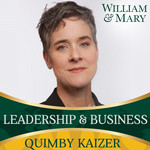 The end of another year. A good time for reflection. A good time to examine your life and career. In terms of your profession, one question you may want to ask yourself is: "Why?" Why do you do what you do? And is it the right fit. Our guest today encourages others to take time to examine their "why." Quimby Kaizer is a Principle at KPMG. She recently spoke to MBA students at William and Mary about their "why," and the way it connects with their "what" and "how." The point being, when the three are aligned, you feel happy, fulfilled, and successful.