Tatia Granger
There's a concept in teamwork called process gain, which is simply the notion of getting more as a result of having a collaborative group contribution as opposed to having an individual contribution.
Female Voice
From William & Mary in Williamsburg, Virginia. This is Leadership & Business, produced by the William & Mary School of Business and its MBA program. Offered in four formats: the full-time, the part-time, the online, and executive MBA. For more information, visit wm.edu.
Ken White
Welcome to Leadership & Business, the podcast that brings you the latest and best thinking from today's business leaders from across the world, sharing strategies, information, and insight that help you become a more effective leader, communicator, and professional. I'm your host, Ken White. Thanks for listening. You look at your calendar, and you see a team meeting is up next. How does that make you feel? Well, love them or hate them, we spend about a third of our work week working in teams. A Stanford University study found effective teamwork is linked to increased productivity. Harvard Business Review says teams make better decisions than individuals 87% of the time. Tatia Granger is a Clinical Associate Professor at William & Mary's School of Business. Among other things, her teaching and research focus on management and organizational behavior. She joins us on the podcast today to talk about teamwork, purpose, and effective teams. Here's our conversation with Professor Tatia Granger.
Ken White
Tatia, thanks so much. This is a busy time, so thank you very much for joining us on the podcast. Great to have you here.
Tatia Granger
Thank you, Ken. I appreciate the invitation.
Ken White
Teams, this is your area of expertise. You teach about teams, you work with teams. Why do so many working professionals dislike working on teams?
Tatia Granger
That's an interesting way to think about it, the dislike perspective. I think it comes from a space of not being as comfortable, surprisingly, because the younger generations have done a lot in teams in the way that they have experienced sports so much and collaborative activities, play groups, those kinds of things. And yet, at the same time, I don't know that they always think about those in the same way that they encounter the team structure, which is much more purpose-oriented and driven, requires more intentional focus on what you're bringing in terms of skill sets and your contributions. I think it's just a mindset shift. Once they get into it, I think they begin to see the value as is intended.
Ken White
How important is the leader of the team to its success?
Tatia Granger
Well, that's another interesting point because sometimes there is no designated leader. That piece is also really challenging because, in a lot of instances, when a group comes together, there's an expectation that someone is going to tell me what to do, provide the guidance, demonstrate, be the role model. Oftentimes, when teams are pulled together, that leader has to come from within. Now, sometimes, when the person is designated, obviously that makes it a lot easier to accommodate the rest of the folks. But getting to a point where that person is not designated and the group has to decide who that person is can also contribute to some of that tension and potential discomfort around this structure.
Ken White
Do you see that it's often more when the leader when we're not told who's going to lead the team? Is it somebody with the expertise, with the experience? How does that often play out?
Tatia Granger
I would say, initially, it is the person who is most willing to step forward. We can take that into a space where we look at their personality traits, those who are more outgoing, not afraid to speak up first. We could make some alignments there. We could also take a minute to consider, again, what's the purpose of this group coming together? As we think about the purpose and how the group processes that purpose, it might be someone who feels like they're an expert or at least has some comfort in that area. Maybe they've done something similar, or it's more familiar than not. That might prompt someone to step forward. It's a variety of reasons.
Ken White
Have you seen changes on teams? We obviously met in person for the longest time. Now we're not doing that so much. What are the changes you have seen in that shift?
Tatia Granger
Yeah, Absolutely. I think the research really dove into hybrid teams, remote teams, and the pros and cons in terms of how those structures impact the outcomes or deliverables. I think we're still exploring. I think there was a mixed bag, quite frankly. I think in the beginning, the expectation was that, or at least the belief was, that we might not be able to get as much done or be as productive. I think we've absolutely seen how that is not necessarily the case. And yet we've also seen how important in-person interactions can be, at least initially in that trust-building phase, which is so important for teams. It can happen in a remote setting or in a hybrid setting, but it absolutely takes longer and requires much more intentional focus. And I think this is where we have taken for granted just how much we gain from being in the same physical location. I can see you. I can notice not only your facial features, which I can see in those little boxes, but I can also pay attention to your body features and responses to conversation. I can notice even the kinds of the ways in which you take notes, whether you're using paper or you're using your laptop. I could just notice more things about you, which give me a head start, if you will, on building a relationship.
Ken White
When we work with new MBA students, when they come in and we put them on teams, of course, we always call it a team sport. They do so much in groups, and we have them work out a team contract. Can that work in the work world, a team contract?
Tatia Granger
Absolutely. I would take it back to the purpose. I would say that's probably how a team contract is started. It is the purpose of the group coming together. It might include some oversight or overarching structure, if you will, from the deliverer of the purpose, and yet it's up to the group itself to determine how they're going to get the work done. That's not just about their skill sets; it's also about the way they are going to interact their interpersonal skills as well as their technical skills. Paying attention to those, acknowledging that both the work and the environment make a huge difference in getting things done as a team, and really charting out a way on the front end before things start to go awry so that you'll have something to come back to and fall back on to help you get over the bumpy pieces if you will.
Ken White
The answer may be obvious, but what are the advantages of a team working as opposed to an individual on a project?
Tatia Granger
Obviously, it is that you have access to more. There's a concept in teamwork called process gain, which is simply the notion of getting more as a result of having a collaborative group contribution as opposed to having an individual contribution. One of the things, one of the other aspects that comes into play is this notion of collaborative intellect, intelligence, and it is pulling on all that you have access to, which can really elevate the output in more ways than if you have an individual doing that same task.
Ken White
Many of us spent some time watching the Olympics recently, right? Everybody I talked to. When you were talking with the new MBA students, you brought that up, and everybody, it seemed, in the room was pretty tied into it. You talked to them about some of the lessons learned from the Olympics in terms of teams. What are some of the highlights from that? Can we pull into teams and our teamwork?
Tatia Granger
Yeah. It was interesting. The MBAs, as new as they are, they really honed in on some of those lessons. Some of the things that they mentioned were the ways in which they saw these groups support one another in both celebration as well as agony. Sometimes, the teams didn't always turn out the way they expected. And not only their specific team but cohorts across their sport; they celebrated other teams that were doing well or not. There was also some attention call to the fact that these groups became teams for very precise reasons. You think about, I'll just use the men's and women's basketball team from the US. Those are all professionals, but they mostly play on different teams. They're usually competing against one another. Now, we're asking them to come together and put aside their natural inclinations to compete against one another, to come together and become a team that competes against others. In the way we need them to come together, we've also got to consider that we have picked what, by any standard, would be a Hall of Famer in the sports arena. Now, we have all of these quote-unquote experts. To your question earlier about who becomes the leader, well, sometimes if it's about the expertise, that makes it even harder to determine. The work of a team really becomes the focus when individuals with talents, lots of talent, come together.
Ken White
Yeah, you've got to wonder. So many superstars. Yeah. Yeah, absolutely. Have a seat on the bench. Yes. Wow.
Tatia Granger
You've got to be comfortable with that, right? You've got to know that there's a time and a place for your skillset, and your opportunity will present itself. It may be more in a supportive role, like a cheerleader if you will. I will use this example. Dawn Staley is a coach that everybody recognizes as a result of her success at the University of South Carolina with her women's basketball team. In one of her interviews, she talks about having a need for, obviously, five people on the court at a time. And yet, I think she has maybe 12. I'll just say 12. But she talks about the value of those individuals who may never get any playing time. And yet, the amount of work that they're doing behind the scenes that we as fans or observers don't see, but how important those contributions are to the ultimate output. And I appreciate that she brings that to our attention because sometimes the teams are organized in such a way that individuals have out-front roles, and we take for granted that they may be the leader. Well, they may have the particular skillset that allows them to be out front, and yet there's been a lot of contribution behind the scenes that has made their presentation what it is. I appreciate when we do have the opportunity to remind ourselves that teams do a lot of work before the work product is presented.
Ken White
We'll continue our discussion with Professor Tatia Granger in just a minute. Our podcast is brought to you by the William & Mary School of Business. The Financial Times, Bloomberg Business Week, Princeton Review, and US News & World Report have all named the William & Mary MBA program one of the best in the US and the world. If you're thinking about pursuing an MBA, consider one that has world-class faculty, unparalleled student support, and a brand that's highly respected, the William & Mary MBA. Reach out to our admissions team to learn which of our four MBA programs best fits you: the full-time, the part-time, the online, and the executive. Check out the MBA program at William & Mary at wm.edu. Now back to our conversation with Professor Tatia Granger.
Ken White
What advice do you have when someone comes to you and says, our team is just not performing? We're not getting anywhere?
Tatia Granger
That's a great question. One of the points I'd bring up about that is, I'm a member of the International Coach Federation, and that's the organization that certifies professional coaches. Within the last year, maybe 18 months, the organization has also begun to offer advanced certification for team coaching, which is a new type of certification coaching certification. That is mostly because of the reason that you just asked. Organizations, teams recognize that it's not a natural process to become a team and to be effective. There are often bumps in the road if you will. Some intentional focus, professional development for teams is evolving in the way that we've thought about professional development for individuals. If we want to focus on the outputs and the deliverables as a result of these individuals coming together, what we realize now is that we have to work with them together. Coaching individuals on a team is different than coaching the team itself. I use that example just to call to our attention that even as the teams get to work, there are ways in which the teams need to focus on team identity and their team unity and their team process as much as they think about the individuals contributing to this collaborative if that makes sense.
Ken White
Totally, because you've seen teams that are great. It's almost like they become friends, they buy in, they're excited to meet.
Tatia Granger
Absolutely. They have more of a team identity.
Ken White
Yeah.
Tatia Granger
That's really important for the developmental piece that we pay attention to the team identity as much as any type of individual skills upskilling that we might need as well.
Ken White
What happens if I like a certain role? I like to be the leader. I like to be the one who puts the slides together, whatever, and I have to get out of that role. How do we convince people that that's okay?
Tatia Granger
One of the great things that can and hopefully does happen on a team is this space of psychological safety that allows us to, one, speak up and say, I'm really good at the PowerPoints, or I'm really good at maintaining our check-ins. And yet, I'd like to try something else. So if it's a space where the trust has been developed and now folks feel comfortable trying or at least asking to do something different, they're more likely to do that, and then the group is more likely to support that. I think some things have to happen before folks are willing to raise their hand for something other than, but that's a part of the evolution of the team. That's one of the great things about being a member of a team is that depending on the timeline for the project, you have some time to get to know each other and to really lean into each other's strengths as well as stretch areas. All of that can happen over the course of being a part of a team.
Ken White
Probably everyone listening, you and I, when we look at our calendar, there's a team meeting coming up. What advice do you give to people when you see that there's so much going on, but you've a team meeting? What can we do in the few minutes prior to get yourselves ready?
Tatia Granger
I would say, first of all, think about the opportunity that it presents. One, you're going to have an opportunity to interact with others and maybe others that you don't normally interact with. I can tell you that some of the teams that I've been a part of here in the business school, committees in this instance have really allowed me to connect with my colleagues in other operational functional areas. I don't normally have an opportunity to do that. I've been so grateful that that's been a vehicle through which I've been able to get to know some of my colleagues better. I think, first and foremost, just recognize it as an opportunity to expand your professional network and your professional understanding of what others are doing to contribute to a space that you're a part of. Then, the other thing I think that matters is, again, really thinking about what's the outcome of this team. What have we been called together to do? How do I want to think about how I can contribute and keep that in mind as I begin to interact with my colleagues?
Ken White
That's our conversation with Professor Tatia Granger, and that's it for this episode of Leadership & Business. Our podcast is brought to you by the William & Mary School of Business, home of the MBA program offered in four formats: the full-time, the part-time, the online, and the executive MBA. Check out the William & Mary MBA program at wm.edu. Thanks to our guest, Tatia Granger, and thanks to you for joining us. I'm Ken White, wishing you a safe, happy, and productive week ahead.
Female Voice
We'd like to hear from you regarding the podcast. We invite you to share your ideas, questions, and thoughts with us by emailing us at podcast@wm.edu. Thanks for listening to Leadership & Business.



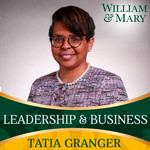 You look at your calendar and you see a Team Meeting is up next. How does that make you feel? Love them or hate, we spend about a third of our work week working in teams. A Stanford University study found effective teamwork is linked to increased productivity. Harvard Business Review says teams make better decisions than individuals 87% of the time. Tatia Granger is a clinical associate professor at William & Mary's School of Business. Among other things, her teaching and research focus on management and organizational behavior. She joins us today to talk about teamwork, purpose, and effective teams.