JD Due
And this element of starting with positive psychology, I think, allowed for a series of paradigm shifts, for people to move away from the fear that's associated with uncertainty and really look at different skills they can link into, as well as other community assets that are there, too.
Female Voice
From William & Mary in Williamsburg, Virginia. This is Leadership & Business, produced by the William & Mary School of Business and its MBA program. Offered in four formats: the full-time, the part-time, the online, and executive MBA. For more information, visit wm.edu.
Ken White
Welcome to Leadership & Business, the podcast that brings you the latest and best thinking from today's business leaders from across the world, sharing strategies, information, and insight that help you become a more effective leader, communicator, and professional. I'm your host, Ken White. Thanks for listening. Well, people in the business world have become acclimated to changing jobs and employers. It's a different picture, though, for those serving in the military. For those in uniform, a change in career or employer is rare. And when the time comes to leave the military, the transition can be an overwhelming experience. That's where William & Mary comes in. Next month, for the second time, William & Mary is hosting Flourishing Through Life's Transitions, a two-week-long certificate program that teaches transitioning military personnel how to flourish in their new careers and in their personal lives. JD Due is Executive Director of William & Mary's Center for Military Transition. He joins us to talk about this unique and successful program that helps veterans and members of the intelligence community flourish in their transition and beyond. Here's our conversation with JD Due.
Ken White
Well, JD. Thanks for sharing your time. Wasn't James Brown the hardest-working man in show business? I think you're the hardest-working guy in the military transition space, but it's nice to have you here.
JD Due
I am. And I try to do it with as much coordination of rhythm as possible. No promises, but we are staying busy, and it's great.
Ken White
Yeah, no question. It's been fantastic to watch what you've done with the Center for Military Transition in a relatively short period of time. You've been here?
JD Due
Yeah, I've been here. It's been 18 months, but it's been, I think a productive 18 months. And it's certainly, I think, been a fulfilling 18 months for all the different sort of folks that we've been able to collaborate with as well as to empower.
Ken White
Yeah, absolutely. It's been really terrific. Well, let's talk about the transition process. Say someone who has been in the military 10-20 years. They're ready to move on. What's available to them? What's the transition picture look like to them?
JD Due
Well, there's a wide array of sources that are there, which is important because the transition process, particularly when the longer one's been serving right, it's really a question of identity, and some of the very sticky and sometimes tricky questions one has to maneuver their way through. And so the process can be exceedingly difficult. Now, that said, there's a number of different resources. There is a congressionally mandated transition assistance program that each of the different services provide at different bases. It's one of the unique things about William & Mary because we're so close to a large concentration of serving service members, right? Whether that's at Norfolk, the naval station that's there, Oceania Naval Air Station just out in Virginia Beach, some additional naval assets that are there, as well as Fort Eustis. Now Fort Craig outside of Richmond, which used to be recently renamed from Fort Lee, as well as in the DC area. All of those spots will provide some assistance. One of the challenges, however, is because one of the key things that the services are concerned with is finding somebody a job. And those transition assistance programs sometimes tend to be overly focused just on that next step of employment. And there, when you're talking about identity, a huge number of other opportunities that we can empower people with that, again, will help them ease not just finding a job but perhaps making sure that they're on a good trajectory for the right job or really a new chapter of service even though they might be outside of uniform.
Ken White
So why, then, did William & Mary, the business school, the Mason School, and the Center for Military Transition start this program?
JD Due
Well, we looked at it with, in some cases, the transition space is, ironically, a little bit underfunded. It's interesting in the fact that in terms of federal funds so just a few years ago, in the same year that the national defense budget was somewhere north of 700 billion dollars, the combined spending of the DoD, the VA, the Department of Labor, the Department of Education, and the Small Business Administration was actually less than $1,000 per transitioning service member. So there are some key needs that aren't being fully addressed, and we were actually approached. The Commit Foundation, which is a world-class nonprofit that supports veterans in the transition process. They work with a really innovative program at Tuck and Dartmouth, which provides folks with business skills. They work with Stanford, that actually provides folks with entrepreneurial skills. But they came to us because of where we are located and a key aspect of the culture of the Mason School as well as the broader William & Mary spirit because they wanted a specific program where people were still wanted the opportunity to explore their own values as well as then sort of see where those values might lead them in an initial career search. So they asked us to be a part of this sort of trifecta where someone could potentially go through all three of those programs. But ours was really important because it had so much of an emphasis on self-discovery and then alignment of personal values with career and future service opportunities.
Ken White
So you may have touched on it. The program that you lead is two segments, so to speak, one week and then the next week. And they're quite different.
JD Due
Absolutely. The first week, they both focus on this notion of flourishing, which, again, I think, resonates with transitioning service members because, in the service, there's a huge emphasis on resilience. Right. There's a huge emphasis on cohesion. But this notion of flourishing is a slightly different twist on that. And we start with the individual. So that first week is actually developing specific skills of how one does flourish as an individual. And it's led through artfully, artfully by the brilliant Kelly Crace, the university associate vice president for wellness. We use the assets of his wellness center. And again, it's an aspect of really having a series of paradigm shifts that allow someone to move away from being motivated potentially by fear to then really look and boil down to these aren't only the values that prompted me to serve in uniform, but these are the values that define me as me. And they address this question of identity that's there, and then we're able to immediately pivot. And again, we put it in the hands of, again, world-class, nationally ranked, and leading business school professors that are then looking at, okay, if these are my individual values, how might those values be congruent with future civilian employment? And then Professor Dave Long is masterful at that. I mean, we look at the science that we know about employee engagement. Typically, that's looked at from a perspective of a managerial or leadership perspective. How can I do certain things to keep my employees engaged? But in this context, particularly on the heels of a week, is flourishing as an individual, the participants are able to see what's congruent in terms of what might keep them engaged. So that second week is then flourishing as a professional, and the two together really go hand in hand.
Ken White
I remember watching last year, that the first year with Dr. Crace, as you were saying. I remember things like yoga and getting out into the woods, and I said, oh, Kelly, no one's going to go, and everyone in the program just jumped in feet first with such enthusiasm. You know more about transitioning than I do. That surprised me. Did that surprise you at all?
JD Due
Yes and no. It was a pleasant surprise. But the other key thing of what actually happened throughout that process was a degree of community building and cohesion that was there. Of all the surprises, I think that was the most pleasant surprise that existed. Because, again, you have human beings that are coming under organizations that use cohesion as a survival mechanism. Right. That's one of the challenges when we think broadly about transition difficulties with the transitioning service members in America, and that added context allowed them to really, really come together. Yeah. And again, and with all the cohesion that comes from there, right? We're on paddle boards out on the lake right behind, right behind the business school. And then, as luck would have it, it's the Coast Guardsmen who falls in the water. That's whose boat capsizes, right? Which, again, folks from the army particularly relish, maybe not as much as some of the Navy veterans, but that was a really, really important sort of component of things. And this element of starting with positive psychology, I think, allowed for a series of paradigm shifts, for people to move away from the fear that's associated with uncertainty and really look at different skills they can link into, as well as other community assets that are there too.
Ken White
Last year was the pilot. That was the first time, and it seemed to go extremely smoothly. But any takeaways or changes that you think about when you think about that pilot year?
JD Due
More than anything, we want to make sure that as we grow the program to be able to help more people. In this particular piece is looking at being able to match up and have a couple of different sort of breakout groups that are there. So more than anything, it's a minor modification, really on the fringes of the program that, particularly when we're looking at that second week, is flourishing as a professional. If some people already have some ideas of different types of industries or roles that they might want to go in, to expand out, whether it's through executive partners, alumni of the program as well, to have some one on one connections with them, to again help confirm these different sort of shifts of transition that they're starting to make.
Ken White
We'll continue our discussion with JD Due of William & Mary's Center for Military Transition in just a minute. Our podcast is brought to you by the William & Mary School of Business. This year the Financial Times, the Princeton Review, US News and World Report, and CEO magazine all named the William & Mary MBA program one of the best in the US and the world. If you're thinking about pursuing an MBA, consider one that's student-centric, well-known, and highly respected, the William & Mary MBA program. Reach out to our admissions team to learn more about our four MBA programs the full-time, the part-time, the online, and the executive. Check out the MBA program at William & Mary at wm.edu. Now back to our conversation with JD Due of William & Mary's Center for Military Transition.
Ken White
You mentioned a little bit ago fear. What are some of the fears and concerns, and questions that the quote-unquote, average transitioning military professional might have?
JD Due
It's an interesting piece. I think through the lived experience of it, it actually sort of starts with its not full gaps, but it's some question marks on some aspects of just basic Maslow's hierarchy of needs, right. Whenever you're looking at particularly the strong cultural indoctrination that occurs over time in each of our military services, it's a question of, okay, where will these skills specifically fit? I have been successful in the past, but what I'm going to in the future is so different that's really those aspects of the fear that exists that's there. Now that's not different from other career transitions and people that might take a pivot within their own sort of professional development. But to do so in a very different way is really, really significant. And then the seriousness of it all. A couple of folks have remarked that they were asking the question what do they want to do when they grow up? However, now they're potentially into their 40s when they're asking that question, and they have all those different sort of uncertainties that sort of revolve around that.
Ken White
The transferable skills is what really strikes that's what strikes me. The people in the cohort last year and all the transitioning military we have in this business school. They have such skills and such experiences that the business would love, but they don't always see it. `Why is that?
JD Due
Yeah, I think it comes back down to this question of identity. If that's the first order question that they're trying to realize with that sort of shifts all different sort of aspects of context of what they're looking at in that because of those questions of identity, they then have a little bit of different gaps in confidence and just seeing where those different sort of congruencies might fit. In many ways, the cohort process, and particularly each day they, became a little bit more cohesive. They're able to share and provide feedback amongst themselves, which again was huge. That was another wonderful sort of pleasant surprise that emerged throughout the entire process. But then I think it's just helping them visualize what that new context looks like. And then it's an aspect of minor translations of making sure that as other-centric as they have been in a life of extraordinary service, they can continue to be other-centric and that other-centricness can then help them to communicate, tell their own story. But again, we're just starting to plant some slight seeds for these slight paradigm shifts. It's not an earthquake, but it's just a slight shift to help them focus on that new context.
Ken White
Are you in touch with some of the folks who went through last year?
JD Due
Absolutely, quite a few. And they're doing great. A couple of chose a couple are actually in our executive MBA program. So they saw what the Mason School had to offer, and candidly they wanted more. Others actually have been able to transition into with some key partners. One of our coasties, a veteran of the Coast Guard, retired out of the Coast Guard immediately after the program. And then we are able to actually connect him with Dominion Energy. So he's now again. He found a new sense of purpose. He's working on Dominion Energy's offshore wind project. Again, which was an alignment of his values but something he wouldn't quite visualizing when he started the program. And it's that value alignment with specific opportunity that's absolutely just wonderful, wonderful to see. And all of them have actually reached back out and have been great in terms of recruiting this new class and plan to help out as well to include one that has actually started to connect us with Ukrainian veterans who are then asking the same broad question when they look forward as they are dealing with some unimaginable issues. They're also asking this question, how can we have similar programs that empower our veterans to help rebuild something new? And again, a stark contrast from the challenges we have, but I think a very meaningful continuation of a virtuous network that this whole program pieces together.
Ken White
So you mentioned the two weeks and how they're different, sort of the individual week one and then the professional week two. What about all the rest? Do they stay on campus? Where do they stay? What do they do throughout that whole period?
JD Due
Yeah, they stay on campus. Actually, we're quite intentional about the timing of the program. And again, it'll start on June 11 and go through June 23. So on their first day here to campus, it's also Williamsburg's second Sunday, so they can then see a very contextualized community event. And we introduce that, not to assume that everyone's going to move to Williamsburg, but to highlight, hey, here's something that's unique that's here, and empower them to ask the question of what's unique in the community that they are going to serve in in that next sort of chapter. So we bring them in on that second Sunday, we get them situated, they have the opportunity to stay in dorms here, and then we host them throughout that entire sort of process. And one of the other key things that we'll actually add to this year, too, is we'll have a more array of what we're going to call dinner time discussions. And as we work through the day, we're just going to, over a meal, have additional guests come in and talk about different topics. One of those dinner-time discussions will be on entrepreneurship, right? We'll work with Graham and his expertise out of the entrepreneurship center to help empower and really inform that conversation. Another one we'll look at our partners with the Virginia Department of Veteran Services to come in and talk about, hey, everyone's really usually well aware of what the VA provides, but here are state-based benefits again to provide people with information and empower them to navigate different ways to find that information wherever their next chapter service may be.
Ken White
So the program is open to whom?
JD Due
The program is open to really sort of three categories of folks. One, it's what we sort of term as a transitioning service member, and that's somebody even within about 24 months of departing the service. The second one is a recently transitioned veteran. So again, someone that might be up to about 24 months on the far side of that transition. And then the third element that we'll have in there are military spouses. Military spouses are a wonderful empowering spot and factor within the broad transition experience for many transitioning service members. And they have to go through these transitions a lot. And sometimes, while that service member is continuing to serve, there's so many different moves that military spouses have both some experience in living through that and then also have that particular need as well. So that's who it's open to.
Ken White
Fantastic. Now, I'll share the website in just a moment, but is that where people should go and check it all out on the website?
JD Due
They can. They can, absolutely. There's a couple of links off the Center for Military Transitions wing of the Mason School website, and then they can also send an email to flourishing@wm.edu. That email gets routed into our team, and we can direct people from there. And that's for participants and or different organizations and companies that also might want to participate as well. Again, this is, I think, a wonderful convening of resources for a really remarkable and talented group of people that are looking to continue to serve even after they depart uniform service.
Ken White
Yeah, a great opportunity for companies and employers to see some potential employees right in front of them.
JD Due
Absolutely. To see those employees, as well as to continue in with meaningful connections and meaningful relationships after the two weeks. That's probably the third sort of piece that exists here in that the Center for Military Transition. As people come through the program, we can then provide some really, really important networking services, professional development services to the folks that come through there. But at the end of the day, it's not just about connections. It's about making those connections meaningful and making them congruent again with the values of the individual and then the professional skills that this entire program can piece together.
Ken White
That's our conversation with JD Due, and that's it for this episode of Leadership & Business. Our podcast is brought to you by the William & Mary School of Business, home of the MBA program, offered in four formats the full-time, the part-time, the online, and the executive MBA. Check out the William & Mary MBA program at Wm.edu. Thanks to our guest, JD Due, and thanks to you for joining us. I'm Ken White, wishing you a safe, happy, and productive week ahead.
Female Voice
We'd like to hear from you regarding the podcast. We invite you to share your ideas, questions, and thoughts with us by emailing us at podcast@wm.edu. Thanks for listening to Leadership & Business.



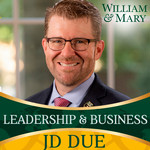 People in the business world have become acclimated to changing jobs and employers. It's a different picture, though, for those serving in the military. For those in uniform, a change in career or employer is rare. And when the time comes to leave the military, the transition can be an overwhelming experience. That's where William & Mary comes in. Next month, for the second time, William & Mary is hosting "Flourishing Through Life's Transitions," a two-week long certificate program that teaches transitioning military personnel how to flourish in their new careers and in their personal lives. JD Due is Executive Director of William & Mary's Center for Military Transition, and joins us to talk about this unique and successful program that helps veterans and members of the intelligence community flourish in their transition and beyond.