Brian Miller
People like to think that the bots are coming for the accounting jobs. I don't think that's true, but I think that the accountants who know how to take advantage of the bots and the accountants who know how to use the tools that are available are certainly going to replace the accountants that don't.
Female Voice
From William & Mary in Williamsburg, Virginia. This is Leadership & Business, produced by the William & Mary School of Business and its MBA program. Offered in four formats: the full-time, the part-time, the online, and executive MBA. For more information, visit wm.edu.
Ken White
Welcome to Leadership & Business, the podcast that brings you the latest and best thinking from today's business leaders from across the world. Sharing strategies, information, and insight that help you become a more effective leader, communicator, and professional. I'm your host, Ken White. Thanks for listening. Professionals, companies, and organizations everywhere are working to determine and refine the role automation and artificial intelligence play in their strategies and day-to-day activities. At BDO, one of the world's top accounting and advisory firms, embracing technology, AI, and automation is a way of life. Brian Miller is BDO's national audit, data analytics, and emerging methods partner. He works with the firm's leaders to set assurance innovation strategies, assurance data analytics, automation, and AI strategies. He visited William & Mary recently, where he was the keynote speaker at the Business School's Accounting Edge program. The next day, he sat down with us to discuss thriving in an era of automation and AI. Here's our conversation with BDO's Brian Miller.
Ken White
Brian, thanks very much for taking your time. It's great to see. I really enjoyed the talk last night.
Brian Miller
My pleasure. It's great to be on campus. I really appreciate the opportunity.
Ken White
Yeah you know, my first reaction was, man, how accounting has changed compared to way back in the day because if I'd have heard somebody from BDO was coming, I would expect a three-piece suit, black wing tips, and you guys were up there rocking the jeans and the sneakers and the sport coats. I think the students were like, wow, this is pretty cool.
Brian Miller
We were told Tracy was very adamant about startup chic, and it was not a stretch because that's how we are comfortable. That's how we get our most best work done.
Ken White
Yeah, it's great to see that change. You talked about automation in AI. Are the robots taking over?
Brian Miller
The robots are certainly helping, for sure. We say all the time that people like to think that the bots are coming for the accounting jobs. I don't think that's true, but I think that the accountants who know how to take advantage of the bots and the accountants who know how to use the tools that are available are certainly going to replace the accountants that don't. We already kind of see that happening.
Ken White
And you talked about some skills that you think accountants and new professionals need to have in order to work with the technology. What are some of those skills?
Brian Miller
Well, they're all soft skills. From my vantage point, I think being curious, learning, challenging the status quo. Is there a better way? So it just kind of depends. We spend a lot of time with our change management program. I have a colleague, Tara, who runs an entire enablement program. And what we learned is just hand-to-hand combat is kind of the only way to really get people over the hump. You can do all the lectures and all the town halls and all the webinars as you want, but we have some really senior partners in the firm who privately said, I know this is a better way. I know this is the right way to do it. I just need someone to show me. I need some help. So, we spent a lot of time doing job labs and individual kind of coaching sessions. And it works this way. It works that way. You push this button, you do these things, and they're all built to solve business problems. So it's not any sort of crazy coding. You don't need to be a data engineer, you don't need to be a comsci major, but you need to understand data extraction is happening and it's safe. These analytics mean these things and draw your attention here. We spend a lot of time on consistent user experience, consistent learning platforms, and learning education and change management programs so that it becomes increasingly familiar, which is a challenge because you're still in a profession that really is somewhat built around the billable hour. So it's really hard to find time to invest. Now, that's the users of the technology for the folks that have kind of come in and are building it. It changes every day. So we spend a lot of time on if it's Altrix or UiPath or data robot or robotx or whatever the application of the day is. We spend a lot of time looking at the business problem researching what the right tool for the job might be. Then, once you find the tool, you got to figure out how it works, is it safe, what the cyber consequences are. Because I have to prove to our regulator that everything that we use or adopt or build is fit for purpose, right? So if we start directing technology at our issuer client base, the regulator kind of comes in and says, okay, well, you took advantage of this, this, and this bit of technology. Show us all the ways that you either built it, stress tested it, QA, QC, and touch wood. We got a pretty good batting average around doing the requisite amount of QA and QC whether we build or buy. I'm really mindful of that because as soon as we stop if we ever were to mess that up, I know it's just going to be very difficult to kind of continue. So, we spend most of our time doing due diligence and QA QC.
Ken White
When you were talking to the students, you talked about very specific examples of how automation and AI are being embraced at BDO. Can you tell us a little bit about data protection technology?
Brian Miller
Yeah, so everything that we do, I was mentioning earlier that the managing partner of our tax firm basically says, you don't want to be the firm that gets their name in the paper for a data breach or a data leak. So we deal with a lot of sensitive information, whether it's personal information in a tax return or whether it's pre-market information in the conduct and audit. So a lot of times we spend with our clients doing direct extraction and basically say, all right, well, I'm going to tunnel into your ERP. I'm going to grab the evidence files that I need, I'm going to grab the ledgers that I need, I'm going to grab the subletters I need. Our really good, our really savvy clients, we need to kind of prove to them that we're going to take care of their information. What does that look like? It's either encrypted or it is stored in a particular environment, or it's purged after a certain period of time. Most of the conversations with our clients are not about what we're actually collecting. It's mostly about what we're not collecting. So we go in and say, well, I need your sales ledger, I need your inventory ledger, I need your warehouse details, whatever it is. But you have to kind of convince them we're not getting Social Security numbers or HR directories or HR kind of files. So we're seeing our savviest clients are the ones that are asking the right and the most intelligent kind of questions. And we have to get them with our cyber people, or we have to get them with our lawyers or whatever. One of the smartest things that we did very early when we got into deep into the extraction and data modes of working is we worked with our attorneys to lay out some pretty standard engagement letter language. So we are going to do these things in these ways and protect it in this particular way. And most of the time, we had a lot of questions about that language, and it continues to kind of evolve and live. But our clients need to be shown and proven that we're going to take as good of care with their information as possible. And again, we don't want to be the firm that gets their name in the paper for playing fast and loose with the data sovereignty the data protection. So we spend a lot of time and energy working with our cyber guys and our infrastructure guys to make sure that everything is just so so that it's safe. But it changes every day. Every day, there's a new threat and a new spam. We run phishing simulations. Like our cyber guys will send emails that are branded as from our CEO or, branded from me or branded from our learning department. Just have a question, please click here, fill out a survey, and it's a gotcha game. And if you click it, the pop-up kind of happens.
Ken White
Absolutely.
Brian Miller
You're assigned 23 hours of data protection, CPE, or whatever it is because you fell for it. Yeah, it's really working because our folks are now very mindful.
Ken White
That is working.
Brian Miller
I don't want to have to take all this homework, so I'll get a phone. Did you really send this email? Did you really ask me to? Yes, I did. Thank you for being mindful. That's an ominous kind of threat.
Ken White
Yeah. Oh, that's great. What's BDO harmony?
Brian Miller
Man, BDO harmony is the most special application to me just because I'm extremely biased towards hiring for reasons that I think will become clear in a moment. So, we started out by building our routines, and we realized pretty quickly that bespoke analytics for every audit client was just not a sustainable model. I couldn't have an analyst or a group of model architects for every kind of unicorn scenario. So we got pretty good at a common data model upfront, so, well, our clients are on QuickBooks. Our clients are on Oracle or SAP or Navision or Dynamics or a native ERP that was custom and invented the third season of Friends or whatever. We see it all. So the question became, how do we standardize our clients' data to a common language, a common convention, a common schema that all our tools will understand? So we started working on Harmony. We called it initially the front door. And the whole idea was drag clients' data in no matter size, no matter format, whatever, and codify it into a common data model that the tools universally recognize. So get in the front door. It's standardized. Everything kind of happens. So front door was going reasonably good. It's kind of an evergreen project at this point. And around the time it started getting really good and really exciting, my mother-in-law came over for lunch. She showed up unannounced. My wife is Korean. And so Julie showed up, and she said, I'm surprised I'm here for lunch, and my kids are running around, and my house is a mess. And I thought, man, I don't think we have any food, like, in the pantry or in the fridge or whatever. And Julie said, no, don't worry about it. I'll take care of it. And so she went in the kitchen, and she called us in 20 minutes later, and there was this very nice, elegant kind of spread that looked beautiful, and I didn't know where she found half of it and whatever. And my oldest son started eating and said, thank you, Harmony. And Harmony is the Korean word for grandmother. So that it hit me like a bolt of lightning like that is what we're doing. We're basically taking mess from different pockets and different places in different corners of any kind of format. So Harmony is named after an 80-year-old woman who lives in Walnut Creek, California.
Ken White
That's great.
Brian Miller
The logo is actually we had our marketing department take Julie's picture from our wedding and turn it into one of our Bots. So like the same dress and the same Versage. So, the Harmony logo. So now whenever we see her and Harmony is featured in a lot of BDO kind of collateral as the way we do analytics, I try to show her and explain to her. I mean, Harmony is in 31 countries now or whatever it is, but it all started with that kind of effort and that lunch, but it really started with the guys trying to understand how can we take all the world's data in every different kind of format and size and shape and codify it into something that we can use consistently?
Ken White
We'll continue our discussion with BDO's Brian Miller in just a minute. Our podcast is brought to you by the William & Mary School of Business. This year, the Financial Times, Bloomberg Businessweek, Princeton Review, and US News and World Report all have named the William & Mary MBA program one of the best in the US and the world. If you're thinking about pursuing an MBA, consider one that has an outstanding faculty, excellent student support, and a brand that's highly respected, the William & Mary MBA. Reach out to our admissions team to learn which of our four MBA programs best fits you: the full-time, the part-time, the online, and the executive. Check out the MBA program at William & Mary at wm.edu. Now, back to our conversation with BDO's Brian Miller.
Ken White
You said last night do what you love and automate everything else.
Brian Miller
Yeah, absolutely.
Ken White
Yeah. Tell us a little more about that.
Brian Miller
Yeah, so last night, we talked a lot about what careers in accounting kind of look like based on the foundation of the type of education you get at the Mason School of Business. Or I went to Wisconsin at our school of business. Or we talked UCLA, North Carolina, whatever. If you got a really good accounting education, there's all sorts of ways that you can go. One of the guys that work in our firm that I speak with a lot is a gentleman named Rich La Marina, who runs our advisory analytics and automation kind of practice. And they do analytics and automation as a service, whereas for audit, we do our client base, or our stakeholders, or our engagement teams. Rich goes out and basically helps companies find inefficient processes, get them optimized, and then automate them so that people aren't just kind of pushing paper from one to another. So, we talk a lot about data lineage. Internally, what that looks like is we're looking at a CRM record. Here's an opportunity. Okay, now it's time to do click a button. Now, your portal provisions, your harmony provisions, your DMs provisions. You answer a couple questions, okay? Subject matter routing. The consultation's been reviewed. Click, click, send it to the next guy. So there's a lot of opportunity there as a service. So Rich has built an entire kind of client base around automation as a service. And his marketing tagline when he goes to his markets is automate everything else do what you love. One of the clients that I had years ago when I was still a client, Beijing practitioner, was these two doctors figured out a way to harvest shrimp membrane and turn it into a hemorrhage control bandage. So they were scientists. They were researchers. And these hemorrhage control bandages were the most efficient hemorrhage control bandages ever. They beat me and whatever off the shelf at Walgreens or whatever. And they ended up with a contract with the military where every servicemen and women deployed anywhere had at least four or five of these hemorrhage control badges. They were that good, and they were that efficient. But their accounting and finance was a mess, and their processes were a mess. And you talked to them about it, and they would say, look, we're doctors, we're scientists. We know we've got this wonderful kind of product, and so we're focused on that. But as a result, they weren't terribly focused on the business or process automation and all these types of things. But there are people who are really dialed into taking concept to opportunity, to action, to de-provisioning lather, rinse, repeat. So we spent a lot of time with clients as a service doing good data, good process, and automating and applying AI algorithms on top of good data and good process.
Ken White
You mentioned it a little earlier. We're talking AI automation. This is a massive time of change.
Brian Miller
Yeah.
Ken White
You got to embrace it, right?
Brian Miller
Or else, well, it's hard. You got to be disciplined to keep up, just to keep your head above kind of water. So what we're finding now, the number one question that we get from our current clients and from our existing clients, is what does BDO do with respect to automation, analytics, innovation, artificial intelligence. In audit, in my world, in audit it's a little bit like going to the dentist, you know what I mean? Nobody really looks forward to going to the dentist, and they judge their dentist by making sure it doesn't hurt. So that's not that far from the service that we kind of do. We got to show that we're providing value in the conduct of the audit. And we also got to make sure that it's as simple and as innovative and as technology-heavy as possible. And if we can do that and we can show some value as a result beyond a compliance activity, here's where we see you compared to businesses like you. That's one of the main kind of jams of Harmony. Once you codify all your client data into a common schema, you can start benchmarking manufacturing, and retail, and bank clients against each other, and suddenly, the audit looks very different. Like we're not just kind of putting our thumb up in the air and saying, all right, this is the concentration of your assets, your revenue, your margin, your inventory turnover, your payroll, your headcount. We're basically looking at jobs now by saying, for a $50 million manufacturing company in the Midwest, you look oddly different in these areas and traditional in these other areas. So we'll go in, and we'll do a bid and say, the data is going to dictate to us how we're going to approach your job, and we have enough experience and enough KPI history now that we can approach clients differently, say, well, what do you care about? Here's what we care about here's, what you see here's, what's a matter of professional standards embedding our technology there. But when we get to a function where we say we're going to scope an audit in a particular way because what we see is atypical compared to, like, clients around this common data model standard, then you're in a really engaging conversation. If we're not doing the next thing and the next thing and the next thing, all our competitors are. So we got to constantly keep our foot in the gas because the stakeholder expectations are continuing to change.
Ken White
What advice do you have for a young professional to have a successful career?
Brian Miller
Stay curious. Stay curious, work hard, and be kind. Those are the three pieces. The colleague who's an alumni here, Tracy Lewis, who brought the opportunity to visit the school she and I started the same year in 2002. And back then, we carried work papers around in suitcases, you know what I mean? And so people were just starting to have their own laptops. Everything continues to change. And so the skills that you're learning on campus right now and the hard work and the rigor and everything you're putting in is going to be very different than two years from now. Very different five years from now. Very different ten years from now. The literacy, the financial literacy, and understanding the language of business, which is accounting, is valuable. We were saying last night it's way easier to teach the accountants the technology. As the world gets more low code and no code, that's going to increasingly be the case. We try to teach the technologists how accounting works and debits and credits and this and that. And one, it's not always terribly interesting, but two, it's also very difficult. But we find the best accountants. You give them the right education and the right curriculum around how the technology works. They could go out and do supply chain management. They can go out and do tax engineering. They can go out and do client advisory automation services or whatever. So, staying curious, and staying interested, and demonstrating leadership, I think that the way we closed the presentation last night. Anything that can be automated will anything that can't becomes more valuable. Leadership, empathy, conscientiousness, mentorship. We had breakfast with the dean this morning, and we talked a lot about well, how can we best prepare students for the rigors of a professional responsibility in your organization. I said we want good team members. We want people we can go to battle with. We want good people who challenge a status quo. Who are interested in is there a better way? People aren't just going through the motions. And so the vibe that I've gotten on campus here while we've been here is that the calibers of the students are that you got a lot of really, why is it this way? Could it be that way? And never lose that level of curiosity, and ingenuity, and philosophy. The other thing I would recommend to undergrads here is just getting off the reservation periodically. Like weave in the business school and take an art class. Take a literature class, take a history class. Round out your portfolio to the extent the curriculum allows. Because you'll find folks in the history department or the English department or the art department have a lot of perspective that may not always exist in the straight line that the business school kind of offers.
Ken White
That's our conversation with Brian Miller. And that's it for this episode of Leadership & Business. Our podcast is brought to you by the William & Mary School of Business, home of the MBA program, offered in four formats: the full-time, the part-time, the online, and the executive MBA. Check out the William & Mary MBA program at wm.edu. Thanks to our guest, Brian Miller, and thanks to you for joining us. I'm Ken White. Wishing you a safe, happy, and productive week ahead.
Female Voice
We'd like to hear from you regarding the podcast. We invite you to share your ideas, questions, and thoughts with us by emailing us at podcast@wm.edu. Thanks for listening to Leadership & Business.



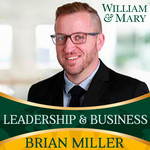 Professionals, companies, and organizations everywhere are working to determine and refine the role automation and Artificial Intelligence play in their strategies and day-to-day activities. At BDO, one of the world's top accounting and advisory firms, embracing technology, AI, and automation is a way of life. Brian Miller is BDO's national audit, data analytics, and emerging methods partner. He works with the firm's leaders to set assurance innovation strategies, assurance data analytics, automation, and AI strategies. He visited William & Mary recently where he was the keynote speaker at the business school's Accounting Edge Program. The next day he sat down with us to discuss thriving in an era of automation and AI.