Todd Mooradian
But I did commit myself coming in that everybody got a blank slate because when you bring in a new dean or a new leader in any role, that's a chance for people to get a fresh start.
Female Voice
From William & Mary in Williamsburg, Virginia. This is Leadership & Business, produced by the William & Mary School of Business and its MBA program. Offered in four formats: the full-time, the part-time, the online, and executive MBA. For more information, visit wm.edu.
Ken White
Welcome to Leadership & Business, the podcast that brings you the latest and best thinking from today's business leaders from across the world. Sharing strategies, information, and insight that help you become a more effective leader, communicator, and professional. I'm your host, Ken White. Thanks for listening. For the first time in 25 years, William & Mary's School of Business, the Raymond A. Mason School of Business, has a new leader. After long-time Dean Larry Pulley announced his retirement and the university conducted a global search, Todd Mooradian was named Dean in August. Mooradian is no stranger to William & Mary or to leadership. He spent 27 years at the Mason School of Business as a marketing professor, associate dean, and campus leader. Then, in 2017, he left to become Dean of the University of Louisville's College of Business. After five years there, he was named Dean at William & Mary. He joins us on the podcast today to discuss his role, coming home and taking the reins from a long-time and successful leader. Here's our conversation with the Dean of William & Mary's Raymond A. Mason School of Business, Dr. Todd Mooradian.
Ken White
Well, Todd, thanks very much for being with us. It's nice to have you on the podcast.
Todd Mooradian
Well, thanks for having me here, Ken. It's so great to be back at the Mason School.
Ken White
And that's what I hear from everybody. He's back. That's what I wanted to talk to you right up front is it is a bit of a homecoming. Our former Dean was here for a quarter of a century, and as you and I both know, he was effective. He was respected and well-liked. Knowing that, what role did that play in your decision to apply for the role?
Todd Mooradian
Well, I'd been a great admirer of Larry Pulleys for more than those 25 years. I met Larry when I was here to interview, and I can remember coming down the hall. They assigned another faculty member to walk you around. And as we looked ahead on my agenda and it said, okay, at 02:00, you're meeting with this guy Pulley. And the person who was walking me down the hall said, this guy is the real deal. He just won the teaching award, he's the best researcher in the building, and he's the nicest guy you'll ever meet. And that was fall of 1989 when I interviewed to come here as an assistant professor. And I can tell you that for the next 32 years, Larry Pulley has certainly lived up to that billing. He's the real deal. We were friends, but the kind of friends where you know which one's the smarter guy in the room. So I listened to Larry Pulley all along, learned a lot from him. And in thinking about that, how that integrated into my decision to come back? I'm not sure it was the driving force. But I will tell you that in five years at Louisville, I learned what a quality organization looks like, both in the fact and in the breach. You know, what pieces were there that are great and what pieces were missing? But I knew that Larry Pulley had built an organization here of quality individuals engaged in a purposeful work for a great institution. So I knew that when I came back, I would be joining a community and an organization that cares about the right things and has obviously made great progress on all the kind of intellectual dimensions of a business school. Great building, great faculty, great students, rankings, resources. But I knew also that it was people who I would respect and trust and want to work with because Larry Pulley built that kind of place.
Ken White
There's been maybe a micro trend taking place of people returning to a former employer. We didn't see that years ago. We're starting to see it quite often now in the corporate world and in higher ed. What is that like, coming back home, so to speak, after you've been gone for a while?
Todd Mooradian
Well, two things are true about that. I was here for 27 years, and I care very much about a lot of the people that define this place, and I'm humbled by the recognition that they seem to care about me. So it was coming back to friends and people that I had a natural empathy for and connection with. So it's great fun. Kind of like getting out of the car at Christmas and walking up your driveway, you know, where all the cracks are because you grew up there, and you know the faces in the door that are greeting you. It's been very gratifying.
Ken White
From a leadership standpoint, though, how do you deal with people who know you and knew you in a different role?
Todd Mooradian
I haven't faced any real challenges in that area, but I think that I did commit myself coming in that everybody got a blank slate because when you bring in a new dean or a new leader in any role, that's a chance for people to get a fresh start. It's kind of like the new semester. The old professor didn't really like your writing style, or the old professor knew that you'd gotten a 75 on the first quiz. Now you got a blank slate. And I think that everybody gets that chance with a new leader. And being a person returning to the Mason School, you could think, well, that kind of takes that away. And I committed to giving everybody a blank slate. Everybody that I had a history of who I loved and knew how great they were, I made sure that I was looking at them through fresh eyes, and people who I had to manage before and we had had to work through kind of organizational issues gave them a blank slate. Al Page, the Dean before Larry Pulley, actually called me up when Larry made me Associate Dean ten years ago, and he said congratulations. I said, what advice do you have for me, Al? And he said all I can tell you is give people a chance. They will exceed your expectations. And I'm trying to do that with some intentionality because I think everybody deserves that.
Ken White
Great advice, and we have a number of listeners who are aspiring leaders and new leaders. They're in that position where now they're leading their friends. Now they're leading what used to be their peers. And the blank slate is interesting process.
Todd Mooradian
Yeah. And the other part of that is it's not about you. It's not about me. Right. You and I work together, Ken, and we join in to get important things done. And you don't have to treat me any differently than you did six years ago when we worked together as associate deans. We joined again. I hope we have a few laughs, but most importantly, we focus on the work and trying to do the best job we can, and we focus on the institution. If I were walking around making sure everybody treated me like something special, I might get disappointed all the time, even at home. But that's not what it's about. It's old friends, old colleagues, and joining together in really important stuff. And I have the great honor of being the one that's the Dean that kind of has some ability to take the tone from the top and set our direction.
Ken White
You left here when you were associate Dean to become the Dean of the business school at the University of Louisville. What was that experience like?
Todd Mooradian
Well, nothing was right. You go someplace, and I was calling something this. And they said, oh no, we call that this here. And they did. Even overload pay for faculty, they called it xpay. I could never figure that out in five years. Finally, I was starting to call it xpay. I came back here, and now it's overload again. So the systems were different. And you say, oh my God, no, this is the way that works. And they said, no, not here at Louisville. That's not how it works. So I got to learn a new system and learn to build relationships deliberately and, honestly, authentically. And that was good. Figured out what works, what doesn't work, who I am. And then I will say that Louisville has a very different mission than William & Mary, or at least a philosophy to the mission. Louisville is about creating access for a broad group of people in a relatively well-defined geographic space. Louisville serves Louisville in Kentucky, and it's a broad mission. It takes 22,000 students who would not have had an opportunity otherwise and gives them a great education, accelerates their lives, changes their lives. William & Mary is competing with the very best in the world and winning its share of those competitions. William & Mary serves a small population. It's a global scope. So those things were different. And I learned at William & Mary, we have a 92% graduation rate or something like that. At Louisville, we set a goal of 75% graduation rate, and we were working hard to get there. That was great fun. Those people are so deserving and so wonderful, and they're going to change the world in their own way, but it was different. At William & Mary, we just don't talk about retention rate as much. Maybe we should, but it's almost at maxed step. At William & Mary, we don't look at anyone in the world and think we can't compete with them. And if we do anything at William & Mary, we think, how can we be the very best there is at this undertaking? And at Louisville, we were much more focused on the greater good, on serving those people, on building things that changed lives in a very practical way. So I learned a lot. And I actually think as I come back to William & Mary, that broadening of my perspective to think about those things is really relevant to the whole world and to William & Mary today because we are all starting to reassess who we serve, what good we do for the greater good. What could we do for the world, and how we change the future? So that was really great. The other thing that's different about Louisville is their ACC basketball. So there were 20,000 people in the Wheeler Center every night. So it's kind of a different texture to the experience. It was a big-time athletics program where they were using that brand in the city. And, you know, you and I are both sports people, so that was kind of fun.
Ken White
Sure.
Todd Mooradian
So now I'm back at William & Mary and Go Tribe.
Ken White
Absolutely.
Todd Mooradian
Ten and one, and I guess at the end, they were eleven and two in football. What a great year! So things are different in ways that don't matter. Like, I love rooting for the Tribe. I love rooting for the Cardinals. And things are different in substantive things about the mission. And then there's language, things like xpays versus overload. And you just learn that you can adapt and function in any system. I think it was good for me.
Ken White
So you have one semester under your belt. Kind of tough to get a whole lot accomplished in your very first semester as the Dean. But what were you trying to do in that first semester?
Todd Mooradian
Well, I didn't see this as coming back to disrupt. If you follow Larry Pulley, you don't think you're going to come in and change everything? And I was careful to be listening to be assessing where the opportunities are to make us better, and I accomplished that. I got to hear a lot about what had happened over the last five or six years because a lot happened. It's a different organization here today than it was when I left, and there's different people here. So I listened a lot, and I tried not to come in and change everything. Who was it? Didi Gregorius replaced Derek Jeter. He wasn't trying to be Derek Jeter.
Ken White
Right.
Todd Mooradian
But you know what? He signed a $28 million contract, and he hit 20 home runs in three seasons. And he's got to be very proud of who he is.
Ken White
Right.
Todd Mooradian
But he wasn't trying to be Derek Jeter.
Ken White
Yeah, no doubt. You mentioned something that struck a chord about listening. I had a friend who was a long-time associate dean who became a dean, and I talked to him maybe a semester or two into his tenure, and I said, what's the biggest takeaway? He said I didn't realize how much listening I had to do. He goes it's so much. He said, by 01:00 in the afternoon, I can't listen anymore. So you listen a lot, don't you? That's a big part of your job.
Todd Mooradian
I try to listen. To be candid, that's a skill that I always have to work on, listen actively and process and think about what the person is saying and what they're feeling when they say it, and trying to push for more information when we're making decisions. So I work pretty hard at listening. And I don't know if it's exhausting like your friend was kind of implying, but there are days, maybe not at 01:00, but somewhere around three, I'm ready to get back to my computer. But the other part of that is you hire a dean or an associate dean like yourself to be connected to people and to be outside connecting to people outside the school, to be connecting inside. And you shouldn't raise your hand for this job if you don't want to do that. But for me, and especially for me and my wife as a couple, this is really a job for two people. We enjoy those things. Paula worked for the alumni association. We were at a lot of events, meeting people. Now that I'm representing the institution, you have to listen. The only way to raise support for an institution is to listen to what the person with those resources, passions are and to connect what we do to those passions. And so I raised my hand, I'm enjoying it, and twist my arm give me a job where I have to go to wonderful events and listen to wonderful people talk about their relationship with William & Mary.
Ken White
And much of that is working and meeting with alumni all across the country. What is that for people who don't understand the role? What's that like? How much of your time do you spend meeting with alumni? What do you do?
Todd Mooradian
Well, there's various levels of that. There's a lot of events where you're meeting with people in relatively large groups, so you have to be practiced, and you're a great communicator, Ken, so you understand this. In an organized way, communicate what we're doing that's compelling and important. And if you're up in front of 40 people, it's not individual, and it can't be rambling. You have to be able to tell the story about the Mason School of Business pretty quickly, and 30 years here or 27 years before I left helped in a big way because I know a lot of those people. I know the underlying structures and values that drive what we do. So that's a big part of the job. And then meeting with the key donors or the key partners who are thinking about changing our world with the resources that they have. First of all, it's great privilege. Can you imagine representing the Mason School? And it's a lot about listening, as you said earlier, listen to what they want. There's a guy, Panas, Jerold Panas, that has written several books about fundraising, and he turns it around a little bit. You're not out asking for money. You're out asking to go to work for those people, to help them do for the world what they want to do with the resources that they've accumulated. And there's a story about this guy Schuller out in California who was the television minister, and he wanted to build a new church, and he went to an architect and said, I need you to design this wonderful church. And the architect said, well, what resources do you have to build the church? And he said I don't have any. We got no money. You've got to design something that's so compelling. People can't wait to give us the resources to build it. So the great fun of connecting with people who are going to contribute to William & Mary and help us be different in the future than we are today is connecting what we can be in a vision that they can't help but want to support. And that's fun. It's not asking for money. You hear people, and they say, oh, I wouldn't want to be a dean. You got to go out and ask for money. We don't ask for money. We help those people who have been fortunate in their lives to accumulate assets and resources, put those things to work in a way that they and their family want to do to change the world. It's great fun. I'm not sure I'm the best at it. I hope I'm getting better, but that's the two pieces of it. I have to be able to talk to a group, and I have to be able to listen to an individual and connect their passion to ours.
Ken White
We'll continue our conversation with Todd Mooradian in just a minute. Our podcast is brought to you by the William & Mary School of Business. The world is changing like we've never seen before, and that means change for business and your role in it. You can sit on the sidelines and watch things evolve, or you could be a part of creating the future. If you want the tools and education needed to succeed in the years ahead, we invite you to consider the MBA program at William & Mary. Wherever you happen to be in your career, William & Mary has an MBA program for you. The full-time, the part-time, the online, and the executive MBA all taught by the number one ranked MBA faculty in America. Take charge of your future. Check out the MBA program at William & Mary at wm.edu. Now back to our conversation with Todd Mooradian.
Ken White
Not to put words in your mouth, but our alumni blow me away. They are just incredible. We've had several on the podcast, but their success, what they do, what they're doing with their lives, the way they conduct business, and their personal lives, I'm assuming you're in awe half the time, and some of these people are just really remarkable.
Todd Mooradian
Oh, they certainly are. And you go out, and you meet with people, and it reinforces something that I think is true when we come back in here. And you and I have been a lot of strategic planning meetings and talking about what our strategy is going to be going into the future. And one of the things that we've latched on to is that a Renaissance education or a broadening education that creates polymaths or Renaissance people is something special about William & Mary. And that's not just something we say when we're in the boardroom talking about what are we going to build things around, what strengths are we going to parlay into success. It's when you meet with an alum from William & Mary, nine out of ten times they surprise you with the breadth of their understanding of the world, the curiosity, all those qualities of a Renaissance person or a polymath or William & Mary person. There's a book out right now, Range. It's been out a couple of years, but it basically makes a 17-chapter argument for William & Mary because it's all about the virtue of being exposed to ideas broadly and being taught to think critically and to continue to learn. And that's special about our education. And it turns out every time you meet with an alum, like you asked about, sit down with an alum from William & Mary, you come away thinking, what a smart person and what a nice person. Curious, asking questions, learning. That's the special quality. And, of course, some of them have been fantastically successful, and a lot of them have just been great William & Mary alums, faithful to their school, and proud of it.
Ken White
Yeah, no doubt. You've mentioned a couple of times about reading. Are you a big reader?
Todd Mooradian
I am. My mother was a librarian, also an artist, so at the University of New Hampshire, she was a librarian and she taught art in the school system. And my sisters and I always had a book in our hand, and I still read a lot. Of course, now you and I read a lot about what's going on in higher education, what's going on in business education, and with all the digital delivery of things to read, it can be a little overwhelming. But I do read a lot, and it comes honestly. My mother was a librarian. She used to look at us and say, you know what? Let's have quiet time and read. And that might not have been my favorite thing when she said it when I was six, but it became kind of ingrained in me.
Ken White
Your parents have definitely had an effect on you. Most conversations with you, your parents come up, either your mom or your dad. You talked about your mom. Tell us about your dad.
Todd Mooradian
My dad was a football coach really coached football, basketball, and baseball at the University of New Hampshire at a time when coaches didn't just coach one sport in the 50s, and then he focused on football and then became the athletic director at the University of New Hampshire. And as a matter of fact, the football field is named after him. They're not the stadium, but the field is Mooradian Field. And I'm kind of waiting until everybody forgets how that happened and start to tell him it was named after me, but it was named after my dad, and he was a coach that believed in coaching by encouragement. He wasn't a Bobby Knight. He was whatever you did. It was the best you could do. What did we learn, and how do we go on to get better kind of a coach and very emotional, passionate coach? And I do think I learned from him how to get people engaged in a way that we're not going to look back and look to assign blame or what went wrong. We're going to look at what did we learn? How can we go forward and do better? And also something about athletics, I think, teaches you that you should always aim high. And my dad had an expression people would say, oh, well, UNH is playing Boston College. What are you going to do? And it's Boston College. He'd say nobody laces 'em up to come in second. We're going to go out there and give it our best shot to win.
Ken White
Yeah.
Todd Mooradian
And I think that kind of what I took away from hearing him always positive and always looking to aim high was that that's the role of a leader. Give people a chance to be great, encourage it, invest in them. I'm not being critical of Bobby Knight, but that's a different leadership style.
Ken White
Sure. Yeah. What would your parents think? Would they be surprised at what you're doing now?
Todd Mooradian
Well, after my freshman fall semester, I would say that there were conversations that this was not where they thought I was headed. But I learned I thought I was a pretty good student other than that one semester where I was pretty good at getting to know campus and where all the fun was.
Ken White
Yeah, sure.
Todd Mooradian
I was a good student. I don't think they'd have thought I would go on to be a professor and a dean, necessarily. There was a time that my dad asked me if I wanted to be a coach, did I want him to connect me to other opportunities in coaching. And I just decided that that wasn't for me. And then, my dad offered to pay for graduate school when I finished undergraduate because we were in the early 80s recession. And he said, if you get a little money in your pocket, Todd, you'll never go back to graduate school. So I think we found our way together on that. But how did I end up being a dean? Gosh, are so fortunate in so many ways that nobody could have predicted.
Ken White
Just like every industry, everything is sort of upended post-pandemic. What do you see ahead for the business schools and the United States in the world? What's the future hold?
Todd Mooradian
Well, everybody bemoans that the traditional college-age demographic is shrinking. So we're going to come off a demographic cliff here. And there's not going to be enough 18-year-olds in 2025 to fill all the universities. Everybody, all of the deans that you go to these deans meetings as you and I do, and you hear people talking about the spiking competition and all the new modalities and all the new varieties of programming from certificates to degrees, but nobody ever says, and the world is just too smart. The world still needs education. The demand is there. So we're fighting with increased competition. We're using new technologies and new delivery methods. We're packaging our products in new ways like certificates and badges and stackable certificates as well as degrees. And that's all true. But driving the future has to also be a recognition that the world needs business education. So we're going to find our way. You asked earlier about coming back to William & Mary. We've got a great brand. So one of the really refreshing things was to come back and say, I'm at a place that's a top 40 university, second oldest institution in the country. We have a dominant brand in the mid-Atlantic of the United States. We need to grow that to be a global brand. But we have some strengths that we can bring to bear to help define that future that you asked about. I think we're going to define it around broadening education, the thing that William & Mary has always done. We're going to define it around excellent teaching, never compromised for research, but coupled with research. And we're going to define it around the William & Mary notion of quality and impact. And so we'll define our own future. What do I see at the macro level for the whole world of business education? It's going to stay chaotic, kind of dynamic for a while. There's so many competitors coming in, so many new ways of delivering. I wouldn't be able to see that into that looking glass.
Ken White
Yeah, fair enough. What would you say to maybe a family who comes to William & Mary and a prospective student, a high school student who's thinking about business school at William & Mary? Why should they consider the Mason School of Business?
Todd Mooradian
Well, it is a Renaissance degree in management, so it's situated on one of the world's great liberal arts campuses. And we will make a person not only deeply skilled in business but broadly educated to think from different paradigms. That's really important. There's an expression T shaped people now. It's been out about ten years. The first time I heard it was about ten years ago. But it's about giving people the breadth and then also giving them the vertical of a tier, the depth, and we certainly are a great business school. They're going to leave here with all the deep knowledge of business to be a successful and impactful employee from day one, but also across the 30 years of their career. They're going to be able to think from different perspectives. And we have a model for delivering that at William & Mary. They have to take math. They have to take two sciences. They have to take social sciences. They have to take literature and philosophy. And each of those disciplines that they get a deep immersion in has a way of knowing the world and solving problems. So the value of the horizontal on the T, the value of being situated in one of the world's great liberal arts campuses, is that you can solve a problem like a chemist, or you can solve a problem like a philosopher. A philosopher does deep reading, steps away from it in hermeneutic circles and understands the text, and takes knowledge in that way. A chemist sets up an empirical experiment and measures things. Both of those are skills that are going to help a business person. The other thing I'll promise them is four years in Williamsburg, Virginia, at the campus of William & Mary. What a great thing. If I had an 18-year-old looking for a school. Both of mine are out of school now. But four years here with faculty that engaged with you, with wonderful student life in this beautiful place, with your classmates, if we have 6,000 students, there's 5,999 other people that are a big part of your experience. I would tell them they can't do better than send a young person to William & Mary.
Ken White
You have an MBA, which, oddly enough, people, I think, are surprised to find out. Many people who work in business schools don't have MBAs. They may have doctorates in business or doctorates in a specialization. But having an MBA, what do you see with our MBA students, our online, our full-timers, our part-timers, our executive MBAs? Why should they consider the Mason School of Business for their MBA?
Todd Mooradian
Well, an MBA teaches you everything about a business in a particular way. It's not just the tools or the pieces. It's how they fit together. And if you get a good MBA, you understand the lifeblood of the organization. You understand how accounting contributes. You understand what finance does. You understand how the PNL works and where the margin comes in on a sale. You understand in a systematic and holistic way how that organization functions and survives. Nothing else gives you that. If you get an MS in data analytics or you get an MS in finance, you know a piece of that puzzle. And at William & Mary, and I say this, we developed a new curriculum. And when I say that you took the lead on that five years ago, it's a wonderful curriculum to do just what I just said. To get the students deeply involved in experiential education, that shows them how that complex system that is a business organization works. What's the lifeblood of the organization? And I would say there's no other preparation that gives a student that perspective. And we deliver that in four different ways. But we always emphasize that holistic, strategic understanding of how a business succeeds and endures. So I think that there are skill sets that have specific half-lives, like analytics, where they won't be using the same tools in 15 years in analytics, but MS in analytics gives you a great leg up to get into an industry that's going to be there in 15 years.
Ken White
No doubt.
Todd Mooradian
But an MBA isn't as skills-based as it is perspective based and a language-based paradigm, a way of thinking. And there's only one degree like that. That's the MBA.
Ken White
If you had a message for our alumni as a new dean, what would it be?
Todd Mooradian
I'm really pleased to be back in a role that connects us to the alumni. I spent 27 years here, and it's so great to see you. The alumni of William & Mary are just terrific. And people that remember different things that happened in class. So thanks for having me back, would be my first message, and it's great to see you. The other thing I would say is by hook or by crook, I'm the Dean, and I can assure our alumni that we've been working hard to get better across all of this time. So since they left, we've changed, we're doing things better, we've been true to our core values, but most importantly, I'd invite them to come back and help us build better still. Our alumni are one of our great assets, and they have a perspective on the world and how a William & Mary degree can help them or help new generations change that world. And I'd love to have you come back and talk to me about how we can do better.
Ken White
That's our conversation with Todd Mooradian. And that's it for this episode of Leadership & Business. Our podcast is brought to you by the William & Mary School of Business and its MBA program, offered in four formats the full-time, the part-time, the online, and the executive MBA. Take charge of your future. Check out the William & Mary MBA program at wm.edu. Thanks to our guest, Dean Todd Mooradian, and thanks to you for joining us. I'm Ken White, wishing you a safe, happy, and productive week ahead.
Female Voice
We'd like to hear from you regarding the podcast. We invite you to share your ideas, questions, and thoughts with us by emailing us at podcast@wm.edu. Thanks for listening to Leadership & Business.



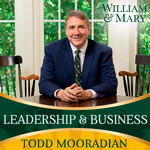 For the first time in 25 years, William & Mary's School of Business, the Raymond A. Mason School of Business, has a new leader. After long-time Dean Larry Pulley announced his retirement, and the University conducted a global search, Todd Mooradian was named Dean in August. Mooradian's no stranger to William & Mary, or to leadership. He spent 27 years at the Mason School as a marketing professor, Associate Dean, and campus leader. Then, in 2017, he left to become Dean of the University of Louisville's College of Business. After five years there, he was named Dean at William & Mary. He joins us today to discuss his role, coming home, and taking the reins from a long-time and successful leader.