Ken White
From the College of William & Mary in Williamsburg, Virginia. This is Leadership & Business. The weekly podcast that brings you the latest and best thinking from today's business leaders from all across the world. We share the strategies, tactics, and information that can make you a more effective leader, communicator, and professional. I'm your host, Ken White. Thanks for listening. Chances are someone in your network at some point decided to leave the United States to work abroad. Maybe that's something you're considering. It's a big step, of course. In addition to dealing with the professional and business aspects of working in another country, the differences in culture can be huge. Our guest successfully made that geographic leap. He left Silicon Valley, where he worked for Apple, to start a career in Asia. Bay McLaughlin is an American headquartered in Hong Kong, where he's the Chief Operating Officer at Brinc, an IoT accelerator. Despite the fact he'd never been to Asia when his wife got a job offer there, he decided to take advantage of the opportunity in the Asian startup world, moving to and succeeding in another part of the world. Here's our conversation with Bay McLaughlin.
Ken White
So, Bay, you've got a cool story. But before we talk about that, what it's like in a different culture? What it's like moving to a different world, actually? Tell us about what you do and what your company does.
Bay McLaughlin
So Brinc is an IoT accelerator. We're based in Hong Kong, Shenzhen, and Guangzhou in, China. So our main focus is to find entrepreneurs fantastic ideas around the world, invest in them, move them to Asia, help them build their products, manufacture their products, distribute their products to retail around the world, and just set them on the right footing to become a large IoT, successful business. So think Apple watch, Fitbit, Jawbone, connected cars like Google.
Ken White
Yeah. What's your technology background?
Bay McLaughlin
I was probably the least technological person. I was just interested in technology. I didn't study it, but my dad bought the first computer he could get his hands on for me. I never formally studied anything, but was always very active. I worked for Apple in college here at William & Mary when I was in the Master's and also undergraduate business programs, but then just started teaching myself how to code. But never really would call myself technical like my engineering staff is, but just enough to be dangerous.
Ken White
So after a while, you're in Virginia, born and raised. You get educated here. Your first big jump was from this coast to the West Coast. You went to work in San Francisco.
Bay McLaughlin
Correct. So I worked at Apple an undergraduate in the Master's program here. And then, unfortunately, they had a very poor intake process from their sort of college programs into the corporate program. So I got my truck, and I picked up my best friend in North Carolina and drove cross country. No job, slept on a couch, found a startup, went to a failed startup, then my next one exited, started my own, failed, went back to Apple a second time after six years total at Apple and eight years in the Bay Area just decided to shake it up again. And that's where the next big one came from.
Ken White
Yeah, no kidding. Shake it up. You left the country, and you went to Asia, and you wrote a great piece about this, about some of the small mistakes. If you could do it over again, some of the things you did. Tell us about that experience. What made you do that?
Bay McLaughlin
So just had turned 30, and my wife and I were looking at each other and just had that moment thinking, are you ready to kind of hang up the hat now and get the kids and get the Tesla and sit in the North Bay in Marin and do the thing, or do we have more gas in the tank? And it was for me she had been to Asia before, but I'd never been so sight unseen. I sold everything but a couch and got in a plane, and flew over to Hong Kong. Never been there. And started looking to figure out what was going to be the right fit and very, I think, luckily, to be honest. Found some fantastic partners in Asia just by running around and doing the circuit, going to conferences, joining a lot of other startup events, and just learning my way through it. But found some great partners that had done the exact opposite. Had gone sight unseen to China when they were 22. Met a whole other generation of people just like me, but had taken a very different path and realized that partnering was a lot better than trying to plow your way through China by yourself or Asia and just show up as an American and try to plant your roots.
Ken White
What about the language barrier? How did you deal with that?
Bay McLaughlin
Hong Kong is the easiest place. Hong Kong is a great stopping-over point. Go to Central. Everyone speaks English for the most part. Everyone expects you to speak English. From there, you have to make a decision. For me, learning Mandarin is more about authenticity, just like learning how to code. So I didn't learn how to code to ever be hired to code, but I needed to hire and manage engineers. And so the same thing in China. So it's not that I am ever going to be some amazing Mandarin speaker, but it's nice to be able to speak to my partners, to speak to the cab driver, to talk to the front desk or the waitress. It just shows that you care enough. And we have a tutor. She teaches my wife and myself, and my friends actually all now get tutored by the same lady. But it's never something I expect that I'll be incredibly proficient at, but it's certainly something that I expect my kids will be very proficient at. Hopefully, fluent, which I think it's going to be very important for that next generation.
Ken White
Yeah, no doubt. What about culture? What were some of the you had to adapt, obviously?
Bay McLaughlin
The culture was surprisingly they're open, but you have to look at it from a different angle. They accept you, and they accept that Americans do business in China, that there are good relations there, and that there's benefits to both parties. But I always call China in particular, so it's hard to speak about Asia. I'm opening offices in Malaysia and Thailand also, so different cultures there.
Ken White
Sure.
Bay McLaughlin
But in China, in particular, it's a business first. I always say that the religion is business. It's certainly not capitalistic. It is communistic. It's 100% capitalistic.
Ken White
Right.
Bay McLaughlin
It's a business first, always mentality. So as long as you approach it as such and you realize that if there's a partnership, there's a way to mutually gain, you're in great shape. And they will always be looking for that. They'll always be looking for a way to do a deal, but also protecting their own wealth and their own partnerships and relationships too. I think it's more of that military mindset in a lot of ways. You create a foundation and a structure, and families are these massive corporations in ways that you probably remember the Rockefellers and things like that, but imagine that's the way it always is all over Asia.
Ken White
Wow.
Bay McLaughlin
And they approach that I think they approach that a little differently.
Ken White
Now, what about you mentioned knowing the business first and the families? When you're interacting in most areas of Asia, there's not a lot of small talk. It's pretty much get down to it. There's not a whole lot of self-disclosure.
Bay McLaughlin
Sure. So it's not as personable if that's what you mean.
Ken White
Right.
Bay McLaughlin
But it is, really. Actually, all the business happens after anyways. It's never during the meetings until you already have a relationship. So you'll hear about Guan Xi in China. Same thing happens in Russia and Japan. Like in Japan, until you sit down to dinner and the boss takes his jacket off, no business is going to be done. It's just part of the culture. So I think in America, you expect to get business done in the meeting. Over there, it's more of chitchat, chitchat, chitchat, go get lunch, chitchat a little bit more. But the end of the day, we're not doing anything until we've had drinks, we've done dinner. I trust you at that point, you can start doing real work, but it's certainly more curt or to the point in that. So it can be a little uncomfortable from a cultural perspective, very blunt, which is different, I think, for Americans, you like to tiptoe around things a lot more PC, but you definitely don't kid yourself. You have not done any business all day long until you've gone out for drinks and dinner, and they trust you.
Ken White
Absolutely. Now, in the piece you wrote, you talked about three mistakes I made when I moved from Silicon Valley to Asia. And the one is name-dropping, which has cracked me up when I read it. Tell us about that.
Bay McLaughlin
So we actually just talked about this today. Someone else brought this up in the career center, I think. It's this idea that when someone says, I know someone, or they see them in your LinkedIn network or whatever it might be. In Asia, they just ask for it that's it. Just seems like it makes sense.
Ken White
Oh.
Bay McLaughlin
For me, it was Peter Thiel who said, oh, you know Peter Thiel, you're part of the Thiel foundation. I would like him to come to Asia. We'll invite him. He should be the keynote speaker. I just laughed, thinking, well, I personally don't know Peter. I've been a part of his foundation for a long time. He actually just recently came to our office a couple of weeks ago, so now I do but didn't then. But I had a formal invitation written and signed to invite Peter to Hong Kong. And this is something I said casually in drinks a week prior that would never happen here. Right. People understand the cultural context of they're in my network. If it's really that important, I'll find a way in for you. But if it's really not that big of a deal, I'm probably not going to go out of my way to do that. Right. And generally, in Silicon Valley, I'll send you an email introduce you two. If you care to talk up to you, but I have no, you know, no credibility or reason to care if it does or doesn't. My job is just to make a quick email introduction. Asia, they will expect to actually have access to that person, have a formal meeting, do something of substance, which is definitely a different expectation than growing up here.
Ken White
So be careful about who you say, you know. No question.
Bay McLaughlin
Definitely.
Ken White
Your second point was old money doesn't matter. What does that mean?
Bay McLaughlin
For me, it was being in Silicon Valley, it was so cool because it was this tech thing, and I always call it the web one, web two, web three type people. So web one would be your IBMs, Microsoft, Oracles, Steve Jobs, Apple. Web two would be the Jack Dorsey, and Twitters and Facebook and Zuckerbergs and Airbnb, and all these other people. And now you have all these new ones like Oculus and Nest and all these other people. But this money is not that big. But people are blown away by the fact you have 100 million dollar business, or you have a billion dollar where it's really just like an equity deal or stock deal. So people have a hard time, I think, understanding what wealth really is. And I thought, well, that's the real wealth, right? That's what I've been told my whole life. Move to Asia, and you find out. Okay, A, you've never seen money like what Asia has. It's kind of like the Middle East in that way. American money and European money is incredibly small compared to the money out there. And you also recognize that the normal person you just hung out with and had drinks is a conglomerate of a family. And you had no idea because you can't search it. It's very opaque. There's almost no transparency. You can't go to LinkedIn and find out the guy who you sat down with family, invented Roulette, have sapphire mines, own all of the TV stations on all of Hong Kong and everything else, and you just played basketball with them.
Ken White
Interesting.
Bay McLaughlin
You can't find it out like you can here.
Ken White
Right.
Bay McLaughlin
We tout it in the west in a way, and the east, they're very quiet about it, and they don't want you to know, and they want you to have access to their sort of empire that they've built. So I didn't really pay attention to it. I've quickly realized that if you want to do anything of substance in Asia, you'll be dealing in the families in that country, like the eight families in Japan or the Korean families. There are a very small group of people that run these countries.
Ken White
Right.
Bay McLaughlin
It's not the government, just like it's here. But yeah, you definitely have to pay attention, learn, figure out what you can do to support them. Again, you have to bring value to the table first.
Ken White
Sure.
Bay McLaughlin
And they have to trust you. I think there's a lot of ability to access that. It takes a lot longer than you think it would, but if you do it correctly, you can really learn a lot about the cultures there because they have built those countries, and they can teach you a lot more. So that's my other point with that, is partnering first versus trying to go build something by yourself in Asia.
Ken White
And that takes a long time in any kind of a business relationship, whether you're doing it at home. But here you're dealing with two different cultures. So patience sounds like it's pretty important.
Bay McLaughlin
Critical, and for me, again, it was this idea that I could do something in Asia but didn't know how much impact I could really have. And then, when I partnered with my two co-founders, that was when I realized just the access they had, having been there for so much longer, and the kind of level of game that we could start playing together because we are so much stronger as a team than as individuals. But for me, I had to leverage their access. There's no question.
Ken White
Your third point in the piece is I can figure it out. I can do this on my own. And you learn some lessons.
Bay McLaughlin
Yeah, that goes to the partnering thing. It certainly wasn't out of arrogance. I realized. I told myself I'd give myself around a year. That was my mental time saying I've been doing business in the States my whole life. Of course, I would need some transition time to just educate myself. So I got on a tour, and I started flying to as many countries as I could, as fast as I could, just to learn. And I popped on a couple of these Silicon Valley kind of flight things that people do, and you just go meet other entrepreneurs and investors. And it was actually surprising, to be frank. There was impact and value to add very quickly. They really do value the Western leadership style. They really are looking for it. They're very hungry for that, however, not in a vacuum. You need to find a way to apply those lessons and logic to the local ways of doing business, the local talent, the local culture. So there was real value to add there. But I realized that you can't just come in by yourself and do that. You have to tweak it and change it. And so again, through partnering, I've been able to learn, get access, and figure out how can I actually utilize what I was good at in a way that applied to the east and actually now turning it around. I just gave a talk in Manhattan around manufacturing distribution and trade in China, which I could have never spoken about a year and a half two years ago. But now I'm able to come back and take those lessons in such a short time, and I'll bring it back to the west. So it's really pretty interoperable, but you can't just outright apply either to the other. You have to tweak it.
Ken White
So you said one culture to the other. You're over there one day. You're back here another. What kind of adjustments do you have to make when you do come back home, and you're in a business setting?
Bay McLaughlin
It's been crazy. I didn't expect it. I thought it would be the same old, same old. So I've been to San Francisco twice on this trip. I'm going again for the third time next week, and I was there for almost eight years, so I figured it would just be like coming home.
Ken White
Right.
Bay McLaughlin
It is in a lot of ways. But it was surprising how different it was, even just having been gone a year and a half, two years. It was far more dramatic. And I don't know if I could probably describe it perfectly off the top of my head, but a couple of things were the pace. The pace in the west is just so much slower. Even Manhattan seems slow, having been in Asia now. We have two offices in China. You come back from China. You're exhausted. They work tirelessly. There's just nonstop energy, and also the volume of people, the amount of international deals, and people you're talking to on a regular basis. It's super energizing when you're there. But coming back here, just a quick realization of, wow, we actually move so much slower. And that's okay. It's just different.
Ken White
Sure.
Bay McLaughlin
But I was surprised how dramatic it was, how much slower it was on a day-to-day basis and simple cultural cues that, let's say, the directness or the desire to get a deal done, which I think is probably more of a Manhattan thing than a West Coast but I was there for so long.
Ken White
Sure.
Bay McLaughlin
It was more of a how do we get the community involved, how do we do what's right for this, how do we do what's right for that? Versus in Asia, it's what's in it for me. What's in it for you? Let's do this deal right now.
Ken White
Got it.
Bay McLaughlin
And it's to the point as long as it's clear we're in good shape. But they don't like to waste a lot of time just chitchatting. It's like they like, you know, going back to later. Once you have that relationship, I can get more done in a week than I can get done in a month over there. Once we have the Guanxi, once there's a relationship, I started looking back at the west and realizing how inefficient business meetings are and how inefficient the relationships are here because you're always having to recommit to the relationship. Versus in Asia, once you're in, you never have to go back again.
Ken White
Interesting.
Bay McLaughlin
You establish it once.
Ken White
Oh, that's interesting.
Bay McLaughlin
So I can speed through business deals afterwards. I spend a lot of time upfront, and then I can get infinitely more done afterwards. So you have to invest it on the front, but you get it back very quickly on the back end.
Ken White
So it's got to be a little frustrating for you. You really have to shift gears and get your head together when you're going from one place to the other, don't you?
Bay McLaughlin
I mean, I'm learning. I've only been doing it for a year and a half or so over there, so it's new. But I think from all the mentors that I have, I think that you start realizing that it just becomes ingrained like any other skill. I think it was just translating East Coast to West Coast for the first couple of years, and then I started doing it enough where you fall into a rhythm, and now I'm in Asia, so I'm falling into a new rhythm. But most of the people that I've known that have done this sort of east and west business life, that it becomes a muscle like anything else. But right now, I'm sort of in that new transition, so I'm able to identify those. Probably a good time to talk about it because I'll probably forget it very quickly, but yeah, it's new. It's conscious now, but I assume that goes away pretty quickly.
Ken White
So many MBA students and younger business professionals, and not so younger, are thinking about what if I were to do that. And when I talked to, especially some of the younger ones, it's the social aspect. Yes, I'm ready to work. What about when I'm not working? What's the social life like? How was that for you, to, and for people in your situation? Because I'm sure, you run across so many Americans over there.
Bay McLaughlin
Yeah. So the big reason we ended up doing our headquarters in Hong Kong was exactly for this. So in San Francisco, a big part of my life at Apple and in startups is building community and culture. So that's something that I am very aware of. And generally, the Asian mentality is real estate first. Build a building. People will come. Well, that works for rentals and everything else, but for culture, that's not how it works. And so Hong Kong seemed like a natural place after having been to Shenzhen and Guangzhou and Shanghai and Beijing and Thailand and all these other places, realizing these are all fantastic places. They have skills and capital and things that you need to do in those various cities for different reasons. But that's not going to be where someone from London or someone from New York, or someone from San Francisco decides to uproot their life and just drop into Shenzhen. It's just not going to happen. And the people that do hats off. Fantastic. Most of them come back to Hong Kong and go, glad to be out of China. It's great for certain reasons, and a lot of people do love living there, but for the normal kind of swath of people, you take 1000 people, 998 of them are going to rather live in Hong Kong and realize that it's actually pretty much wherever you could be. You could be in Manhattan. You could be in LA. You could be in San Francisco. You could be anywhere. It's very simple. It's a fantastic life. It's very fast, it's very humid in the summer, but you literally could be anywhere in the world. It's super comfortable. And now you're a five-hour flight from 70% of the world's population, and the coolest beaches and jungles and fun things to go explore.
Ken White
Yeah, no doubt. So someone who's thinking about this comes to you and says, I think I'm ready to take the plunge. What kind of advice do you give them?
Bay McLaughlin
I just had this happen in Manhattan. I generally say first thing is you get your ten-year China visa right now. It's $100 guaranteed. Obama passed all that, so just go get it's. $100. Just do it once. You save $1,000 if you do it, and you end up going once a year, so might as well get it. That gives you the comfort and ability just to go to China anytime you feel like. Hong Kong, as an American, you can just pass through freely. So you get 90 days, no issue. And then I make a joke, but I'm serious. Just type in Brinc with the C and Google Maps and come to the office. We're in Central, right off the escalator, happy to show you around. It's the comfortable neighborhood to be in, but I don't think you have to overthink it. I think a lot of people really do think like there's all these websites. Plan your first trip to China. It's not that big of a deal. I think I was surprised. Hong Kong, you literally could just be anywhere, and then you pop over 45-minute shuttle bus or taxi, and in three years, we'll have a 15-minute bullet train into Shenzhen and a 45-minute bullet train into Guangzhou, which is now 2 hours. You could just pop over for the day, go get some dim sum, go hang out, walk around, see what's there, go to the wash on Bay, the electronics market, or whatever, and then come back to Hong Kong and just try it out. It's not as difficult as people think it is, so I think don't overthink it. Just come check out Asia.
Ken White
Excellent.
Ken White
That's our conversation with the COO of Brinc, Bay McLaughlin, and that's our podcast for this week. Leadership & Business is brought to you by the Center for Corporate Education at the College of William & Mary's Raymond A. Mason School of Business. The Center for Corporate Education can help you and your organization by designing and delivering a customized leadership development program that specifically fits your needs. If you're interested in learning more about the opportunities at the Center for Corporate Education, check out our website at wmleadership.com. That's wmleadership.com. Thanks to our guest this week, Bay McLaughlin, and thanks to you for joining us. I'm Ken White. Until next time, have a safe and productive week.
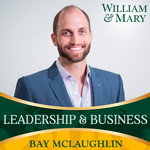 Bay McLaughlin left the USA to try his luck in the Asian Startup world, and he succeeded. Learn from his experience as he details the cultural changes and challenges of becoming an ex-pat.

