Ken White
From the College of William & Mary in Williamsburg, Virginia. This is Leadership & Business. The weekly podcast that brings you the latest and best thinking from today's business leaders from all across the world. We share the strategies, tactics, and information that can make you a more effective leader, communicator, and professional. I'm your host, Ken White. Thanks for listening. Public relations. It's come a long way from the days of the news release. Today's PR professionals are experts in strategic communication and reputation management, and they can have a positive, measurable effect on a business or organization. The Public Relations Society of America (PRSA) is PR's professional organization, with over 22,000 members worldwide. Joe Cohen is the immediate past chair of PRSA. He's also Senior Vice President for Communication at KIND Healthy Snacks in New York City. We sat down with Cohen recently in New York to discuss public relations, how the field is constantly evolving, and what it can do for your organization. Here's our conversation with Joe Cohen, Senior VP for Communication at KIND Healthy Snacks.
Ken White
Joe, thanks. It's nice to see you. You're in a new role, but before we start, let's talk about your previous role, where you and I got to know each other at the Public Relations Society of America. What was your role there?
Joe Cohen
Sure, Ken. It's always great to see you. Now, if we go back a couple of years, more than a couple of years at PRSA, I was the Volunteer National Chair, and for a time, I was co-interim CEO because we had a CEO transition during the middle of my year as National Chair. And it was a very interesting time to serve as the Chair and co-interim CEO of the organization. Within PR, there's been so much change in recent years. Social media just really caused a paradigm shift within PR, whereas in the past, public relations had been really all about earned media and securing placement in the press for the companies you represent and your clients if you're on the agency side. Once the social media revolution took place, PR people found themselves wearing more hats than ever before, playing a role in advertising, working much more closer with marketing professionals, being challenged to measure their work at a deeper level because you were able to with a lot of the different social media platforms, being able to measure sentiment in real-time and commentary and how often articles are shared and all that good stuff. And also, PR people began to have more of a role in content creation, whereas, in the past, PR sometimes was acting in a little bit of a silo. When you look at platforms like Facebook and Twitter and LinkedIn, and dynamic websites, you started to see a lot more necessary collaboration between the disciplines. And serving as Chair of PRSA during this time frame, when social media was more or less leveling the playing field between the disciplines, it was just an amazing time to serve. And as an organization, we were challenged to help our members become more adept at wearing new hats and understanding the fundamentals of integrated marketing and advertising, and media buying because more and more of those competencies folded into their jobs. So, amazing experience. I had a chance to work on some pretty cool programs, such as the MBA initiative, with you.
Ken White
Right.
Joe Cohen
And now, as I conclude my tenure on the National Board this December, I feel as though I'm leaving the organization headed in a really exciting direction where you just see PR expanding and shifting and literally expanding. I mean, the category is one of the fastest growing sectors, according to the US Bureau of Labor and Statistics. So, in addition to all the change, now is a really exciting time to go into PR, and I see a lot of companies and leaders who are more and more beginning to understand and value the role of reputation management and strategic communications within a larger business strategy and an integrated marketing framework.
Ken White
I was on the bus from LaGuardia into town the other day and sitting next to a college student who is majoring in public relations. And we were talking about the difference that you just said social media made, and we really didn't measure back in the day. There was no way to measure. And you could see your eyes just saying, really? How did you quantify what you did? We didn't that much. It was really a persuasive presentation to the board or the shareholders is what you would do. So it is interesting to see that shift in social media. Would you say that was the biggest thing you've seen in your tenure?
Joe Cohen
That was a game-changer. I think that with in the past, the way you typically would measure would be the number of articles, the amount of editorial space you'd have in articles, the ad equivalency, which is a metric that we don't use too often anymore. But I think social media and really when you look at a lot of the changes in the way people just consume media and share information. When I had started, I went from radio into PR in 1999, and when I made that jump at the time, there was no Facebook. Their email was still pretty relatively new back then, and I think that also people looked at that time to their local radio stations, terrestrial radio, to their daily newspaper for news, and it was still kind of a new thing to use new media like websites to get information. And now you fast forward to this age of information overload when people are just absorbing bite-size information and news travels so quickly. One, it's had a big ability in impacting PR people to more effectively measure their work. It's definitely changed the landscape because we have these new mediums to communicate. I think part of it also is it's really heightened the importance of reputation management because whereas we used to talk about a 24/7 news cycle. Now it's a three-second news cycle. And information travels so quickly that the reputations of venerable brands could be tarnished in an instant. So I think in addition to a lot of the differences in the way people consume media and the way we measure PR and the expanded role of PR just because of the nature of this media environment, the importance of having a strong PR function in place is just critical. I think that's really helped business leaders begin to understand on a deeper level the value of the function and embrace it wholeheartedly more and more.
Ken White
Senior Vice President Communication for KIND. What an interesting product, an interesting company. Tell us about KIND.
Joe Cohen
Sure. I mean, KIND is a great brand. I'd been on the PR agency side for 15 years, and I did that concurrently while I served on the National Board of PRSA. And I made the jump in-house to KIND for a number of reasons. One is it was a brand that I enjoyed for years and years. It was when I was going through Business Traveler at Hudson News I would grab a KIND bar, and it was kind of my go-to. And at Starbucks, I would grab a KIND bar. And what I always liked about it was you could tell it was a great product. It was a little bit better than the other products out there. And I was always kind of a bar guy. And as I learned more and more about the company, I started to realize that it was real premium ingredients, whereas other products were kind of these mashed-up emulsified slab bars. This was a bar using whole ingredients. One of our trademark sayings is ingredients you can see and pronounce, and part of the brand presentation and identity is transparent packaging. KIND of was one of the first to do that. It really shined attention on the ingredients. And now that was back in 2004. Now you look at the snack category, and there's just a lot more brands using whole ingredients and a lot more brands that are focused on creating snack foods that consumers can feel good about eating but also tastes good. So I liked just functionally that the bars tasted good, and I felt like I was eating something good. Also, what really resonated with me about KIND is that it's a purpose-driven brand, and one of the core parts of the business is giving back and spreading kindness. And we have an arm within the company called the KIND Movement that's all about supporting causes, and we like to say spreading kindness one snack and one act at a time. There's many purpose-driven brands out there that are just changing the way companies do business, like Patagonia and Warby Parker, and having a chance to run the communications team at KIND and represent a brand that I was excited about that I still feel has so much potential, and also a brand that really just has such incredible values. That was something that I felt like I had to make the leap, and I'm really glad I did, and it's been an exciting year. I think also part of what I liked about KIND is that our CEO and founder, Daniel Lubetsky, really values communications. And he has a deeper understanding of the mechanics of communications than I've ever seen a CEO exhibit before. And the level of support, the level of focus, the role of what we call our comms team, having a seat at the table, those are all things that excited me about KIND. And having been here now almost ten months, it just feels great to be part of what I believe is a terrific company and also a movement that's reshifting the focus within the snack foods category and also, in many ways, the way companies do business.
Ken White
How is that movement affecting communication in KIND? What are some of the things you're doing that maybe others aren't doing or others are doing?
Joe Cohen
Yeah, well, I think part of it is that we're very transparent with the press, and I think that's something that more and more brands are doing. Whereas you kind of think about old school PR thinking, where you kind of want to only give so much. For us, it's one because one of our values is transparency. We feel inclined that we need to walk the talk on transparency, but also, we genuinely just embrace the press and bring them within our doors. Often times we entertain media at our headquarters, where we answer questions head-on. And I think it's something that when media asks questions, where do your products come from? Where do your ingredients come from? That sort of thing. Those are questions we address. And I think it's easy when you have a product that you really believe in and that's great, and that is made from great ingredients. But I think, in general, that's something that you see more and more brands doing.
Ken White
Well, in the old days, it was sort of write a release and tell them to print a story. It's just not the case at all, is it? There's got to be a relationship between the media and the organization.
Joe Cohen
Oh, sure. I think when you look tactically at the way we approach interacting with reporters, it's very different now. I think a lot of it comes down to part of what's always been essential to PR is relationship building. But I think that now what you're seeing is there's less media, there's many more outlets, but I think a lot of outlets are working with smaller teams. And because they're constantly under pressure to crank out content, reporters are less likely to have time to meet up with you or to go to press events, and there's tighter deadlines than there had been. And so, in this real-time environment, we look for different ways to build relationships. And also it's important for us to deliver upon the belief that many press have that we're going to be a kind company. So I think that some of that comes down to figuring out creative ways to meet with reporters, to creating experiences, to engage with them digitally. But also, a lot of the old-school PR practices of getting out there and doing face-to-face meetings and going on the road and doing events, those still exist. You just have to do them in a manner that makes it less of a burden on press. And some of that comes down to timing, some of that comes down to making the extra effort and going to them. And a lot of it comes down to just having really cool stories that they want to report on that they'll make time to meet with you.
Ken White
Which is kind of the key, isn't it? It's about content. We were talking just the other day a group of MBA students about that, and some of them were business owners and had worked in the field, saying that I had a CEO that wanted this in the press regardless of content. And they'd scream if it didn't get placed. But why would a reporter run it if it wasn't all that interesting? So it's about content.
Joe Cohen
Yeah. Well, I think, Ken, that's a really good point. Before I had gone into PR, I mentioned to you that one of my early jobs was radio. And I also had studied broadcast journalism. And I think that having that understanding of what happens on the other side of, we used to say, the fax machine back then, what happens in a newsroom? And understanding the pressure on reporters and journalists to crank out compelling content that will make people buy a magazine or click on a website, or not flip the switch on a radio. I think that understanding that it's on us as communicators to give the press content to work with, that is something that was true back then, it holds true now. And I think that you need to approach interactions with the media not as transactional but as a relationship where there's a certain amount of give and take.
Ken White
Small businesses don't have a considerable amount of money to have employees and to hire people. What would your advice be to someone with a fairly small business who doesn't yet have that communication or PR function? What might they do to get started, or what might they focus on?
Joe Cohen
Sure. Well, I think that there are a lot of good solo practitioners. And I think that, as in with any trade, within any trade, you want to begin to understand the fundamentals, and you want to begin to understand the mechanics of the way the business works. Certainly, there's people who will pick up the phone and call reporters themselves. I think, within certain contexts, that's fine. I think it's always good to have a little bit of knowledge in how to approach that. I think there's great universities where you could go to, and I'm sure just as your one is a fantastic one where you could go to begin to understand some of the fundamentals of what goes into strategic communications. I think it's also good to consult with PR people. I think that one thing that I like about PRSA is that it's very much a community of individuals who help one another. And I think that even if you don't work within the field, you could go to Prsa.org and find your local PRSA chapter. There's 115 chapters across the country. Go to a meeting and start speaking to some of the pros, and you may get some good ideas. So I think in between investing in education and actually going out and meeting some pros, I think that's a good combination for you to be well suited to launch your own PR campaign. Your own PR program and strategy.
Ken White
So back to KIND. What are you focusing on in your role? What are you looking to do in the next year or so?
Joe Cohen
Sure, I mean the business is growing rapidly. And believe it or not, even though we're now one of the fastest growing brands in the snack food category and certainly within the bar and snack bar space, there's still a lot of people who don't know the brand or they'll see our bars, and they may recognize them but not know the name. So we're still very much driving awareness, getting in front of consumers, getting in front of not just reporters, but health and nutrition experts because we found that a lot of doctors and registered dietitians and personal trainers all kind of look at our snacks as a go-to item that they recommend to their clientele. So building relationships within those verticals are very important to us, and I think also just as a company, making people aware of both the taste and nutrition aspects of our bars, but also telling our company story. And our CEO just penned his first ever book, which is called Do the KIND Thing. And in that book, he tells the story of how he built KIND from a startup into a national brand. And also, he speaks not just about the products and the idea of creating a purpose-driven brand, but he gives a lot of life lessons that basically espouses the values that we follow within here, which he calls his Ten Tenets. And I think that those are real. I mean, the ten tenets that he goes through, such as the end philosophy and the idea of avoiding false compromises, that you could create a product that's healthy and nutritious, and you could have a business that's profitable and delivers upon a social good. I think that's cool philosophy. That's something that certainly appealed to me when I made the leap to join here. I think telling that story is a huge part of our focus now. I think that in the coming years, as we continue to grow, it's just exciting to be a part of that.
Ken White
What about the field PR communication? If you have a crystal ball, what do you think is in front of us? What might we see in terms of changes and, trends, strategies?
Joe Cohen
That's a great question, Ken. I think there's going to continue to be more and more integration between PR and the other disciplines. You see a lot of the big PR agencies that are shifting their business models to function more like an advertising agency or a media buying agency. And I don't think that they'll switch over to that, but I think having those capabilities where they could offer one-stop solutions to the brands they represent, I think on the same breadth, a lot of ad agencies are hiring PR experts to help build out that function. So I think you'll see agencies that may specialize in advertising or specialize in PR but are offering a much wider suite of services. And I think as the years progress, you'll continue to see more integration and possibly consolidation. I think measurement. We're getting so much more sophisticated at being able to measure. And as a CEO or a CMO or a brand director, or any leader within an organization, I recommend that you do challenge your PR teams to quantify their results. In the past, people may have said it wasn't possible. It definitely is. I think that, in general, the value of communications, particularly when it comes to crisis comm and reputation management, I think that'll only increase, especially when you look at all the it seems like there's a crisis du jour with different brands having issues every day.
Ken White
Yeah.
Joe Cohen
So I think that in between the continued integration, bigger focus on measurement, and I think continued elevation and perceived value of PR, I think those are some of the trends I'm seeing. I think also very specific within our field, a lot more specialization. Twenty years ago, you had a lot of PR generalists. Now you have a lot more people who specialize in food or in, automotive or in healthcare, and I think that will only continue.
Ken White
Joe, thanks very much. It's great to catch up with you. Congratulations on a wonderful and successful term at PRSA, and good luck to you at KIND. Really, it's great to see you here.
Joe Cohen
Hey, Ken. Thank you so much. It's just wonderful to be a part of this podcast.
Ken White
Thank you.
Ken White
That's our conversation with Joe Cohen, immediate past chair at the Public Relations Society of America and Senior Vice President for Communication at KIND Healthy Snacks, and that's our podcast for this week. Leadership & Business is brought to you by the Center for Corporate Education at the College of William & Mary's Raymond A. Mason School of Business. The Center for Corporate Education can help you and your organization by designing and delivering a customized leadership development program that specifically fits your needs. If you're interested in learning more about the opportunities at the Center for Corporate Education, check out our website at wmleadership.com. That's wmleadership.com. Thanks to our guest this week, Joe Cohen of KIND Healthy Snacks, and thanks to you for joining us. I'm Ken White. Until next time, have a safe and productive week.



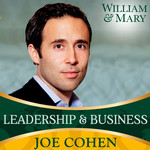 Joe Cohen is the immediate past Chair of the Public Relations Society of America. He's also the Senior Vice President for Communication with KIND Healthy Snacks in New York City. We chat with Joe about the new role of PR professionals and how social media has changed the industry.