Tim Lloyd
No one organization or group of media outlets in any country sets the news agenda, particularly among a younger demographic who are going to get their news from someone they really respect or trust or served up through an algorithm.
Female Voice
From William & Mary in Williamsburg, Virginia. This is Leadership & Business, produced by the William & Mary School of Business and its MBA program. Offered in four formats: the full-time, the part-time, the online, and executive MBA. For more information, visit wm.edu.
Ken White
Welcome to Leadership and Business, the podcast that brings you the latest and best thinking from today's business leaders from across the world, sharing strategies, information, and insight that help you become a more effective leader, communicator, and professional. I'm your host, Ken White. Thanks for listening. When you think of corporate or organizational crises, the list of examples is never-ending. The BP oil spill, the Tylenol tampering incident, the Wells Fargo account fraud scandal, the Equifax data breach, and countless others. A crisis can threaten a number of important elements, including your ability to operate, your relationships with stakeholders, the ability to pursue your strategy, and your reputation. Tim Lloyd is the managing partner at Social Simulator. He works with companies and organizations across the world, helping them train and prepare for a crisis. He was recently at the William & Mary School of Business, helping executive MBA students as they work through a crisis simulation. Before that, he joined us to talk about crisis management, the role of social media in a crisis, and why every organization needs to be prepared. Here's our conversation with Tim Lloyd.
Ken White
Tim, welcome. It's great to have you. You're coming from London. Welcome.
Tim Lloyd
That's right. Thank you for having me. It's great to be back here in Williamsburg, Virginia.
Ken White
Yeah, you've been here again before. What we're doing with our executive MBA students after we record this, actually in a couple of hours, is pretty cool. Before we get into that, tell us about Social Simulator, what that is, and your role.
Tim Lloyd
Social Simulator is a piece of software that we developed and own as a business. We take it into organizations, academic institutions, big businesses, and we stress test their teams to help them understand what it feels like and looks like to be immersed in a crisis situation. Social simulator looks like X, looks like Instagram; it looks like your email inbox, mainstream news feeds, all the bells and whistles. It's live. It's a live scenario that's usually bespoke to the client. We have a team of role players and a little bit of AI to help keep the pace fast and furious.
Ken White
Yeah, and I've seen it, and it's amazing. You feel like you were in the midst of a corporate crisis. How do you customize it for various businesses and industries?
Tim Lloyd
We look at the location of a scenario. We've got thousands of media templates behind the scenes for different countries, different regions. We look at the critical stakeholders for an organization. That might be the media, it might be investors, shareholders, it might be armchair commentators, bloggers. It might be a large, loyal, but upset customer base, for example. Then we recreate all of that on social media through phone calls, through email, all coming through the platform to help represent the audiences that the client business is most worried about.
Ken White
And as your client, a business is going through its mock, for a lack of a better term, crisis, how long do you normally run it?
Tim Lloyd
They vary wildly. I think that's partly to do with the confidence of the team that we're testing and also the scale of the organization as well. So typically around about four hours, a half day. What we're doing here this week, of course, is over two days. That's not unusual either. For our really big oil and gas clients who have a regulatory duty to rehearse environmental accidents and that thing, we could be doing three or four days over multiple time zones. And I think that's the thing we all love the most at Social Simulator is just the sheer variety of exercises and work that we deliver.
Ken White
So, with our executive MBA students, you and your team are here this week. We're running them through a crisis, and they're in teams, and they've got to respond like the C-suite would respond. Can you tell us a little bit about what they're going to be dealing with?
Tim Lloyd
Yeah. So we've got a really interesting scenario. I can't take any credit for this. This came from your team and a couple of other people in mind, but they're going to represent a fictional company that suffers an internal physical attack between employees and then a resulting supply chain crisis, loss of confidence among stakeholders in the business, lots of internal communications issues, and, of course, all the media coverage that comes with that on top. And this year, we've introduced a stock price ticker as well. So they're going to see the real financial impact of this scenario on the value of their fictional business.
Ken White
Excellent. And we're going to run them through a mock board meeting where they have to meet the board. They're going to meet the media, and so on. So, when you meet clients, how many of them understand the importance of crisis and crisis preparation?
Tim Lloyd
I would say this is really interesting, actually, to our business development. They all understand the importance of preparedness. Everyone in the world talks a really good game about that. I think the big difference is how much they commit to it, both in terms of time and investment. I always say to people our biggest competitor is PowerPoint because people say, well, we're committed to crisis preparation, but actually, what I'm going to do is show our C-suite or show our frontline employees a slide deck of examples, and then we'll simulate, in inverted commas, a little bit of an exchange. We'll do a media interview. I'll chuck a few social media posts up onto a screen, and we'll work out how to react to that. Our mission, if you like, is all about making this much more real and immersive because we think that that's where businesses are missing the rigor of crisis preparation.
Ken White
Because, man, when it hits you, it hits you. Everything's coming. It's hard to recreate that other than doing something like you're doing.
Tim Lloyd
You and I have been on both sides of the fence as well, haven't we? You're in an organization now that may be subject to a crisis, but you've also been on the other side of the fence, being, if not the protagonist, reporting on the crisis, at least on behalf of a news organization. That's the same for me. I think that gives us both an invaluable insight into what it's like for those who are caught in the middle.
Ken White
On a typical crisis team, who are you seeing on that? Meaning, is it the C-suite or are there other people when an organization puts its crisis team together?
Tim Lloyd
I think that for a reputational crisis, then it's the C-suite. For an emergency drill or incident, a big weather event, for example, then it's typically an embedded and dedicated emergency response team. There's two very different dynamics there. With an embedded emergency response team, you're talking about a mindset that's more akin to your emergency services, people who are very process-driven, very calm. They've got a plan. They know what they're doing. C-suite is no less confident or necessarily less prepared. But when it's a reputational issue or incident, there's a lot more emotion in it, I would suggest. And there's competing issues and demands that need to be thought through and unpicked.
Ken White
There's several, as you mentioned, several outside entities coming at you when you're in the midst of a crisis. When we think traditional media, it always cracks me up. Most people, I think, think of journalists by what they've seen in the movies. In your experience, when you're dealing with organizations, do they see the traditional media, the radio, the TV, they seeing that the right way?
Tim Lloyd
Yeah, this is a big issue for us, I would say. And something, if I'm honest, we still struggle a little bit with certain clients in certain parts of the world, certain cultures, and so on. Our position on this is to help clients treat an influencer exactly the same as a mainstream news reporter. I firmly believe now more than ever, and I think most people listening probably would feel the same, but it's interesting to challenge this slightly. I feel very strongly that no one organization or group of media outlets in any country sets the news agenda, particularly among a younger demographic who are going to get their news from someone they really respect or trust or served up through an algorithm. It's really, really important that when we're in an environment like this, in this media studio today, our clients are faced with mobile phones and big cameras, that they know some names of established reporters and outlets, and there are some others that they don't know. But you can't triage based on perceived fame or knowledge. It's all about that individual's influence with your audience, your customers, and investors.
Ken White
You're talking mostly social media influencers when you're-
Tim Lloyd
Yeah, definitely. Or in some cases, it could be a customer who happens to have a really big profile online or a sphere of influence in other areas that you may need to bring right to the top of your stakeholder list in order to mitigate any problems further down the line.
Ken White
We'll continue our discussion with Tim Lloyd in just a minute. Our podcast is brought to you by the William & Mary School of Business. When it comes to choosing an MBA program, people sometimes look to the rankings, among other things, for guidance. The William & Mary MBA program is ranked among the best in the world. The Financial Times includes William & Mary's full-time MBA program in its global top 100. Fortune ranks the executive MBA in its top 20. And US News & World Report lists the online MBA program in its top 20. If you're thinking about pursuing an MBA, check out all the indicators of quality, like a world-class faculty, unparalleled student support, and a brand that's highly respected, the William & Mary MBA. Reach out to our admissions team to learn which of our four MBA programs best fits you: the full-time, the part-time, the online, and the executive MBA. Check out the MBA program at William & Mary at wm.edu. Now, back to our conversation with Tim Lloyd, Managing Director of Social Simulator.
Ken White
What should an organization do to identify these folks so they're not caught off guard? Should a crisis hit?
Tim Lloyd
Well, we do some mapping work for some of our clients. As well as simulating hypothetical crises, we also look at audiences that they might need to address in the future. I think there's a framework that guides this work, but essentially, we'd look at relevance and actual evidence of engagement with that individual. For example, as a Anglo-US business, I might get interviewed about US tariffs and the impact on my business. And if that interview request comes from the Washington Post, I'm going to panic and think, oh, wow, the Washington Post. Okay, I need to get this right. But arguably, are my customers reading the Washington Post? I don't know. But I know that there's a huge community on social media of people who do things like us, who represent our core client base. And I might be more worried about an interview or a comment on LinkedIn, say, and where that might go because those are the people who ultimately are writing the checks for the work that we deliver. We map by relevance to our work and our audience, and our target market. The evidence that someone is hosting a conversation, someone is being read and acknowledged, and their content is being shared. Those two things are really important.
Ken White
Whose responsibility on the organization side is it to make sure they're on top of those influencers They know who they are. What team is that or what individual is that?
Tim Lloyd
Well, I think this is something that's still very much up for debate, and I see no commonality between all the organizations that we work for. It's a concern because social media influencers, taking one type of audience here, tend to fall into a proactive marketing bucket. People who are buying and creating advertising think about social media influencers to help amplify and extend that reach, but they don't think about them in terms of a risk for crisis. Similarly, media will fall into the press office domain, and never the twain shall meet. A lot of our work now is helping organizations to not think negatively about all the other types of audience who are out there, but just to think about the whole thing more holistically and to join up individual teams within organizations as well. When we run a crisis simulation, we're testing the press office, the marketing team, the legal team, the operations team all together in one room or virtually and ensure that they're talking to each other and beginning to get an appreciation of the common risks and the common audiences that they share.
Ken White
It must be interesting to watch those, to watch the PR team go up against legal. That's never fun. They're coming with different agendas.
Tim Lloyd
Yeah, it's a huge privilege of what we do that our clients trust us to come in and lift the lid and share with us basically the things that they're struggling with, the issues they're struggling with, and also usually where their attention is within the business as well. I mean, any consultant will say the same, but it's sometimes easier for me or one of my colleagues to go in and just call out some of those differences and call out some of the realities than it is for someone internal who knows the answer, who knows what needs to be done. But it's hard if you're the employee; it's easier for me as an outsider to do that.
Ken White
What's the difference between crisis communication training and media training?
Tim Lloyd
Media training has its place, and it's very valuable alongside a simulation. Media training, to my mind, is about preparing an individual to be interviewed in good or bad times to enable them to rehearse a message and stay on message and deliver that message in a really compelling and authentic way. Crisis training is about the whole thing in the round. So, monitoring and identifying a crisis early on, escalating information, bringing in the right people at the right time, formulating a response, and again, crucially, dealing with the long tail of that crisis as well. So, a common misconception that we encounter as a business is that once that media interview is done, the media will move on, and the crisis is dealt with. But we're seeing more and more evidence of campaign groups, really sophisticated campaign groups that spring up around an incident or problem, and they're not going to let go. Quite rightly, I would suggest. They want answers, not just next week, but in the months and the years to come. Bigger businesses can relate to this. Those who have had their reputations damaged years and years ago, there's a corner of that business that's still fighting for the reputation of that business years after the event. And I think that's the difference. Crisis training is about the beginning, the middle, and the end, which can go on for some time. Media training is about that moment in front of the camera.
Ken White
If I work in an organization and I realize we don't do a whole lot about crisis, we're not talking about it; we're not practicing thinking it, even no strategy whatsoever. What's your advice for maybe the first step or two that they should take?
Tim Lloyd
Well, I think that the first thing is to have a playbook, have some process, however basic, to set out what constitutes a crisis for our organization. There's only so many scenarios you can plan, but there's levels of impact on value, on safety, on reputation that you can map out. And then play a few of those out. Clearly, you can use social simulator, but frankly, you can sit around a table and just war game a bit of that. I think the third thing that is critical is the roles and responsibilities. So often, even some of the most rehearsed organizations still struggle to identify who's going to do what in a crisis. Just taking the time out to breathe, to think about who the gold command is, who are the silver team, and who are the bronze team, who are the doers, the researchers, the monitors, the deliverers of a crisis response, that's really crucial. The more of that that you can get nailed down before a crisis happens, the easier you'll find the situation when it arrives.
Ken White
That's our conversation with Tim Lloyd, and that's it for this episode of Leadership & Business. Our podcast is brought to you by the William & Mary School of Business, home of the MBA program offered in four formats: full-time, part-time, online, and Executive MBA. Check out the William & Mary MBA program at wm.edu. Thanks to our guest, Tim Lloyd, and thanks to you for joining us. I'm Ken White, wishing you a safe, happy, and productive week ahead.
Female Voice
We'd like to hear from you regarding the podcast. We invite you to share your ideas, questions, and thoughts with us by emailing us at podcast@wm.edu. Thanks for listening to Leadership & Business.



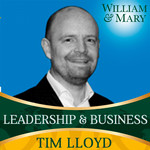 When you think of corporate or organizational crises, the list of examples is never ending: the BP oil spill, the Tylenol tampering incident, the Wells Fargo account fraud scandal, the Equifax data breach, and countless others. A crisis can threaten a number of important elements, including your ability to operate, your relationships with stakeholders, the ability to pursue your strategy, and your reputation. Tim Lloyd is Managing Partner at Social Simulator, he works with companies and organizations across the world helping them train and prepare for a crisis. He was recently at the William & Mary School of Business helping executive MBA students as they work through a crisis simulation. Before that, he joined us to talk about crisis management, the role of social media in a crisis, and why every organization needs to be prepared.