Female Speaker
From William & Mary in Williamsburg, Virginia. This is Leadership & Business, produced by the William & Mary School of Business and its MBA program. Offered in four formats: the full-time, the part-time, the online, and executive MBA. For more information, visit wm.edu.
Ken White
Welcome to Leadership & Business, the podcast that brings you the latest and best thinking from today's business leaders from across the world, sharing strategies, information, and insight to help you become a more effective leader, communicator, and professional. I'm your host, Ken White. Thanks for listening. Well, the role of today's leader is quite different from the role leaders played in the past. Today's senior leaders are navigating several challenges simultaneously. Inflation, fast-moving technology, work from home, and that's just the tip of the iceberg. Andrew White is a senior fellow in management practice at the University of Oxford Saïd School of Business in England. A leadership coach to top CEOs, he leads the Advanced Management and Leadership program at Oxford. He says leading in the modern age provides CEOs with unprecedented challenges and opportunities, such as meeting sustainability goals, ensuring diversity, retaining top talent, and navigating the fast-changing geopolitical landscape. Here's our conversation with Andrew White.
Ken White
Well, Andrew, it's great to see you. Thanks very much for joining us on the podcast.
Andrew White
Ken, it's wonderful to be here, and thank you so much for inviting me to be part of your work.
Ken White
So we see a lot of leaders and CEOs in the United States and deal with them. You're obviously seeing sort of different groups of CEOs and senior leaders. When you interact with them, what's on their minds? What keeps them up at night?
Andrew White
I think there's one headline I want to talk about, and I've been doing research with businesses for 20 years. When I started, if you got hit by a disruption, you were unlucky. You were a Polaroid. If I fast forward to where we are today, I don't think there's a business; there's an industry that is not either in disruption, having gone through one wave of disruption and facing another, or has got disruption, not on the near term horizon. So that sense that everything's being disturbed, the status quo can't be relied upon, and that for good leaders forces a conversation about transformation. And transformation, I think, is the positive reaction to that. I think that's the headline, Ken. That's what I think a lot of people are feeling. It disrupts them as individuals. It disrupts the way their company functions. It disrupts their markets. It disrupts who their competitors are. And they're having to rethink a lot of things. And I think that's what they come to Oxford for. That's what they come to the leadership program that I run for is to have the space to think through that stuff and to really get on the front foot and see the opportunity as well as address the risks.
Ken White
So a few years ago, not even a generation ago, but a few years ago, as you said, disruption was so uncommon. Does that mean now leaders are different today than they maybe were a few years ago?
Andrew White
I think that's, let's call it, the big transition. If you look at particularly towards the top of the mature organizations, the larger organizations, whether that's in the US, in Europe, or in other parts of the world, a lot of those leaders have got to the top because they've been very good at executing the status quo. And what's being asked of them is a different muscle, so to speak. And many of them haven't been trained for that. They've not been developed for that. That's not what they've experienced. So they're being pushed into it. I think there's a younger group who are coming through, who are more open to seeing the world in all its diversity, all its change, and where I've seen really, I suppose what I would say brilliant older leaders, they've had the humility to be mentored by younger leaders in the organization, often multiple levels lower with humility to recognize that, particularly around things like tech. A 28-year-old can teach a 58-year-old an awful lot, which reverses the hierarchy of power, so to speak. But you need humility to do that. And I think that's what great leaders are recognizing, that they need to lean into these things and have that open mind and that humility to learn.
Ken White
Yeah, and humility would have been a weakness, possibly 20 years for a leader, right.
Andrew White
Exactly. Now I think it's a critical strength.
Ken White
Wow. So one of the pieces you wrote, you said leaders can no longer operate under 20th-century values and models. And that's exactly what you mean then, right? We just can't do what we used to do.
Andrew White
No. And I think one of the other things that disruption forces you to do is to think about the whole question of why you exist. I think purpose has been a bit overused in recent years, but I don't think the notion has disappeared that when you go through disruption, it forces you to reevaluate who you are and why do you exist, and for who? Because your ways of working start to become challenged, and in a sense, you become a bit semi-detached from that. And so, it forces you to think about those bigger questions. I think what workers are looking for is authenticity around that conversation. And authenticity comes in two ways. It comes through an honest conversation about why we exist and for who, but it also comes through concrete actions. And this is where I think leaders perhaps have been a bit slow off the mark. They've been very good at working with marketing and PR agencies around the messaging, but then the lack of authentic implementation of that gets them in trouble, not just from an employee point of view, but from competition overtaking them and then being caught out by people coming in from outside the industry who have got better solutions for their customers.
Ken White
You said through disruption. You've got to stop and think. Are leaders doing that?
Andrew White
Yeah, I think this is I've just completed a big bit of research on transformation. And I think this is the bit that I noticed was very different. Historically, I think leaders were almost dragged kicking and screaming into disruption. You heard phrases like it was like a burning platform underneath them. I think there's a group of leaders who are recognizing the world's changing, who are driving into that, who are embracing some of the difficult emotions, like fear, like anxiety, like stress, but also, let's call it the excitement of seeing what's new. It's not all negative emotions, but they're embracing it, that they're bringing disruptive voices into their executive committees because they recognize that what might have been a voice that you could ignore historically, you can't. And the classic one at the moment is the energy industry. And if you just look at what's happened over the last year with the big oil and gas companies, they're having to pivot huge resources. I really wouldn't want to be leading one of those businesses. I think they've got huge challenges on their hands. They've got shareholders that expect dividends. So they're seen as a dividend stock. But really, I would argue they should be seen as a growth stock for the next ten years as they go through that transition. And they need to embrace the climate scientists. They need to embrace the climate activists. These people could actually be agents of change. And some of them are starting to do this if they really realize that there's a different industry that will exist in the next ten or 20 years, and the ones that can move quickest to it are going to grab that industry land and over and above their existing competitors, and the new competitors that are piling into the space, as well as capital, starts to mobilize into that.
Ken White
And at the same time, those we know household names, great companies of today, may not be around in ten years.
Andrew White
Yeah. And when we look back over history in periods that were less disruptive, we've seen that. And so, I think we're going to see that even more so that they're just not going to have the ability to transform themselves in the way that they need to.
Ken White
You've written some about what you call the modern challenges facing today's CEO, and four, in particular, I'd love to briefly talk about all four. One of them is meeting sustainability goals. How critical is this now for today's leaders and CEOs?
Andrew White
Yeah. So I think sustainability has gone from being something which you could do through your corporate CSR activity. It's now core of the business. And if you're not doing it, regulators will force it on you. Customers will start to demand it coming through social media, and competitors will come and produce products that are better and more aligned with regulatory structures, are more aligned with what customers want, and you're increasingly being measured on it. So you're having to disclose your carbon footprint. I don't think it will be long before that becomes even more of a formal way of accounting for resources. You know, I'm hearing about companies putting carbon budgets into their senior leaders KPI structures. So they'll have a certain amount of carbon that they can spend, typically on travel. How do they choose to allocate that? In the same way, they have an expense account that they have to be accountable for. So these things are no longer separate from the business. They're no longer adjacent. I think sustainability and profitable growth are two sides of the same coin in many cases.
Ken White
It's interesting dealing with young people about to get their Bachelor's or their MBAs. It's important to them, too. They want to work for a company that's got some real sustainability goals.
Andrew White
Yeah. And I think that it's not just you're absolutely right, but it's also I wouldn't want my pension invested in an oil and gas company with 100% in there of my capital in there at the moment. I'm not sure I'd want that much exposed to it for the reasons we've spoken about. So is this business going to be around in ten years, in 20 years, or is it going to be a shadow of its former self like Kodak is, I think, today compared to where it was? And we have to take these things into account as investors, as customers, as employees as well. And I think with a younger generation, for them, it's not just about salary. It's also about questions of values. Does this company have enough of do I see enough of my values represented in this company? Being a leader today, I think a much more complicated job.
Ken White
We'll continue our conversation with Andrew White in just a minute. Our podcast is brought to you by the William & Mary School of Business. If your organization is interested in retaining your best people, consider enrolling them in one of our MBA programs for working professionals. William & Mary's online MBA, part-time MBA, and executive MBA programs are designed for the professional who works full time. So both the employee and the organization benefit. Show your employees you care by investing in their growth. Check out the MBA program at William &Mary at wm.edu. Now back to our conversation with leadership coach Andrew White.
Ken White
Another modern challenge that you've written about facing CEOs diversity.
Andrew White
Yeah. And I think this has several layers to it. Let's call it a societal level. How do we create a fair and equal society, and how do we address some of the historic problems that we've seen in certain countries, the US and the UK being big examples of those. But also, how do we bring diversity of thought? Companies can be quite homogenous and closed-minded. And in a time of change and disruption, you need people who think differently. You need to bring in people from different communities with different backgrounds who see the world differently and leaders who can see that as an asset and can create that space and that psychological safety that people feel comfortable speaking up. So I think on those two levels, it's becoming increasingly important. I mean, I reflect on myself in terms of the benefit I've gained from the employers I've had. I wouldn't be doing what I'm doing today without the brand of Oxford behind me. And I think historically, too much of that, let's be honest, has been captured by people that look like us white men. And that resource that good organizations have, I think for a creative, fairer society, has got to be distributed equally. But also those organizations need that diversity, as I say, for the thinking as well. So I think it's in all-round that the arguments just becoming stronger and stronger.
Ken White
Another modern challenge you talk about is retaining young employees. Boy, this is a tough one, isn't it?
Andrew White
Yeah. And I think for all the reasons we've spoken about.
Ken White
Yeah.
Andrew White
I don't know what the job market is like around where you are, but here it's hot at the moment.
Ken White
Very.
Andrew White
And so employees have a lot of choice. You've got more data available so you can see what the experience of other employees has been. You've got more opportunity. And I think if I think about my grandfather worked at the same organization from the age of 14 through to retirement, and it was a cradle to grave. It was a final salary pension, and it was extreme loyalty from the organization and extreme loyalty from him. And that world's gone. And in a sense, organizations have created that. I think because they've got rid of the pension schemes, they've got rid of the sense of a lifetime employment, they've got rid of the training schemes that created that sense of loyalty. And as a result, I think, particularly the younger employees have gone, well, okay, if that's the case, then you don't get my loyalty, you have to earn my loyalty. And so that's moved the needle of responsibility back onto senior leaders to actually ensure that they retain people.
Ken White
Sure has. And your final and fourth modern challenge is the changing geopolitical climate. Wow. We've never seen it like this, have we? Or have we?
Andrew White
Well, I'm always nervous of statements that say never because my father reminds me that when I think interest rates might be higher in the UK, they're starting to go up. He had interest rates of 15, 20% in the 70s, so now I think what we've seen is an era of low-interest rates, an era of low inflation. So some people are old enough to remember a different world. We've had a reasonable run of peace in the world, certainly between the superpowers since the end of the Cold War, and things that we thought were well and truly in history, I think, are showing themselves not to be. And there's a sense of deglobalization. And we've seen that quite strikingly with the way in which companies have pulled out of Russia, even industries that are not regulated to do so. A lot of companies have taken that decision that they don't want to be in that country at the moment because of what's happening in Ukraine, and the relationships with China continue to be collaboration, competition. And you have to almost companies are having to walk that tightrope depending on what sector you're in. That's a greater or lesser challenge. So it's not easy. And who knows where all this will land in five years, in ten years, or even next year, to be honest.
Ken White
Back in the day, if you wanted to be a leader or CEO, maybe you joined the sales team and knocked it out of the park, and then you went over to marketing and did a great job. What's the path now? Because this is so different. These are issues that leaders have not necessarily had to deal with in the past. What kind of advice do you share with young, high-potential professionals who think they want to lead at some point?
Andrew White
Well, I think they have to still do those things. I think that's not become unimportant. It's still really important that you deliver the numbers, deliver at delivery and performance. But I think there's a layer on top of that, which is understanding people, developing the listening skills to really hear what people say and what they don't say. How do you build an inclusive culture around you, where people want to work with you, where they feel that their potential that it will be seen, where their endeavors will be rewarded, where you're somebody that builds and helps other people grow, and step into that? Do you create a safe psychological space around you where people feel able to speak up? Are you curious about people? Are you curious about the world? Are you curious about other industries putting it quite practically? Do you just look at the same websites, which I know we all have the tendency to do, or do you read across the spectrum? Are you curious about why people believe something different from you? I don't want to call them soft skills because soft implies that they're easy. They're not. I think they're quite hard, but I think this is where the edge is. And where do you go for reflection, for renewal? I think what we're starting to see more is a spirituality come back into work, not that's religious or can be for some people, but is questions of meaning and purpose. And how do I find stillness in the midst of quite a chaotic world, particularly for very senior people? So I think all of these things are going to become more pertinent, and we're going to see the shape and form of organizations change as a result of this.
Ken White
That's our conversation with Andrew White, and that's it for this episode of Leadership & Business. Our podcast is brought to you by the William & Mary School of Business, home of the MBA program offered in four formats, the full-time, the part-time, the online, and the executive MBA. If you're looking for a truly transformational experience, check out the William & Mary MBA program at wm.edu. Thanks to our guest, Andrew White, and thanks to you for joining us. I'm Ken White. Wishing you a safe, happy, and productive week ahead.
Female Voice
We'd like to hear from you regarding the podcast. We invite you to share your ideas, questions, and thoughts with us by emailing us at podcast@wm.edu. Thanks for listening to Leadership & Business.



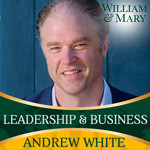 The role of today's leader is quite different from the role leaders played in the past. Today's senior leaders are navigating several challenges simultaneously: Inflation, fast-moving technology, work from home—and that's just the tip of the iceberg. Andrew White is a Senior Fellow in Management Practice at the University of Oxford's Said School of Business in England. A leadership coach to top CEOs, he leads the modern age provides CEOs with unprecedented challenges and opportunities, such as meeting sustainability goals, insuring diversity, retaining top talent, and navigating the fast-changing geopolitical landscape.