Ken White
From the College of William & Mary in Williamsburg, Virginia. This is Leadership & Business. The weekly podcast that brings you the latest and best thinking from today's business leaders from all across the world. We share the strategies, tactics, and information that can make you a more effective leader, communicator, and professional. I'm your host Ken White. Thanks for listening. He's one of the longest-serving leaders and success stories in the financial services industry. He's Mark Shenkman, President, Chief Investment Officer, Senior Portfolio Manager, and Director at Shenkman Capital Management, an organization he founded in 1985. The firm, with 30 billion dollars of assets under management, has offices in New York, London, and Stamford, Connecticut. In our discussion today, Shenkman shares his thoughts on entrepreneurship as well as his philosophy of doing ordinary things extraordinarily well. Here's our conversation with the founder of Shenkman Capital Management, Mark Shenkman.
Ken White
Mark, thank you for taking the time to talk with us today. You just talked with MBA students who really enjoyed your talk with them, and I noticed that some of the things you said really excited them. You can tell by their body language and by the notes they were taking. And one of the things that really that you said that seemed to catch them was you said that entrepreneurship is the backbone or should be the backbone of business education. Why do you feel that way?
Mark Shenkman
The primary reason that entrepreneurship is so important is because you have technical knowledge, you learn accounting, you learn finance, you learn specific, but an entrepreneur has to learn and think quickly. And it's not always by the book. You have to innovate. You have to think quickly in order make the right decisions, and that's something you need to start when you're in business school. You can't wait till you're 40 years old and start thinking like an entrepreneur.
Ken White
How did you learn to be an entrepreneur?
Mark Shenkman
So I feel very fortunate because my dad who's still alive at one hundred and one. He instilled in me the idea of being a businessman early on. So I was 12 years old, 13 years old, and he would take me to shareholder meetings, and I observed what public companies said and did. Then he got me subscriptions to The Wall Street Journal, Business Week when I was a teenager, and then he was President of his own company, a public company. And I would go to meetings with him and just listen and observe and take notes. So it was instilled in me from a very young age. It wasn't something that I thought about when I got older. I knew from the time I was a teenager I was destined to be a businessman.
Ken White
You shared some principles with the students, and I thought we could just. If you don't mind, I'll mention it and see what you had told them about it. One of the principles you said to be successful is create the niche and be great at it. Yeah. Can you talk us through a little bit more about that?
Mark Shenkman
Of course, so the world is very complex. The world is changing rapidly, and the competition is so intense in every facet of life. So I believe the way to win in today's competitive and ever-changing world is to find something that is different, unique, and specialized. And then just become the expert in that field. And it's better to be narrow than broad and generalized. You want to find a very specific facet of any business and just be the best. So another example I was down in Florida last week, and a company and they specialize just in knobs hardware knobs, but they're one of the biggest companies in America. And now with the Internet, they can sell it all over because they're so specialized they can sell it at a cheaper price. They can have more selection, and they can create their own product which is unique only to them. But imagine just having a company that sells doorknobs and handles. But it could have been a hardware distributor and done all kinds of things but they specialized in one facet of the hardware business. And that's true. I mentioned the gazebo company. You got to find something that you can be the biggest and best in order to excel.
Ken White
Another tip you shared with the students was employ smart people. Find the smart people, but they need to be nice people as well. Can you tell us more about that because that's something you don't hear every day?
Mark Shenkman
No. So we take great pain and care in interviewing not to find out their technical expertise, not to ask them technical questions but to find out how they think and what they're proud of in their life. And you can always tell by the answers whether they're willing to talk about themselves, talk about their successes and failures, failures too what they've overcome in order to get where they are today, and to open up and engage in what is important to them. And when they talk about family. When they talk about could be their pets or anything that shows that they have compassion, understanding, and relate. Is it's the kind of talent we're trying to recruit versus they want to talk about some paper or thesis they've written? In other words, are you an extrovert an introvert, and we're not looking for techie people or people? I hate to use it, but like geeks who are only interested in the book knowledge. We want people, people skills. The more people skills, the better they are as team members.
Ken White
You also focused a great deal on integrity. You keep coming back to that, and the student that seemed to resonate wonderful with the students. In fact, you said integrity is number one. Can you tell us more about that?
Mark Shenkman
Sure. So Wall Street has a bad reputation very bad reputation that they're only interested in making a lot of money stepping on people's their achievements. But everyone wants to make a lot of money, and they don't care how they make it, and I feel it's more important how you make it than how much you make. And it's most important that you have core belief system. A value system says this is right, and this is wrong, and there are no shades of grey.
Ken White
Never sacrifice quality for expediency. That's tough for an entrepreneur. How do you get there?
Mark Shenkman
So it's very tough for an entrepreneur because most people today are looking for shortcuts. They want to get to Point A and to B in the quickest and the easiest way. And so what you do is you compromise something in order to get to that point B. And my attitude has always been I'd rather take the long journey but the right way than the fast journey and do it in a quick and in some ways compromising your integrity and your willingness to do the right thing.
Ken White
You shared something that was that everyone's found very interesting when you were talking to our MBA students recently. You write down every day you take some time to write down your accomplishment for the day. What's the plan? What's the goal for that, and how do you do that?
Mark Shenkman
So every done it my whole life. The last week of December, I write a list of the ten things I want to accomplish in the next year, and the only way I know whether I'm achieving those ten goals and some are personal, some are business, and some of them have to do with let's call it values of success. But the point is if you measure what you're doing on a daily, weekly, and monthly basis you're more likely to achieve those ten goals than just wake up one year later and check off well I got number one, but I didn't get two, three, four, or five so it's a monitoring system to make sure you achieve the ten goals you set out for for the next year. So in this calendar year my ten goals I've gotten eight out of 10. I need two more to get done before December 31st.
Ken White
You've got time.
Mark Shenkman
Yeah.
Ken White
Cause we're recording in the beginning of October.
Mark Shenkman
It's almost two and a half months.
Ken White
Right. You also mentioned the importance of being optimistic always having that optimistic attitude for some entrepreneurs that gets difficult after a while. It's not always not every day is a great day. What advice do you have for people who are fighting that? Not being able necessarily to be so optimistic at the end of every day.
Mark Shenkman
Well, actually, I've learned that true entrepreneurs are more optimistic than they should be. So there's got to be a balance between being totally in Never Never Land and reality, and so you want to be realistic, but you also want to take the positives, even if they're small ones, and put them ahead of the negatives because what you don't want is the negatives to overwhelm or suffocate the successes that you achieve and that can be little things like I just won a new account. Don't focus on I lost an account today, but I won an account today. So look at the positive side of the coin not the negative side of the coin. And then the other thing is very important is I don't base it on how much money I make or the company's profits. But I'd base it on did we achieve our milestones that we set in terms of this is our revenues. These are number. I want to win 20 new accounts for the year. I want to add five new people. So don't measure always on a monetary basis but measure it on accomplishments that are creating value in the business, not just profits but value to the company.
Ken White
You said to our students conventional wisdom is always wrong, and they all looked at each other as you said that. Interesting. What do you mean by that?
Mark Shenkman
So that's the number one mantra I constantly remind my team is they assume because they read about it in the paper. That's the way it's going to occur. And I am just the opposite in almost everything I do. If I read about it in the paper, I say to myself that's old news, or it's wrong news. And so, for example, everybody that I talked to and read about said the Fed was going to raise interest rates in September. And I said if it was unanimous, if everybody was right on all these predictions, there'd be a lot more successful and wealthier people in the world. It's the people that go counter to conventional wisdom are the winners in the long run and have always believed don't think like everybody else. If I took the advice of so many people, I would not be where I am today. It's all a basis on I think differently than the way my peers would think or my competitors. And that's what sets us apart. And that's what gives us our great success.
Ken White
I think many people, when they think of leaders, entrepreneurs, these are people who make decisions, and you mentioned when you're talking to the students, sometimes it's tough to make that decision, and your advice was that's okay. Postpone it. You don't have to make the decision. And that somewhat goes against what's other people. Some people say no, make the decision. That's what a leader does. Why is it smart to just wait sometimes and think it out?
Mark Shenkman
So it's the opposite of taking SAT, which is your first answer is usually your right answer. I feel in business decisions, your first thought or instinct isn't your best. You want to weigh the positives and the negatives and see which side comes out. And also, I'm a believer in the law of unintended consequences. Meaning that if you make decision A and not B, what is the ultimate consequence if you're wrong? If you're wrong, and then what's the consequences if you're right? So it's weighing, evaluating, and analyzing the information that will give you the best outcome. Now sometimes you don't have complete information, so it takes time also to gather more information. So you're basing it on a larger fact set that allows you to make a better decision. So my belief is, which is again counterintuitive to conventional wisdom, it's better to postpone an important decision rather than an act impromptu or in a quick decision that could be a serious mistake. So my best decisions have always been delayed decisions. Now maybe I've learned that also because being a trader. Traders can't postpone decisions. You either buy, sell at that moment at that price and in that quantity. So being a trader has made me a little more cautious when I'm making a business decision. So there's a difference between making an investment decision and a business decision. Two different sets of information.
Ken White
Do you think entrepreneurs are born, or are they taught? Cause you had an interesting upbringing with your dad. I mean that that's.
Mark Shenkman
So I would say it's a combination of both. You have to have some genes, some DNA that make you an entrepreneur. But at the same time, you can learn additional skills and sort of refine and improve and enhance your entrepreneurship. So in my case yes it was built into my DNA but I learned it by being at Fidelity. I was always at the right spot. I mean, I feel very blessed and very fortunate because I've always been at the right place at the right time. And I took full advantage of each of those opportunities and never let an opportunity I was able to perceive the opportunity and then seize the opportunity to take me to the next step. But no, if I hadn't been first, I was an officer in the Army, and I had a very important job in the US Army computer systems command. Then I got a job at Fidelity which was a fantastic place to start a career going to Lehman Brothers, where it was what you learn, not what to do. And then being President of a organization that was a little unique. And then starting my own firm. So it's being at the right place taking advantage of those opportunities and with your, DNA programmed to think like an entrepreneur. It all builds to greater success.
Ken White
That's our conversation with Mark Shenkman of Shenkman Capital Management, and that's our podcast for this week. Leadership & Business is brought to you by the Center for Corporate Education at the College of William & Mary's Raymond A. Mason School of Business. The Center for Corporate Education can help you and your organization by designing and delivering a customized leadership development program that specifically fits your needs. If you're interested in learning more about the opportunities at the Center for Corporate Education, check out our website at wmleadership.com. That's wmleadership.com. Thanks to our guest this week Mark Shenkman and thanks to you for joining us. I'm Ken White. Until next time have a safe, happy, and productive week.



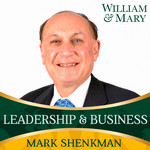 Mark Shenkman is a highly successful professional in the financial services industry. He's president, chief investment officer, and director at Shenkman Capital Management. We discuss entrepreneurship and his business philosophy in this episode.