Ken White
From the College of William & Mary in Williamsburg, Virginia. This is Leadership & Business. The weekly podcast that brings you the latest and best thinking from today's business leaders from all across the world. We share the strategies and tactics that can make you a more effective leader, communicator, and professional. I'm your host, Ken White. Thanks for listening. If someone went online to learn about you, your personal brand, and what you offer to others, what would they learn? Well, your online presence is extremely important. It's an extension of your resume, and data show people rely on social networks to learn about others. According to a recent story posted on Mashable.com, 77% of companies and organizations are using social networks for recruiting purposes. That means your customers and prospective customers are using social networks as well to learn about you. Well, as a result, your online presence is directly linked to your success. Our guest this week can help steer you in the right direction, wherever you happen to be, in terms of your online presence. Dr. Dawn Edmiston is a Clinical Associate Professor of Marketing at William & Mary's Raymond A. Mason School of Business. An award-winning educator, Edmiston has also held marketing management roles at Discovery Communications, IBM Business consulting services, and Pricewaterhouse Cooper's consulting management services. She helps executives and aspiring executives build their brands online, and she joins us today on Leadership & Business.
Ken White
Dawn, we know what brands are. We see them everywhere we go. What's a personal brand?
Dawn Edmiston
A personal brand is how you position yourself in the market. And I like to challenge individuals to think about their personal brand promise. My personal brand promise, I like to believe, is that I teach people how to pursue and promote their passions. So everything that I do, relative to articles that I write, conferences that I'm invited to attend, consulting projects that I undertake, I always ask myself, am I reinforcing my personal brand promise?
Ken White
Why is a personal brand important for rising executives and people in business today?
Dawn Edmiston
It's critical because it's how other individuals are going to identify you and what you can contribute to their organization. So having a very clear, specific personal brand, one that's consistent across all media channels is one of the greatest competitive advantages that you can have in the market.
Ken White
How do you get there? How do you develop your brand?
Dawn Edmiston
The first step to developing a powerful brand is to give considerable thought to that personal brand promise. And then once you've determined your personal brand promise, and you start to think about, who would benefit from what I have to share, who would benefit from this personal brand promise, then you think about those audiences and what their needs are and how those audiences are communicating with each other. So one of the first places that I recommend all individuals consider for their personal brand, their professional brand, is LinkedIn. That's a great starting point. So if you do not have a profile on LinkedIn, that's a great place to start to build your personal and professional brand.
Ken White
Right before we hit the record button to do this podcast, you and I were talking about this personal branding and social media. And five years ago, when this was discussed, we thought we were way late to the game. But people still, not all people are there, are they?
Dawn Edmiston
And it's evolving. I mean, I don't know that you ever truly get quote there. It's a constant management process, just as though you are marketing a brand like Coca-Cola. They have brand managers who are constantly trying to understand their audiences and measuring how to effectively communicate with those audiences. And you need to do the same. So there may be opportunities for you to take advantage, for example, of new social media channels or new platforms or to start sharing new messages. And so even though personal branding is something that's been talked about since Tom Peters first mentioned it in a Fast Company article decades ago, at this point, personal branding is a continuous process, and it's one that we should often be reflecting upon and we don't always take the time to do that.
Ken White
So someone creates a personal brand, they go through the exercises, and answer the questions. Their brand is different than most. It's better. So they're truly differentiated. So when they do go on LinkedIn for the novices, what do they do? Why go there, and what do they do?
Dawn Edmiston
So an important consideration when you start looking at LinkedIn and other social media channels, this is not an exercise in ego development or ego management. This is truly an exercise in understanding audiences that truly value your services. So you always need to position yourself from the perspective of a potential client or a potential employer. So this is not about you sharing all of your credentials. It's about you sharing experiences that you believe other organizations could derive value from. So first and foremost, it is really important to have that mindset. Because if you start developing a LinkedIn profile and you're constantly using I statements, or you're starting to develop lists, and you're not sharing projects or experiences that other organizations potentially could value, then you're not using LinkedIn to the extent that you should. So once you develop your profile on LinkedIn, perhaps the greatest single tip that I could give to individuals relative to securing that personal brand is to be certain to personalize your URL. So what I mean by that is, typically, when you develop a LinkedIn profile, your web address will be a series of letters and numbers. LinkedIn makes it very easy now to customize your profile URL so you can become Linkedin.com/im/kenwhite I'm /dawnedmiston. And so, however, you decide to represent your brand, if your name is John Smith, we might have to do creative work as to developing that brand. But that's very important to customize that URL so that when individuals search for you on Google and across other search engines that, your LinkedIn profile will be the first site that they see that reflects you and your personal brand.
Ken White
Do you recommend people actually look for the .com address and buy that in their name?
Dawn Edmiston
I do. In fact, I have a friend who, when her godchildren were born, she bought that as their gift. I own my own URL, @dawnedmiston.com, and I would certainly encourage others to do that as well, even if you don't know quite what you will do with it at this point. That's important real estate. That's an important investment for you to make in yourself.
Ken White
So going back to LinkedIn, some of the guidelines you're saying be audience-centric, really, right? Not about look at me, look at me, but yes, this is how I can help you more or less and focus on the audience. This isn't Facebook, so the photo is quite important.
Dawn Edmiston
Absolutely. And research demonstrates that your profile is more likely to be viewed upwards to eleven times more often if you have a profile photo attached to your LinkedIn profile. And, of course, it needs to be professional. People will give your profile a second look if they believe that it's a professional presence that you exude from that profile photo.
Ken White
Now some LinkedIn profiles are fairly bare bones, other people really lay it on. There's a ton of information. What kind of guidance do you give to professionals?
Dawn Edmiston
LinkedIn is not necessarily a place where you should be sharing anything and everything that you have ever done. You really want to be, again, very forward-thinking as well. I have consulted with individuals who are considering career change, for example, and that they were in the accounting profession and now they were seeking to transition into project management and consulting. And so we had a discussion as to how projects that they worked in accounting could be positioned differently on LinkedIn. So that's very important to do. And in fact, they decided not to include two of their initial roles in accounting because it made them look too accounting-centric, and that really was not the path that they wanted to take moving forward. So I think that you need to be very selective. Currently, I've read research that has said individuals will take 6 seconds to look at your resume. So I can infer from that that they will probably only take about 6 seconds to look at your LinkedIn profile. So what do you want them to learn about you in those 6 seconds?
Ken White
Those familiar with LinkedIn know they can post articles they've read, they can list comments. How active do you recommend that? How active do you?
Dawn Edmiston
Definitely, LinkedIn is offering great opportunities to publish posts, to share articles. I'm not necessarily one to want you to have your notification setting on. And what I mean by that is when you update a new photo, or you change a skill, I typically recommend clients turn off the notification setting. When you share a post that will be shared across your audience, so that's not the same as changing your profile, and I would prefer there's a very simple setting where you can change it to update notifications and turn it off. And I would recommend that you do that, but because when you post, you want people to look at what's really important, you don't necessarily want them to know that you changed the spelling of the College of William & Mary within your profile.
Ken White
People unfamiliar with LinkedIn have connections. Is there a sweet spot in terms of the number of connections you have? And who those people are?
Dawn Edmiston
There is a sweet spot. So the sweet spot for LinkedIn is definitely that 500. Because at 500, LinkedIn simply shows your connections as 500 plus. And 500 is also a level where you have really expanded your network and created connections that can prove to be very valuable. Having said that, I'm a personal believer in having quality contacts because I want my LinkedIn profile to be a place that I can refer to when clients need suggestions for networks when students need opportunities for internships, that I know these individuals, that I can reach out to them, and that I can ask for insight. So that is important to me. I prefer only to connect with individuals that I have at least had a personal connection with in the past, even if it's in an airport or I've had plenty of great connections on airplanes as I'm traveling to and from places. I often end my conversation with do you have a LinkedIn profile so we can remain connected?
Ken White
Yeah, great.
Dawn Edmiston
But that 500 is a good aspirational number.
Ken White
So I've worked on my personal brand, I'm differentiated, and then I'm on LinkedIn. So if they go, they understand what I do and how I can help them in their organization. Where else, social media-wise, what are my other alternatives in getting out there?
Dawn Edmiston
So that's great. If you've done all of that homework, you should also know that in addition to social media channels, which I will address next, LinkedIn will work for you. This position at the College of William & Mary, which I just started this past year, was as a result of LinkedIn sending me this job posting. I was not in the market for a new job. I was a tenure professor. I was very happy at my former college. And when I saw this posting from LinkedIn, I said, they're right. This would be the perfect job for me. So if you've done your profile well, if you've used keywords, if you've been very focused upon what you want to do, then your LinkedIn profile will not only allow you to develop networks, but it will work for you relative to the opportunities that it presents to you.
Ken White
Great.
Dawn Edmiston
And that's similar in other social media channels, whether you decide to use Facebook or Twitter or Instagram, or Pinterest. My next advice would be to be sensitive as to where your audiences might be. I've had various clients, for example, who want to start Twitter feeds and want to use Twitter because they feel that that's what they should be doing. But if your audience is not there, then that's not where you should be. Then maybe your focus really should be on developing a community within Facebook or other tools, other social media channels that have value for your particular audience. I have made the decision that I have my own website. I have LinkedIn, I do have a Facebook profile, but it's private, and it's where I share my personal, and I'm not certain that everybody in my life wants to know about the personal aspects of my life. So I've chosen to have that be private. I do have a Twitter feed, but I'm not near as active on Twitter as I am on LinkedIn. I tend to be most active on Twitter when I'm attending conferences, for example, because it's a great way you can hashtag, you can trend, you can connect. So I definitely have a Twitter channel for that. YouTube has become also a very powerful. We may not think of that initially as a social media channel. In fact, YouTube has been known to be the second-largest search engine in the world. Of course, they're owned by Google, the largest search engine in the world. But that's also a very powerful place to have a presence.
Ken White
And I think some of the social media, you have to like it, right? If you're going to go on Twitter, that has to be something you enjoy. I'm on Twitter. I love it. I love tweeting about communication. I'll read a cool article. I want other people to see it. Off it goes.
Dawn Edmiston
Definitely.
Ken White
And form this group out there who likes it, and it is it's fun. But this can all be time-consuming.
Dawn Edmiston
Yes.
Ken White
And you've run across sometimes on social media, and you look at someone or their profile and say, do you actually get any work done? Or do you spend most of your day branding yourself? There's a line, right?
Dawn Edmiston
Sure.
Ken White
What kind of advice do you give to people on how much time they spend or what kind of role it plays?
Dawn Edmiston
There are individuals who have developed careers based on these social media communities that they've developed. And if they're good at that and they can share that and share that expertise with others, then that's where they should be. I personally believe I actively maintain my profiles. I know that I have limited time within social media, so I really focus on maintaining a consistent LinkedIn profile. I do make certain that my profile photos across all of my social media are consistent. So that's a quick example. I'd love it when I go to a conference, and people look at me and say, you look exactly like you do online. That's brand, and that's where you want to be, and that does not take a considerable amount of time. And you can also have tools that work for you. For example, there's a tool called BrandYourself.com, and that is a great tool. It was developed by entrepreneurs at Syracuse University in upstate New York, which is where I was raised. So I have a special fondness towards this tool-free tool. You register for this tool, and it will actually evaluate your Google search presence for you and it will send you updates. One of your links has fallen off the first page. There is an unknown link that has now appeared on Google when you Google your name. And so there are plenty of tools out there that can also provide you with insight as to how to further strengthen your personal brand. So it doesn't have to be time-consuming.
Ken White
The social media aspect can be pretty overwhelming, or at least sound overwhelming. If you're on you've got a nice LinkedIn profile and say you're either blogging or you have a Twitter feed, it could probably use improving. And if you're not there, you need to be there.
Dawn Edmiston
Yes.
Ken White
That seems to be sort of the takeaway.
Dawn Edmiston
92% of children under the age of two have a digital shadow.
Ken White
Wow.
Dawn Edmiston
So whether you choose to develop a brand or not online, it will be there. So you need to be proactive. You need to take the time to make this happen. You can be very selective about what you choose to do, but you need to make that choice, and you do need to invest in yourself in that regard.
Ken White
That's our conversation with Professor Dawn Edmiston of the College of William & Mary's Raymond A. Mason School of Business, and that's our podcast for this week. Leadership & Business is brought to you by the Center for Corporate Education at the College of William & Mary's Raymond A. Mason School of Business. The Center for Corporate Education can help you and your organization by designing and delivering a customized leadership development program that specifically fits your needs. If you're interested in learning more about the opportunities at the Center for Corporate Education, check out our website at www.wmleadership.com. That's wmleadership.com. Thanks to our guest this week, professor Dawn Edmiston and thanks to you for joining us. I'm Ken White. Until next time, have a safe and productive week.



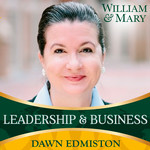 Dawn Edmiston is a professor of Marketing and knows how important our online reputations are. She discusses how to make sure your online presence is looking its best for future employers, and how to start managing your reputation on the internet.