Ken White
From the College of William & Mary in Williamsburg, Virginia. This is Leadership & Business. The weekly podcast that brings you the latest and best thinking from today's business leaders from all across the world. We share the strategies and tactics that can help make you a more effective leader, communicator, and professional. I'm your host Ken White. Thanks for listening. This week our podcast features a conversation with the Chairman and CEO of Honeywell, Dave Cote. Honeywell is a Fortune 100 diversified technology and manufacturing leader serving customers all across the world. Cote has served as Honeywell's leader since 2002. He's been recognized by several major media outlets as one of the most successful CEOs in all of business. He recently spoke to MBA students at William & Mary's Raymond A. Mason School of Business. We sat down with him shortly after his talk to get his views on leadership, corporate culture, and success. Here's our conversation with the chairman and CEO of Honeywell, Dave Cote.
Ken White
Thank you for taking the time. What we're looking for, and I know in a couple minutes after we're done, you'll be talking to the students at William & Mary. They're looking forward to it, and they love to see leaders and hear from leaders because they're aspiring leaders, as is our audience. What advice do you have for the aspiring leader who's listening?
Dave Cote
Well, I guess a couple of items. The first one, especially for a bunch of kids go into a school where everybody smart. Is it takes more than just being smart, and there's a I see plenty of smart people get beaten every day by others who are either more hungry and ambitious, have more common sense and good judgment, have better interpersonal skills, and an ability to work with others, and they beat smart people all the time. So it takes that combination of things. It's not like you can be not smart
Ken White
Right.
Dave Cote
and you are fine, but it takes more than just being smart. The second one I think I'd point to is that when I talk about good leadership, and I have this discussion with my own folks is that it takes three things. Only one of which is really visible and is the one that everybody talks about. The first one is the ability to motivate a large group of people, and I have to say, for most of the stuff that I ever see on leadership, that's what it focuses on. How do you motivate a large group, but in reality, I have always thought that was 5 percent of the job, and you can do it with a rousing speech. Some people do it that way. Others do it through quiet example. There's a bunch of ways to motivate people.
Ken White
Sure.
Dave Cote
The second one, though, that I don't think gets as much attention, and that's that good leadership requires being able to pick the right direction. If you can motivate a bunch of people, but you spend 40 years wandering in the desert, you're not a good leader. You might be able to motivate them, but you picked the wrong direction. And being able to pick that direction ends up being important, and I see too many leaders do something that I love the phrase. I didn't coin it, but I love it. But I refer to it as fad surfing. Where whatever the hot thing is, you can find that leader talking about it. Analysts will like it. Their people will like it because it's the hot thing. But fad surfing is a good way to lose money and get burned, and you just need to be really thoughtful about what direction you pick. And it is not as visible as that first item, but it is a heck of a lot more important. Then the third item I point to on leadership is okay. You've motivated everybody. You've picked the right direction. Can you now get everybody moving step by step in that direction? And the bigger the organization you have, the tougher that is to do because they all have different motivations themselves, no matter how motivated you think you've got them or how good the direction. You can't just devolve that to a bunch of others and say okay, now make everybody move. You have to be involved in how do you, step by step, move everybody in that right direction. And I've always thought those are the three big principles of leadership I actually covered in my share owners letter one year. That first one is 5 percent of the job, but it gets, I swear, 90 percent of the attention when people talk about good leadership.
Ken White
Right. So in order to get them moving, what kind of a role does the CEO have to play? You've got a lot of things to do. How do you do that?
Dave Cote
I've learned that the big thing is to get out there. So I travel a lot in this job. I've been to over 100 countries, and what I do is actually meet with my people, meet with customers, and I just ask them how things are going. If there's something that I'm trying to get going in the company. I'll go out there and just say so what do you think of this. And the response you get is pretty interesting sometimes when people say um gee, I don't know what is it.
Ken White
Yeah.
Dave Cote
You get a sense, oh, okay. Whatever I'm doing is not working right now, or when I go out there, I'll ask a group so what do you think I should be doing. What's hot on your agenda, and what do you wish I would do? What do you talk about when you get amongst yourselves and start to talk about things? What do you say, gee, you know what I wish Dave knew, or you know what I wish Dave would do is what are those things?
Ken White
Yeah.
Dave Cote
It's remarkable the stuff that you end up learning. I also, of course also, try to set up metrics because I like to get some sense of movement, but I'm very cautious on metrics, and I always tell them again my own training classes, and this is kind of a takeoff on something. But I'd say if you measure something, the metric will get better. It doesn't mean anything actually gets better.
Ken White
Good point.
Dave Cote
The metric, though, will get better because everybody understands the metric is what's going to drive it, and if that's what you're going to look at by golly, organizations have learned to make metrics look better.
Ken White
Yeah.
Dave Cote
So you have to be very careful what you pick and always try to make sure that you have like a counterbalancing measure if you're going to get the right things done.
Ken White
So it sounds like you're out a lot. I was going to ask you what your day is like what percentage of your day is spent on this and that. What percentage is spent being out there? It sounds like you're listening even more than you're talking when you're out there.
Dave Cote
Well, I try to. It's an interchange because they want to hear from me.
Ken White
Sure, sure.
Dave Cote
When I have like country dinners where I go to a country and get all the leaders are as many people as I can have dinner, and I break it up into two pieces. The first piece is a business review where they go through their businesses, and I ask them questions, and then for the second half, when we actually go to dinner, I say, okay, your turn, open season. What do you want to know? So I try to have it go back and forth and try to get a sense for what the politics of the country are like in terms of how my people view it versus others. So I spend about 50 percent of my time on the road would be I guess. I can't say I have a standard day, but I do have what I would call standard work during the course of the year. So I have the strategic planning reviews, the operating plan reviews, the people reviews, which I do three and four times a year. I have set aside growth days, board days, operations days to focus on specific topics I'm interested in. Then the rest of it, I do all kinds of stuff, whether it's operations, strategy, people, analysts and investors, government folks. It's really all over the place, and it's one of things I like about my job. Is I always said maybe a slight bit of ADD is not a bad thing because I have a tough time doing anything for more than two hours so?
Ken White
Yeah, perfect. You're in the right role.
Dave Cote
It seems to appeal to my personality.
Ken White
Yeah. You're talking about you teach a lot of leadership to the folks in your company. I do a lot of that here through our Center for Corporate Education. The thing that the topic that comes up over and over and over again is I wake up, and I'm behind because of technology, and you're with a global company, so the emails are coming in 24 hours a day. How do you handle that or how do you coach others to handle this being inundated?
Dave Cote
The onslaught.
Ken White
It's something, isn't it?
Dave Cote
I'd say I changed the way I work about 20 years ago because I used to, so email I hadn't even started yet, but I used to take two weeks off in the summer, and I would say no mail, no nothing for two weeks. And I came back after two weeks, and it took me a full day and a half to get through the entire stack of mail and phone calls and all that. And I said this is horrible. I don't want to do this again. So instead, I've come to basically, well, I guess it's 16 hours a day in touch. So first thing I do in the morning is email. I do it all during the course of the day, traveling with my iPhone so that I can do it on the way back to the airport. I do it at night before I go to bed to make sure that I'm caught up with people in China and Europe and others who are starting, and I just stay absolutely religious about keeping up with that. I also try do my mail every day. I get it shipped to me if I'm going to be anyplace for any period of time. And I just try to make absolutely certain I keep up with everything and respond as quickly as I can because I'm always scared to death that the organization is held up somehow because they're waiting for me for a decision.
Ken White
Right.
Dave Cote
And I do not want to be the impediment to decision-making in the company.
Ken White
Communication is a big part of what you do. And also it's not hard to find you in the media. The media like you. They like to interview you.
Dave Cote
That's a nice change from where things started 13 years ago.
Ken White
Tell me about that. You really interact with the media. You do a great job. Why? Fun, useful. Why? Why do you do that?
Dave Cote
Actually, I stayed away from the media for the first seven years. I think that I was in the company, and it was because we were in so much trouble that I always said I gotta have develop a story before I start talking to the media. I'm going to work on the, so I basically didn't talk to anybody. So I refused interviews from magazines. Occasionally I'd do one if it had to do with earnings on one of the TV networks, but I basically just stayed away from everything. That's changed in the past four or five years because I was on Simpson-Bowles, which added a lot of visibility, and then people noticed that we'd been doing pretty well for about seven or eight years at that point, and it started to build upon itself. So I just kept doing it.
Ken White
Did you prepare any differently, whether it's a radio or a print, or a TV interview?
Dave Cote
No, actually, I don't know that that's one of the things. In fact, my communications guy can probably reinforce that with you, but I usually I say this is one of the nice things about having your internal story be the same thing as your external story. Is that there's not a lot of adjusting you have to do? So I don't have to do. I don't do any prepping before I go somewhere to do something because I generally know what it is I want to say.
Ken White
And you probably know what they're going to ask.
Dave Cote
Well, generally, I mean generally, they say this is what we're interested in.
Ken White
Right.
Dave Cote
So you have some sense of the topic. Every once in a while, you get a ambush question which happened to me about seven months ago, and it was kind of funny because that was, I won't say, the network, but they were aware of the that I was coming on, and they didn't give me a heads up that there was going to be an ambush question. But I looked over, and it was on the teleprompter.
Ken White
Oh, that's beautiful!
Dave Cote
So I got like a 60-second head start because I just happened to like I do. I have this distracting habit of looking around while I'm thinking. So I'm talking. Looking around, I saw the teleprompter. Ha. Well, that's a good one to know. So the ambush question happened, and my response to the guy was I come all this way to talk about this. This is the thing you want to talk about.
Ken White
Very good.
Dave Cote
He blushed and said I'm sorry, but you know they put it on. The producer put it on. I had to ask.
Ken White
Blame the producer, right? Yeah.
Dave Cote
It was pretty funny.
Ken White
You're obviously very good at what you do. The numbers speak for themselves, the culture, the brand. It's all there, and you it seems like you have fun. You really enjoy it.
Dave Cote
I actually do. I like my job.
Ken White
Yeah. How did you get here? Was it your what prepared you for this? Upbringing? Education? Personality? What was it that prepped you for this role?
Dave Cote
Wow. That's an interesting one because I'm not sure what because my path to getting here is not typical. It took me six years to get through college, and if my wife at the time hadn't gotten pregnant not had to work, I'd probably still be an hourly employee somewhere because I hated school. It took me six years to finish, and then early on, I was just driven by I needed money. I had a family support, and I didn't have any money. So I just did whatever would pay better next. There was no career planning, nothing. Whatever would pay better, I was willing to do, and I just kind of started to grow, and I ended up I started manufacturing ended up in finance. Then realized after a while that, geez, you know, I kind of seen with general managers do. I think I could do that. So I pushed to get into general management and did and then went from GE to TRW and then to Honeywell and just kind of grew into it. I'd say I was 40. I'd say before it even occurred to me that, gee, maybe I could be a CEO. As I start looking at all this, I think I could probably do this. I would say one of the things that I do think has helped me is because it took me six years to get through school, and I worked the last couple of years of school. I was an hourly employee for two and a half years working in a factory, and I'd say that gave me even though it wasn't a fun job, it gave me a lot of insights into how an organization thinks about things, and just because you're at the top thinking, this is a wonderful thing that's not necessarily how people in the organization are going to view it. And if you make it too complicated, they're not going to spend the time to learn it, and their motivations are different than yours.
Ken White
Yeah.
Dave Cote
I end up learning that whenever I go to a town hall in a new plant, or something and or a existing plant, and I'm ready to talk about the stock price and what are all the things we're doing to stay competitive and what they really want to know is is this plant still going to be here ten years from now. Am I still going to have a job? That's what's relevant to them, not my grand strategy, and yeah, it's nice their 401k's going to do better because the Honeywell stock is in it, but what they really want to know is, am I gonna have a job here ten years from now? And you need to be able to recognize that just because you think you have a hundred thousand person organization aligned. They're like 40 percent aligned. So that's why getting everybody to move in the same direction is tougher than people think sometimes.
Ken White
No doubt. So for, those who would like to be a CEO, they figured it out, and they think that this is something they'd like they want to lead. They want to make a difference. What advice do you have?
Dave Cote
Well, I'd go back to the stuff we talked about at the beginning, and that's make sure you recognize it takes more than being smart and on the leadership side that it takes those three things, and it's more than just being able to give a good speech or a good presentation, and it takes those other things also because you've got to be able to interact with people. They aren't always going to agree with you, and how do you get all the opinions and make a good decision? It's not as easy as the books make it sound when you read leadership books.
Ken White
Greatly appreciate your time. This was wonderful.
Dave Cote
Happy to do it. It's fun.
Ken White
Thank you very much.
Ken White
That's our conversation with the Chairman and CEO of Honeywell, Dave Cote, and that's our podcast for this week. Leadership & Business is brought to you by the Center for Corporate Education at the College of William & Mary's Raymond A. Mason School of Business. The Center for Corporate Education can help you and your organization by designing and delivering a customized leadership development program that specifically fits your needs. If you're interested in learning more about the opportunities at the Center for Corporate Education, check out our website at wmleadership.com. I'm Ken White. Thanks for joining us. Until next time have a safe and productive week.
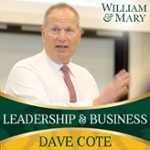 Dave Cote is the chairman and CEO of Honeywell International Inc. Dave became chairman of the board in 2002 and is now one of the highest-paid executives in America.


