Ken White
From the College of William & Mary in Williamsburg, Virginia. This is Leadership & Business. The weekly podcast that brings you the latest and best thinking from today's business leaders from across the world. We share the strategies, tactics, and information that can make you a more effective leader, communicator, and professional. I'm your host Ken White. Thanks for listening. One of the toughest leadership challenges is being at the helm of the big institution, whether civic or private bureaucracies often move at a snail's pace, and it takes a special leader with special qualities to drive change and improvement. Robert Gates says large companies and organizations can be transformed, and he explains how in his book "A Passion for Leadership: Lessons on Change and Reform from 50 Years of Public Service." In the book, Gates shares his experiences from his many leadership roles, including director of the CIA, president of Texas A&M, and Secretary of Defense. Currently, he's partner in the consulting firm RiceHadleyGates and serves as chancellor at William & Mary. On the podcast today, he shares his advice on successful leadership. Here's our conversation with Dr. Robert Gates.
Ken White
Well, thank you for being here. We greatly appreciate your time. I know there's a roomful of MBAs is waiting to hear from you, as you're going to interact with them as soon as we have completed with our conversation.
Robert Gates
I'm happy to do it.
Ken White
So the book. What encouraged you to write it? What got you to write the book?
Robert Gates
Actually, it was midway through my experiences as Secretary of Defense and especially after I'd been asked to stay on by President Obama, and that had never happened before. I look back on my career and realize that I had led several different very different organizations. All of them were huge and had made some pretty significant changes in each of those institutions, and the light dawned, and it suddenly occurred to me that maybe my core competency was actually leading change and figuring out how to do that in institutions that are not generally perceived as being amenable to much change.
Ken White
Absolutely. In one of the chapters is my favorite chapter in the book. You call it agent of change mirror mirror on the wall, and it's a chapter where it where you're encouraging the reader, if they want to be a leader, to look at themselves and really say do you have these qualities? One of the qualities you talk about you say the best leaders have their egos in check. Can you elaborate on that a little bit?
Robert Gates
Well, I think that I think that leadership is a team sport. Most people think of it as somebody riding in on a white horse and sort of taking command and so on and so forth. But in fact, in most big institutions, leadership leading change is about how you, first of all, developing in league with others. The career professionals, outsiders, and others, a vision of where an organization ought to go. What's wrong with it? How can we make it better or simply a vision of a different future? And the only way you get people to be honest with you and get their best ideas is if you're not always talking. And so it requires a lot of listening. It requires respecting other people's points of view, and then at the end of the day, when it comes time to make decisions, it's a matter of integrating what you've learned from all these different sources into your own decision-making process as the person responsible. But an egotist is the antithesis of the kind of leadership that is needed for transformative change because I believe for that kind of change to last and to work, it has to have the support of people inside the institution, and that means they have to have buy-in and that means they must feel that the change was as much theirs as it was the leaders.
Ken White
You talk about listening one of my favorite pieces in the book. It says never miss a good chance to shut up, and you know when you're talking, you're not learning. One of the pieces you share as a leader must maintain his or her dignity and some distance. On the distance, how do you negotiate that? Because you don't know if it's too distant.
Robert Gates
I think you don't want to be aloof. You want to be approachable, but by the same token, you have to maintain a certain mystique a certain distance. And that means you can't be just one of the boys or one of the girls. You can't be the student's best friend. You have to realize in dealing with staff and the people who work for you that the time may well come when you have to fire that person. And if you've developed a very close personal relationship, that's going to be very difficult and even more difficult for the person who has to be let go or demote them or move them someplace else. But you will have to take an action that they will regard as negative. I also think that the leader has to be a role model. And I think if you're in a leadership position. I'll give you an example of avoiding too much familiarity. And in this day and age, this will sound very anachronistic, but I used to chide the combatant commanders. Now, these are four-star generals. Okay.
Ken White
Right.
Robert Gates
For their tweeting and Facebook. I said you know the truth is people really aren't interested in your travel schedule.
Ken White
Right.
Robert Gates
Or what you did on your summer vacation.
Ken White
Good point.
Robert Gates
But the more, the more you are familiar with your troops, the less awesome they see you. The more that you're sharing bits and pieces of your private life or what you're doing in the office the less, the less mystique there is around you. You're a four-star general, and you're going to order people into battle. It's hard for me to imagine Dwight Eisenhower or George Patton on Facebook.
Ken White
Right.
Robert Gates
I just think that you have to remember that once you're in charge, you're no longer one of the gang.
Ken White
Right.
Robert Gates
It's very interesting. I have a friend where I live who was a fireman, and he was promoted to a deputy fire inspector. So now he wears a tie and a white shirt, and the guys in the firehouse hardly talk to him anymore because he's management.
Ken White
Right.
Robert Gates
They work together, they sacrifice together, they did everything together for years, and now he's in a different place in their eyes.
Ken White
Right.
Robert Gates
And it was a shock to him the first time he went back to the firehouse, and you know, I will say I think the guy who's got this formula down just right is the president of William & Mary Taylor Reveley. I think everybody every student on this campus loves Taylor.
Ken White
They do.
Robert Gates
Thinks Taylor is a great guy really enjoys him. But you don't see Taylor out in his t-shirt playing touch football.
Ken White
No, you don't.
Robert Gates
And so there's a there is a way to do this that makes you accessible and friendly. I've been told the military the guys in the military in, particularly those who fought in Iraq and Afghanistan, really admired me and thought I had their back and was their supporter and their friend, but they were never familiar with me.
Ken White
Right. You talk in the book about having Lieutenants who you can really count on that they're willing to do the work and buy into the agenda. My point what I'm getting at is who can you be familiar with in the organization. Can you be close to them, or is that friendship you have where you confide in someone else? Is that someone outside the organization?
Robert Gates
I think that you know, in an organization, there's generally one or two people where you can really let your hair down and share, and generally, that's somebody who is very close to you in your office or in your immediate staff. Somebody like that, somebody you can trust so that when you do rant against something or somebody, you know it never goes beyond the four walls, so you can at least let off steam. But by and large, you have to be very disciplined.
Ken White
We'll continue our conversation with Dr. Robert Gates, author of A Passion for Leadership. In just a minute, our podcast is brought to you by the Center for Corporate Education at the College of William & Mary's Raymond A. Mason School of Business. The Center for Corporate Education is offering a terrific program for professionals looking to expand their business leadership skills. The certificate in business management is a five-day program that runs from April 10th through the 14th at William & Mary. Each eight-hour day will be dedicated to an important facet of business, including communication, managerial accounting, business strategy, operational effectiveness, and executive leadership. The program helps you broaden your professional skills and helps you think and lead strategically and successfully. For more information about the program, visit wmleadership.com. Now back to our conversation with the Former Secretary of Defense and author of A Passion for Leadership.
Ken White
You say a good leader must compromise and adjust plans because you don't always get what you want. That's difficult for some leaders. They think what they say goes.
Robert Gates
Well, one of my role models in this is Ronald Reagan, and it used to drive some of the ideological purists in the White House and in the conservative movement because Ronald Reagan was himself a dealmaker and a Ronald Reagan could cut a deal on a proposal that he made and get 65 percent of what he wanted. He would grab it, take it, and then immediately turn around and start the effort to get the other 35. So I cut thirty-six major military programs in the spring of 2009. If they had been built to completion, it would have cost the taxpayers 330 billion dollars. Most of my predecessors were lucky if they got one or two programs cut. I got 33 of the 36 approved or sustained by Congress in the summer of 2009. And I came back the next year and got the other three.
Ken White
There it is.
Robert Gates
So you know, sometimes you don't eat the whole pizza at one bite.
Ken White
Right.
Robert Gates
You take a piece at a time.
Ken White
Don't overstay your welcome. When do you know that time's up?
Robert Gates
Oh, I think this is the hardest. This is the hardest question for every leader and particularly if you've had a pretty good run. As I like to put it, the key question is, when do you dance off the stage? And ideally, the sweet spot is to leave where people are saying I wish he weren't leaving so soon instead of how the hell do we get rid of this guy? Finding the place right in between those two is key. And I think a part of it is understanding that you're not indispensable, as many people in history have said the cemeteries are full of indispensable men. And I think the key is it goes back to keeping your ego in check that the institution will survive without you. And a key part of this also that I write about is when are you out of gas. When are you out of energy? When are you out of ideas? Part of the theme in the book is you got to be continually changing an organization. No organization can be static, and so you know when you go on vacation or on a trip, and you've got your yellow pad, and you're putting down the kind of the to-do list of things that I want to continue to do. As long as your yellow pad is filling up, you probably ought to stay in the job. But once you come back and your yellow pad is empty, then it's time to go. The other key for me is can you be as critical in evaluating the success of programs you've put in place and people you've put in place as you were in evaluating the programs and people your predecessor put in place. And if you can't evaluate and see if these people have grown, if you're ideas no longer work, or need to be changed. If you can't do that, if you're defending rather than moving forward, it's time to go.
Ken White
You talk about how leaders are custodians of the organization. They should believe they can and should make it better. Is that front and center first and foremost? Is that what leaders should remind themselves of beyond, above, and beyond all others?
Robert Gates
Well, I think that I think it's the leader's responsibility. I believe that every organization can be better. I believe I've worked for some amazing places, and I've always felt they could still be better. And I think that leadership is the central purpose of leadership or aim should be. How do I preserve those traditional elements of the culture and the traditions of this institution that give it life that give it meaning for the people who work here, and yet change the way we do things to make us relevant five years from now, ten years from now, 15 years from now? The core challenge is identifying the critical parts. Every organization has a culture and has lots of traditions. Some of them are foolish and don't make any sense anymore and can be put to the side. But what's core? What makes it different? And I would say that I discovered this at the agency at CIA, at Texas A&M, and at the Defense Department, and subsequently at the Boy Scouts. The one thing that is common that is critical in the culture of each of those institutions is that they consider themselves part of a family and that they will take care of each other and look out for each other, and a leader has to figure out okay that's fundamental. How do I strengthen that because that's the foundation?
Ken White
You mentioned Ronald Reagan. You quote Winston Churchill, who are some other leaders you think are just fantastic.
Robert Gates
Well, I think one of my favorites has to be first President Bush, George H.W. Bush. He was wonderful the work for a wonderful sense of humor. You know, I worked with some amazing people in the military, and you know, in each of the institutions I've, I've made friends and have learned from people. The two chairmen of the Joint Chiefs when I was secretary Pete Pace and Admiral Mike Mullen. My provost and executive vice president at Texas A&M, David Pryor, my chief of staff at the Pentagon, Robert Rangel, there just every job, there's been a handful of people who played a huge role in whatever success I had.
Ken White
What would you like people to take away from the book A Passion for Leadership?
Robert Gates
I think two things. The first is that people are unhappy with government and government institutions and a lot of private sector institutions, and for good reason and. That all of these institutions can be changed, can be reformed, and should be, and that we owe it to our citizens and our customers to do that. And you know, a lot of times, I think particularly these public institutions, people just throw up their hands and say there is nothing you can do about it quote unquote, you can't fight city hall. Well, the truth is one of the main themes of the book is you can change these institutions. I know because I did it.
Ken White
Right.
Robert Gates
And here are the tools to do that. The other message is really kind of at the end of the book, and it is the distinction between leadership and management. Management can be taught in school, and God knows we need good managers. In HR, and marketing, and manufacturing, and everything else. But in my view, leadership is more about the heart than the head. Dwight Eisenhower once wrote his son in 1943 that you can learn leadership and man and that the key is to try and get them to want to do things for you, and the way to do that is through devotion to duty, sincerity, fairness, and good cheer. And I tell people devotion to duty, sincerity, fairness, good cheer. You don't learn these in school. These are personal qualities. And it boils down to do you have a vision on how to make a place better and do you love people well enough to work closely with them to help bring about that change.
Ken White
That's our conversation with Robert Gates. And that's our podcast for this week. Leadership & Business is brought to you by the Center for Corporate Education at the College of William & Mary's Raymond A. Mason School of Business. The Center for Corporate education can help you, and your organization get to the next level with business and leadership development programs that specifically fit your needs and get results. If you're interested in learning more about the opportunities at the Center for Corporate Education for you or your organization, visit our website at wmleadership.com. Also, we'd love to hear from you regarding our podcast. Please share your comments, thoughts, and suggestions with us via email at podcast@wm.edu. That's podcast@wm.edu. Thanks to our guest this week, Dr. Robert Gates, and thanks to you for joining us. I'm Ken White. Until next time have a safe, happy, and productive week.



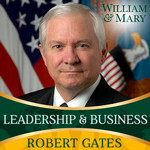 One of the toughest leadership challenges is being at the helm of a big institution. Whether civic or private, bureaucracies often move at a snail's pace, and it takes a special leader with special qualities to drive change and improvement. Former Director of the CIA and Secretary of Defense Robert Gates says large companies can be transformed, and explains how in his book "A Passion for Leadership." Dr. Gates joins us today to share his advice on successful leadership.