


Commanding change: William & Mary MGJW Scholars help shape the future of Army Aviation Training
The work of the Major General James Wright Fellows at William & Mary rarely stays within the walls of a classroom. Each year, officers step into the MBA program with a dual mission: grow as leaders and deliver real solutions for the Army. The program compresses core business coursework into thirteen months, integrates officers into the full-time MBA cohort, and concludes with Lean Six Sigma training and an intensive capstone for Army clients. Each project lasts about six weeks and pushes teams to apply analytical tools, operational experience, and business judgment. Fellows earn Green Belt certification and brief senior Army leaders on their recommendations.
In the summer of 2024, that model produced one of the program's most consequential projects. A team of MGJW Scholars, Gregory Hacker, Peter Lees, and Spencer Anderson, examined what the Army should require in its next aviation training helicopter. Their work aligned with Flight School Next, a broader modernization effort focused on improving aviator instruction and evaluating contractor-operated training models. Their findings later appeared in 2025 Army Times coverage, which noted how the William & Mary team helped inform analysis related to the Army's consideration of a contractor-owned, contractor-operated training model.
The capstone unfolded during a pivotal transition for the U.S. Army. The team’s analysis provided unique insight and clarity to the Army just as the institution began the most significant reorganization effort in decades. TRADOC was reorganizing into T2COM, the Transformation and Training Command. As staff and functions relocated, timelines and resources shifted, and priorities evolved, the Scholars’ work offered clarity that leaders could implement immediately.
Faculty leadership and Army partnerships
Tracy Johnson-Hall, who leads the capstone program and teaches Lean Six Sigma, plays a central role in connecting academic rigor with Army needs. She works closely with T2COM to select projects, guide teams, and ensure that the work meaningfully supports the force.
"Bringing serving Army officers into our MBA cohort offers a powerful opportunity to advance the Mason School's focus on principled leadership," Johnson-Hall said. "Their values, discipline, and service experiences enrich our classrooms. The capstone is where everything comes together, and this project showed how meaningful the results can be."
Jonathan “JD” Due, a retired Army officer and executive director of the Center for Military Transition, described the fellowship as a strategic asset for both William & Mary and the Army.
"This program blends broad tactical experience with an education that sharpens analytical thinking," Due said. "The work these officers produce gives Army stakeholders insights they can use, and the Scholars leave with a set of skills that strengthen William & Mary’s classrooms and their future Army assignments."
For the Army, the partnership has long-term value. Matt Page, who serves as a senior liaison for the T2COM program, emphasized how the Fellows' work supports transformation at scale.
"The Major General James Wright Program shows how essential partnerships are to Army modernization," Page said. "These officers tackled a high-stakes challenge in rotary-wing training and delivered recommendations that directly support the mission of transforming concepts into capabilities. Their work helps shape the future of aviation training and prepares a new generation of adaptive leaders."
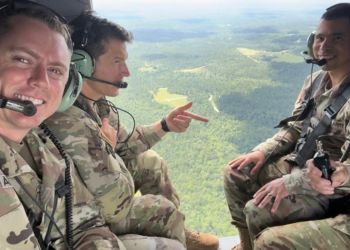 Fieldwork, analysis, and unexpected insights
The aviation training project required students to evaluate a wide range of factors, including instructional throughput, simulator integration, maintenance cycles, pilot rotation, cost components, and vendor options. The team drew on interviews at Fort Rucker, Army data, industry conversations, and process-improvement methods to help leaders compare potential platforms.
The students' insights shed light on how their different military backgrounds contributed to fresh thinking. Greg Hacker, a Finance and Comptroller Officer, said the team's non-aviation perspective proved unexpectedly valuable.
"The biggest surprise for me was how much the Aviation Center of Excellence valued what we could bring, even though none of us were aviation officers," Hacker said. "We arrived thinking we'd be playing catch-up, but visiting Fort Rucker, meeting with subject-matter experts, and seeing the aircraft up close gave us the clarity we needed. I realized that not being the expert can help you notice things insiders might overlook."
One of those observations proved crucial.
"One moment that stood out was when we pointed out that one of the platforms rotated in the opposite direction from what Army aviators are trained on," he explained.
"It seemed like a small detail, but it had real implications for muscle memory and training. It showed how a fresh set of eyes can surface issues that aren't immediately obvious."
Hacker said the project reshaped his view of expertise.
"You don't have to be the subject-matter expert to make meaningful contributions. What matters is knowing how to find the right people, ask basic questions, and seek first-hand understanding. I'll take that with me into every future project."
Spencer Anderson, a Signal Officer, echoed that sense of discovery.
"I was struck by the depth of the facilities and equipment used for flight training," Anderson said. "The cost of a single simulator is significant, but having dozens of them saves millions in fuel, maintenance, and aircraft wear. Seeing that scale in person was eye-opening."
He also noted how their assumptions evolved.
"We initially thought the Army would simply choose the most cost-efficient option. We quickly learned the decision is far more complex. Maintenance, fuel, pilot rotation, repair parts, and training throughput all influence the outcome. Sometimes the lowest sticker price doesn't create the best long-term value."
His biggest takeaway centered on perspective.
"I learned the importance of looking at a problem from several angles and working as a team. That approach helped us uncover considerations that might have been missed otherwise. It was an opportunity with real-world impact for our team, for the Army, and for the organizations involved."
A program built on service, analysis, and results
The Flight School Next project demonstrates how targeted, focused efforts can deliver value to large organizations while preparing officers for leadership roles at higher levels. The capstones also reinforce William & Mary's commitment to public service and to educating leaders who act with clarity and purpose.
To date, MGJW Scholars have completed more than seventy capstone projects, saving the Army nearly sixty thousand person-hours through improved processes, analytical insights, and innovative recommendations. Graduates advance to key leadership roles across the Army, including key command and staff positions as senior officers, and many pursue further graduate education.
The MGJW Fellowship demonstrates how rigorous learning and operational experience can produce solutions that matter. The program also contributes to William & Mary's recognition as a Military Friendly School, with the Mason School ranked second nationally among graduate programs in the 2025–2026 Military Friendly survey.